|
Well, hello, and welcome to this week's edition of the eCommercer.
I've lost count of the number of people who've told me they tried AI and it just didn't work for them. They plugged in Claude, asked it to write something, got back a load of nonsense, and quietly decided the whole thing was overhyped. I've felt that frustration myself. So when this week's guest put his finger on exactly why it happens, I wanted to pass it on.
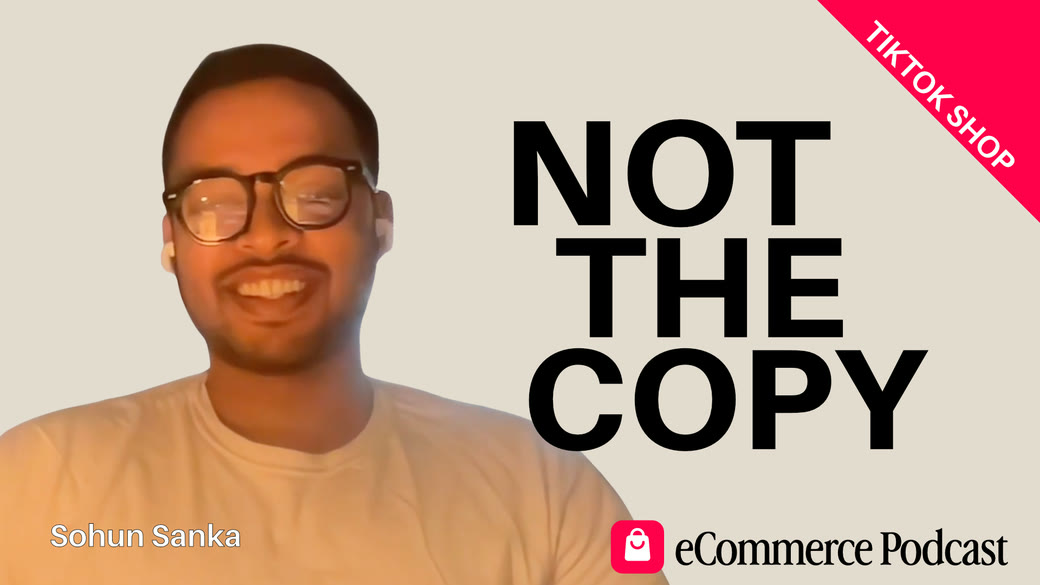
My guest is Sohun Sanka, founder of Clankers. He's 25, spends his days knee-deep in TikTok Shop and Claude Code, and he's audited something like 2,000 affiliate programmes, so he's seen the backend of more brands than most of us will meet in a lifetime. Our conversation ranged across TikTok Shop and AI, but one idea sat underneath the whole thing.
The thing nobody feeds their AI
One of the things Sohun said that makes a lot of sense to me is this. The biggest mistake we're all making isn't the tools. It's that we've never written down what good actually looks like.
His line was that when you bring a new employee on, you give them 90 days to ramp up. A proper onboarding guide, calls every week, shadowing, the lot. Then we turn to AI, give it two sentences, and expect it to do the same job in one second. When it can't, we conclude AI is useless.
The fix is to show it what good looks like. A folder of your best work. Your brand colours. Examples of the copy you're proud of. Without that, you get what Sohun calls AI slop, because the model just optimises for whatever it was trained on rather than what you actually want.
| | “You don’t even have a folder on what good looks like. You’re not feeding it anything.”
Sohun Sanka |
What struck me about that is how it turns the problem inward in a useful way. The reason we can't tell AI what good looks like is often that we've never worked it out for ourselves. We hide behind ambiguity and fluff, which is a bit ironic in an industry that never stops talking about ROAS and CAC. Answering the question forces you to build the process you were pretending you already had.
Where this gets a bit mad
If you want proof that the granular stuff wins, Sohun told me about a friend of his, a top-100 TikTok Shop affiliate who makes around a million dollars a year in commissions. His edge is that he runs a whole account doing nothing but A/B testing the lighting on window fans. Different gradients of light, multiple videos a day, hundreds of them, just to find the angle that sells. Then he feeds the top-performing videos into a Claude Code pipeline and repeats.
I think he's right that on TikTok this matters more than we give it credit for. When someone's scrolling fast, a fraction of bad lighting in the first two seconds and they're gone, before a word of your carefully written hook gets a chance. You can pour all your effort into the script and still lose because the video simply doesn't look good enough to hold a thumb.
The lesson underneath it is one I keep relearning. Consistency and volume beat the one perfect swing. The top affiliates post 15 to 21 times a week per brand. It's the same logic as split-testing headlines in ecommerce, just pointed at parts of the video most of us never think to test.
The tea towel test
This is exactly what my son does. He's a nutritionist with a large Instagram following, and it's where he makes his living. He tests everything. The angle of the camera, the distance he stands from it, all of it thought through. He worked out that if he draped a tea towel over his shoulder while filming, engagement went up. A tea towel. That one detail, along with a hundred other tiny adjustments, is part of what took his account from good to genuinely big.
I'm comfortable split-testing a headline because that's ecommerce. Watching him test whether a cloth on his shoulder changes the numbers was a reminder that video rewards the same obsessive, granular testing, we've just been slower to apply it there.
It's also why we've hired two people recently with the sole purpose of doing AI. The opportunity is real, but so is the opportunity cost, and someone has to sit with the tools long enough to work out what good looks like for us.
|