
Data is a Relationship, Not a Report
Why Google’s Chief Strategist says great brands use data to listen (not to spy).

Well, hello, and welcome to this week’s edition of the eCommercer.
In this week’s newsletter, we’re looking at two very different sides of building a business — one about listening better, the other about lasting longer.
First up, a thought from Neil Hoyne, Google’s Chief Strategist, who reminds us that data is a relationship, not a report. It’s a brilliant reframe on how we use analytics — not to track people, but to understand them.
Then, we meet Michael Simpson, who bought an 18-year-old eCommerce business and discovered that buying can be just as messy as building. His story is a refreshing reality check on what it really takes to keep a business alive when the excitement fades.
Plenty of food for thought in this one.
Have a great week, wherever you are in the world.
Until next time,
Thought For The Week →
When Data Stops Being Human, Growth Stops Too
It’s easy to forget that behind every data point is a person.
A real human being who clicked, scrolled, or abandoned a cart — for a reason.
When I spoke with Neil Hoyne, Google’s Chief Strategist and author of Converted, one line really stayed with me:
“Data is a relationship, not a report.”
It’s a simple idea, but a meaningful one.
Most founders I meet either chase data obsessively by building beautiful dashboards no one looks at or avoid it entirely and just go on gut feel and Google Analytics screenshots from 2021.
Neil’s point is that great brands see data differently and chose to treat it like a conversation instead of surveillance.
Every purchase is your customer telling you what matters to them. Every return is feedback on trust. And every unclicked email is a story about disconnection.
When you start to see data this way, it changes how you build.
Growth becomes less about squeezing out numbers and more about strengthening relationships.
It’s the difference between a brand that manipulates and one that earns trust — between a founder trying to control everything and one learning to truly connect.
Businesses that win aren't the ones that collect the most data - they're the ones that interpret it with empathy.
They listen better, act faster, and earn loyalty that spreadsheets can’t measure.
This idea came from my conversation with Neil Hoyne, Google’s Chief Strategist and author of Converted.
It’s one of those conversations that makes you look at familiar metrics in a completely new way — and it’s well worth a listen.
[Listen here →]
This Week’s Episode of the eCommerce Podcast →
Buying an eCommerce Business Instead of Starting One
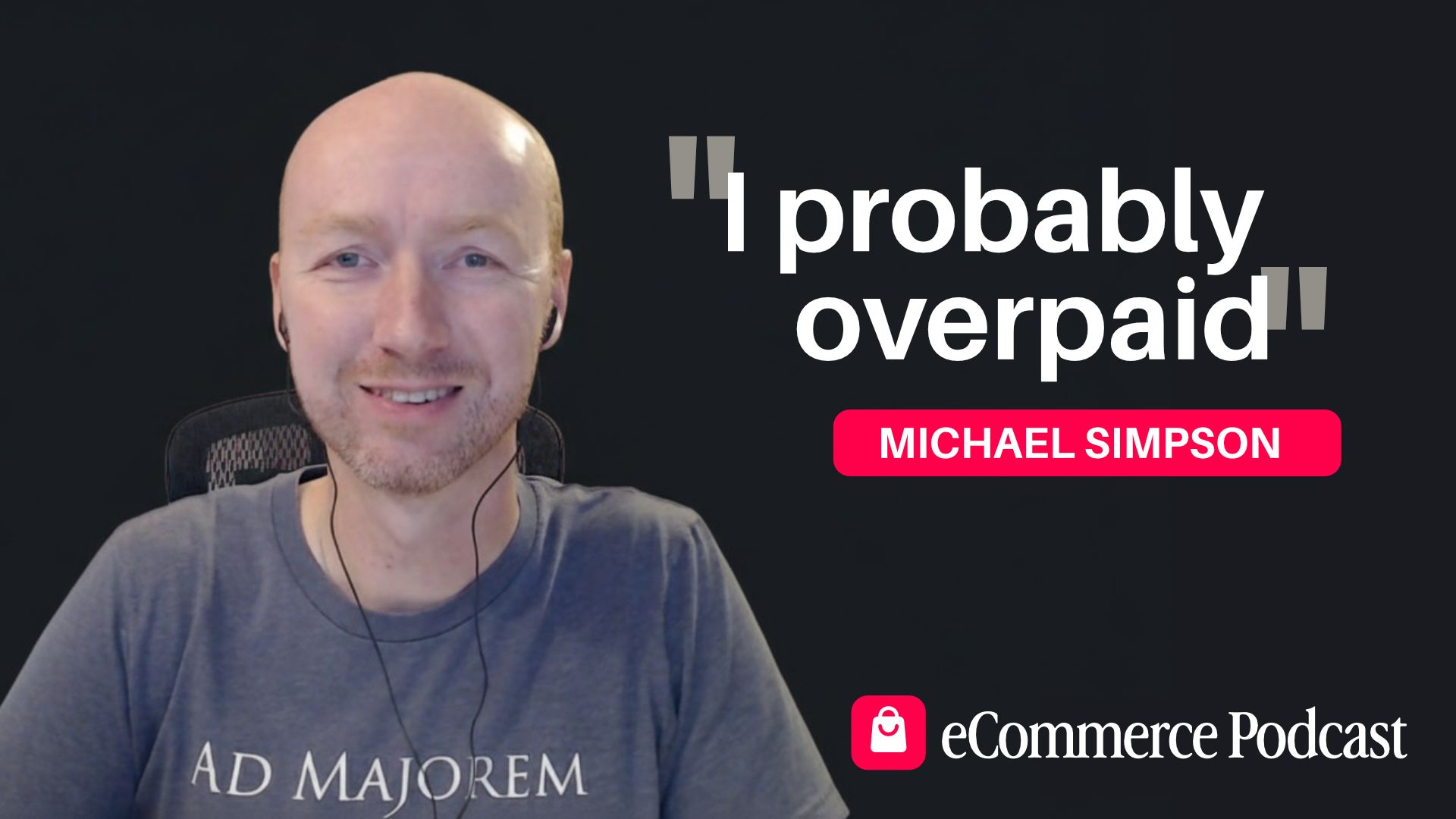
Most entrepreneurs dream of the startup story — the garage moment, the first sale, the hockey-stick graph.
Michael Simpson took a different route.
After 18 months of searching and evaluating 40 businesses, he bought an 18-year-old eCommerce store.
Four years later, he’ll tell you something most founders never would:
“In retrospect, I probably overpaid.”
This isn’t a failure story.
It’s better than that.
It’s an honest look at what really happens when the broker slides the glossy presentation across the table and you sign the deal anyway.
The Search That Opened New Possibilities
Michael had four non-negotiables:
No Chinese suppliers — his National Guard security clearance made that tricky.
His own website — not Amazon-dependent. He’d seen how fragile that game could be.
A real customer base and an active email list — the heart of any eCommerce business.
Products he could actually believe in — no supplements, no random women’s clothing.
Then he came across Discount Catholic Products — an 18-year-old store selling medals, prayer cards, and crucifixes made in Italy and the US. It ticked every box.
He used an SBA loan to buy it.
90% financed.
10% down.
$500,000 in total.
The government even waived the fees and covered his first three months of payments — saving him around $30,000.
Not a bad start.
What No One Tells You About Buying an Existing Business
Growth didn’t come easy.
Here’s what caught him off guard:
1. The migration that never happened.
The business ran on AbleCommerce — a platform few have even heard of.
After a year and £30k spent prepping for a Shopify move, Michael pulled the plug.
His mastermind group warned him: “Your sales will drop, guaranteed.”
With cashflow tight, he couldn’t take the hit.
2. The growth ceiling.
The site ranks brilliantly for “Catholic products.” But that’s demand capture, not demand creation.
When you sell to people already searching, there’s only so much room to scale.
3. The inherited constraints.
He bought the brand Discount Catholic Products.
Great SEO — tough positioning.
“Discount” made it hard to move upmarket, and the 23-year-old platform that “still worked” also tied his hands.
The Daily Discipline That Helps … a Lot
In 2024, sales dipped.
Michael stopped paying himself.
With seven kids to feed, he went back to full-time work.
The business survived on one habit: daily cashflow forecasting.
“It doesn’t matter if you’re profitable or not. You can be wildly profitable and still go out of business if you run out of cash.”
Instead of the usual 13-week forecast, Michael tracks every pound daily, looking a month ahead.
It gives him early warning — enough time to launch a campaign, call a few customers, or draw on his credit line before things get critical.
He also learned the hard way that not all funding is equal.
Shopify Capital might advertise 6% fees, but the real interest rate is far higher.
His fix? A proper bank line of credit — prime plus 1%, around 8%.
Would He Do It Again?
“As long as you stay in the game, you can win in the end.”
That’s not optimism. It’s endurance.
Four years in, Michael’s business isn’t a viral success story. But it’s alive, stable, and slowly improving.
And maybe that’s the real lesson.
Entrepreneurship through acquisition isn’t a shortcut. It’s just a different path with a new set of challenges.
When you build from scratch, you wrestle with product-market fit and slow growth.
When you buy, you inherit systems, technical debt, and decisions you didn’t make.
Neither path is easier.
They’re just different games — both played one decision, one day, one cashflow forecast at a time.
Michael’s Links:
Visit Episode Page →Freebie of the Month →
A systematic framework for questioning business assumptions that feel like "just how things work." This 20-minute exercise helps you identify hidden constraints limiting your growth and discover alternatives you haven't considered.
Be A Guest →
Got an eCommerce business with stories worth sharing?
Come be my guest on the eCommerce Podcast, where I chat with founders about the wins, the disasters, and everything in between. Your story could be the one that helps another founder grow smarter (or avoid your mistakes).