
The Red and Dying Evening

Four reflections on writers who have written about war.
Lately I’ve been thinking about William Faulkner’s Nobel Prize speech. It was a curious, albeit celebrated speech, occasionally rumored to have been hastily scribbled on the plane to Stockholm. Faulkner touched on the usual hits of artistic merit - human spirit, the need to endure and prevail - but, strangely, much of his speech focused on the Atomic bomb. “There are,” Faulkner said, “no longer problems of the spirit. There is only the question: When will I be blown up?”
To understand this, we have to return to the paranoia of the nuclear age, when people realized that their likelihood of dying by the callousness of an explosion had become somewhat likely. Still in the long shadows of two world wars that killed millions, and reckoning with the uneasy, inhuman truth that there is a general indifference when it comes to life, the concept that man had come upon a weapon that could annihilate life - in a moment - was one society had to struggle to accept. And then, society did.
And so we live our lives at gunpoint, and shrug.
***
“Something is significantly wrong,” Suzanna Collins wrote, as she closed out the Hunger Games trilogy, “with a creature that sacrifices its children’s lives to settle its differences.”
One of the things you’ll encounter when speaking with experts in warfare, or those who assume they’re experts, is the way they calmly and dispassionately explain why innocents must die, especially children.
It’s never expressed as killing children, because these people don’t consider themselves monsters. They prefer the term “realists” and believe those who don’t accept killing children as naive or overly idealistic.
There are reasons, they tell you, to kill children. They will tell you that the enemy is cowering behind children, and therefore those children must be executed. Or they’ll say that the enemy has killed your children, and so their children must be killed, as this is only fair. Or they’ll say that your children are in immediate and certain danger and, to save your children, their children must be murdered as quickly as possible. Or that international rules of war allow for the assassination of children, as long as it is done within certain acceptable parameters that many people have agreed upon, and if you haven’t read these rules, you’re in no way fit to complain about the massacre of children. Or that the military has weapons of unquestioned aim and strength and it is only the rarest of incidents when children are blown to bits, and that is deeply regrettable, although acceptable.
And so we live our lives at gunpoint, and adjust the gun so that’s it pointing toward the child behind us.
***
“The choice today,” wrote Martin Luther King, Jr., “is no longer between violence and nonviolence. It is either nonviolence or nonexistence.”
I’ve only been in a few fights in my life. One happened in high school, my junior year, in the boy’s bathroom. It wasn’t much of a fight. I put the kid in a headlock and squeezed and, after about twenty seconds, he begged me to let him go. I did, and he stood up, crying, and told me he was going to come back to school the next day with a gun.
This was years prior to Columbine, and school shootings had yet to become casual discourse in America, so I didn’t take him seriously. I was nervous the next day, but I saw the kid a few times and he ignored me. The fight had ended and the threat came to nothing, but what I chiefly remember about it is my disgust. The fact that he hadn’t been able to beat me, and was instead determined to use a gun, seemed like cowardice. It lent itself to a feeling I’ve never been able to shake - that guns are ultimately the weapons of weak, and somewhat insane, men.
And I am aware that those who refuse weapons are often the first to be slaughtered. And I suppose the only hope against an armed enemy is to have stronger, and more, weapons than they do. But that’s the path toward insanity, a particular worldview where oppression is seen as the necessary rule of land, and the need to kill is both accepted and embraced.
And so we live our lives at gunpoint, and extend a hand to shake.
***
John Allen Muhammad, better known as the Beltway Sniper, left a note during his killings that read, “Your children are not safe anywhere, any time.”
At the time, only a year removed from the horror of 9/11, this struck me as cruelty to the point of insanity. I understand that there are always men eager to fight and kill, who only need the vague idea of an enemy to hold a gun, but one hopes that those men will fight others like him. That armies will only kill armies. This, of course, is rarely the desired case.
Any country that wields nuclear weapons is stating, implicitly, that they are hoping to destroy far more than an army. Like any bomb, a nuclear weapon is inexact, and reaches further than its target - it reaches through time, into the future. A nuclear weapon is designed to destroy more than a military installation. It’s built to level an entire city, to annihilate a country’s population. It’s designed to kill innocents.
Like any terrorist, those who own nuclear weapons or wield bombs are saying, “Your children are not safe anywhere, any time.”
And so we live our lives at gunpoint, and wait.
Subscribe now
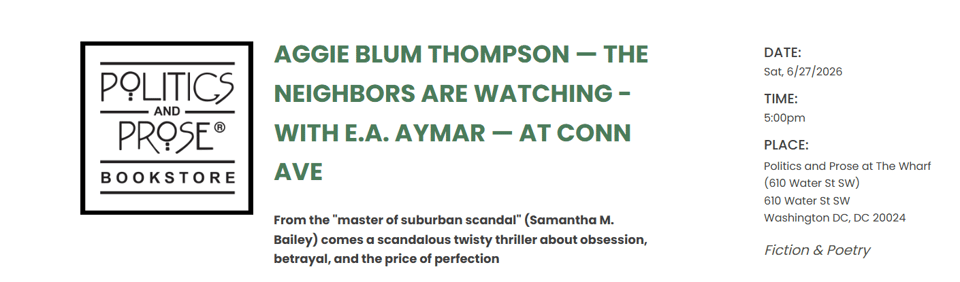
This is a couple of months away, but I’ll be interviewing Aggie Blum Thompson about her newest novel, The Neighbors are Watching, at Politics and Prose on June 27 at 5 pm. Aggie is so smart and funny and a wonderful writer and I’m so excited to have the chance to talk with her. Learn more here!

This one isn’t about me me me, but rather my good friend, historical novelist, Carrie Callaghan and a retreat she’s leading with Politics and Prose from May 22nd-24th. Carrie is a fantastic instructor and leader and there’s no one better to risk getting hopelessly lost with in the woods. Check out the description below and learn more here!
Join Politics and Prose as we retreat to the historic hot springs resort Shrine Mont to write, spend time examining our writing, and refill our creative wells. Instructors will run craft-focused classes discussing narrative structure, prose style, characterization, and other key topics tailored to student needs. Both fiction and nonfiction writers are welcome. The grounds offer opportunities for hiking on trails ranging from easy to challenging, and the beauty of the Shenandoah Valley is astounding in the late spring. Room and board is included in this charming, summer camp-like setting. Tuition will also include the book Thrill Me by Benjamin Percy, which will anchor some of our class sessions.

It's giveaway time! The winner of a copy of Aggie Blum Thompson’s The Neighbors are Watching is:
jn___@uscotton.com
Congrats, and I'll send you an email soon!
Last newsletter I posted that I would be interviewing David Swinson at One More Page. Unfortunately, due to a scheduling conflict, I won’t be able to do the interview, but it’s still happening with a TBD writer who is far better at managing their calendar than I am. Make sure you attend, because David is a terrific writer and interviewee.
Add a comment: