
Subduing the Porcupine


No, this isn’t another newsletter focused on pets, although I sometimes think I would like to own a hedgehog and, frankly, probably will. Rather, the title of this newsletter comes from my interview with the extraordinary MJ Soni, whose debut novel, The Masala Chai Mystery Club, was published last Tuesday and received, among other praise, a STARRED review from Library Journal! The point is, I really like that porcupine phrase and plan to use it all the time. It’s mine now. I invented it.
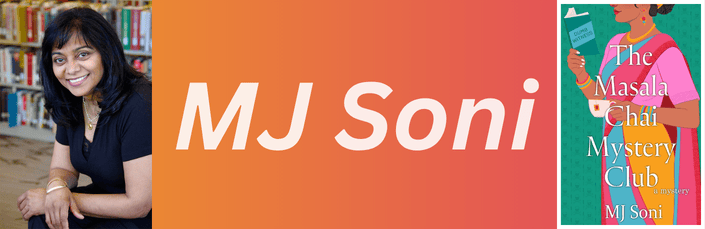
Before I stole and trademarked her phrase, MJ and I met at ThrillerFest, when we worked on her pitch for her query letter, and have stayed in touch over the years. A survivor of apartheid, MJ Soni is also a retired physician whose short stories have appeared in Ellery Queen and Alfred Hitchcock Mystery Magazines, in addition to a variety of other publications. I’m so excited that her debut novel was published and hope that, after you read the interview below, you realize what a thoughtful, fascinating person she is and ORDER HER BOOK!
You've written before about the effects of apartheid on both people and institutions, but how did that system affect you most as a writer?
While I lived in South Africa, I didn't consider being a writer. I was too busy being a young mom and a doctor.
But I think what held me back was also knowing that becoming a published author, like so many other careers, were off-limits to people of color like me. The publishing industry was White–owned, and most fiction they published was by White authors.
Even if books by people of color were published, they were often banned under one of the myriad laws the fascist government had passed. These included the Riotous Assemblies Act, Suppression of Communism Act, Immorality Act, Official Secrets Act, Post Office Act, Defence Act, Prisons Act, Customs and Excise Act, Improper and Indecent Photographic Material Act, Atomic Energy Act, and the Newspapers and Imprints Registration Act.
But the spirit of defiance could not be extinguished. As students we would cover banned books in newspaper and pass them around in bathroom stalls. Many of them were about the Civil Rights Movement in America. Time Longer Than Rope — A Century of African American Activism was one I remember that had huge impact on us.
And, in spite of the risk of their books being banned, or being arrested for treason, many authors smuggled their manuscripts overseas to be published.
When I moved to the US, I joined a writing class at my local community center. But I found myself creatively blocked because I had PTSD from having lived under an authoritarian system like apartheid. I had so many tragic stories of patients who had suffered — children dying from malnutrition, a young mother of three who had extensive burns because all she could afford was a paraffin stove that had blown up in her face, and so many patients blinded by birdshot pellets used by police to quell protests.
My writing teacher suggested I distance myself and write these events as fiction, which helped me get over my block. Once I started writing I couldn’t stop. The result was my nonfiction book, Defying Apartheid, published by Amazon Kindle Singles UK.
After that I felt I could move on with writing fiction, and multiple rejections later, my debut, The Masala Chai Mystery Club, has finally been published on July 21.
How did you turn to writing from your work as a scientist and surgeon? Was there some inherent relationship?
As a surgeon I didn't do much writing, but as a pharmaceutical physician I was in a writing group where my role was to write detailed clinical summaries of entire drug development programs to submit to the FDA for review.
I really enjoyed writing these documents because it was a challenge to summarize in a hundred pages a ten-year development program.
I used to call it ‘wrestling to subdue a porcupine.’
And now that I write fiction, I realize writing an entire novel is like wrestling to subdue that porcupine too. But the science writing was easier because the basic data were all there, I had to put it into a logical format that was easier to digest.
I find creative writing so much harder. I alone have to create everything, from the characters, to the plot, to the setting, to the weather.
But to quote John Grisham, “Writing's still the most difficult job I've ever had - but it's worth it.”
In addition to nonfiction, you've had short fiction published in some of crime fiction's top magazines, and now you're publishing your debut novel. Do you want to continue writing so diversely, and do you want to expand even further? Or do you want to narrow into just one form?
Before my debut I dabbled in thrillers, psychological suspense, and domestic suspense. This was partly because I really wasn't clear on what each genre was about, I was writing what I liked to write. Even when I wrote The Masala Chai Mystery Club, I thought I was writing a mystery with some tea and food elements, I didn't know what a cozy was until my agent called it a ‘new cozy.’
However, now I'm in the cozy genre I'd like to hopefully explore it further with more books in this series. Having said that I still plan on writing short stories in various other genres.
What led to The Masala Chai Mystery Club? Was there a scene or character that called out, or was it inspired by something else?
The Masala Chai Mystery Club’s protagonist was inspired by my mom.
As a child my mom was never allowed an education, but when her marriage to my dad, a young lawyer, was arranged she learned to speak, read, and write English, she learned to type and became his legal secretary, and she passed her driving test. Of course, all her aspirations came to a halt when my siblings and I were born. But I've always admired her determination and her discipline.
Unfortunately, when she developed dementia, I began to lose her bit by bit, until she forgot who I was. She said I was her friend. And I think I wanted to capture her vitality and her badass personality in my protagonist, Neeti Shah. But I gave her an education and made her a librarian.
Another inspiration was of course libraries. As a teenager I was not allowed into the Johannesburg Public Library, which was only a ten-minute walk from us. It was for White people only. So, I really appreciate libraries and librarians.
Thank you, MJ, for taking the time to chat with me about your life and work! You can learn more about MJ Soni and her writing here.
EA
Subscribe now
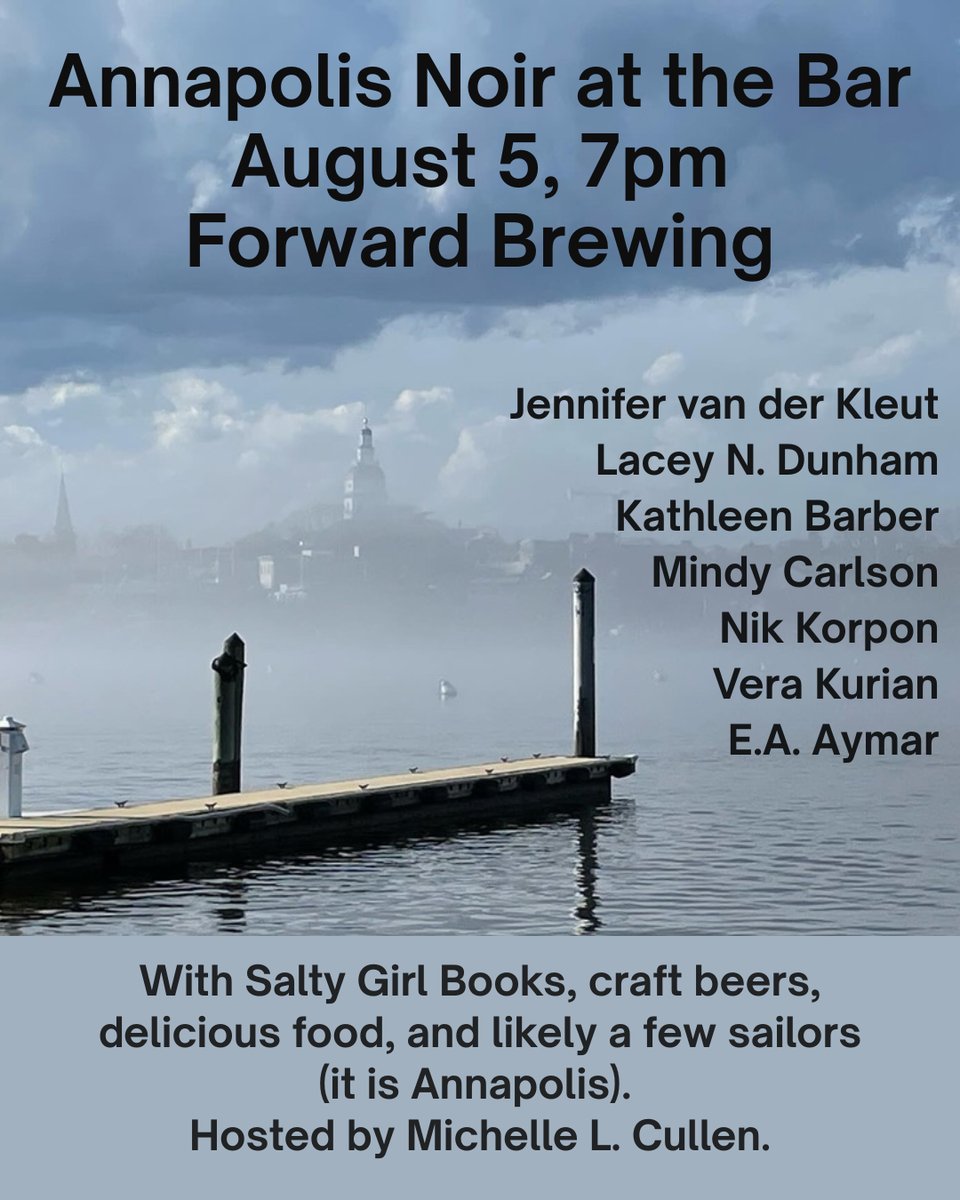
If you’re in Annapolis, or nearby, or you’re not nearby but you’re really into flying, come see me and a slew of great writers on August 5 at Forward Brewing. I’ll be reading at this event with so many fun writers, including my old pal and noir legend Nik Korpon, who rarely gets off his butt to come to these things. The lineup is STACKED and this will be a fun time and also, according to the flyer, there will be saviors! Or sailors, I don’t know, I read it fast. COME GET SAVED!

It's giveaway time! The winner of a copy of MJ Soni’s debut mystery, The Masala Chai Mystery Club, is:
Congrats, and I'll send you an email soon!

Even though, a few months ago, I was like I don’t need reviews lol, turns out I missed doing them and jumped at the chance to immediately write one for the Washington Independent Review of Books. Do you like rap? You don’t, whatsoever? I don’t care, you should still read my review of Raps of Resistance, which is a nice rap primer and gave me the chance to talk about what I thought the book got right, and what it didn’t.
Also, weeks later in that same publication, I interviewed my friend and writer-I-admire Hilary Davidson about her latest novel, Every Lie I Told, which was a banger of a book! Check out our talk here.
Thank you, I love you.
Add a comment: