
Want to see some listener survey results?
Plus, my latest interview with Emily Dufton, who has a gift for making very confusing politics clear and interesting!
First, I want to make sure you saw this week’s episode, with Dr. Emily Dufton.
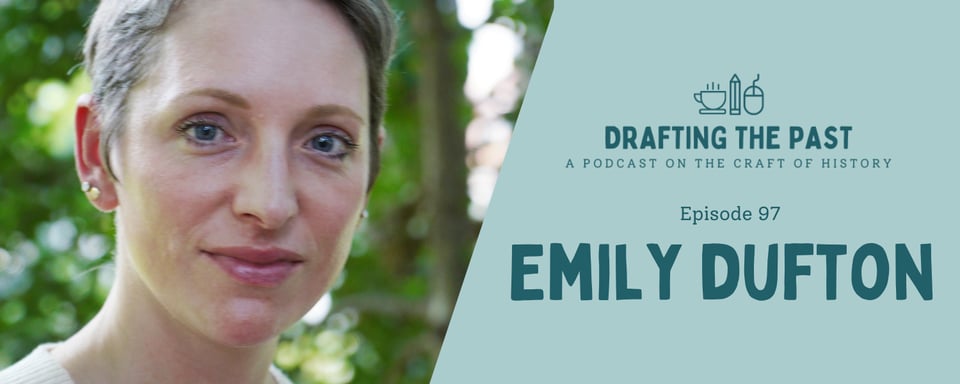
In Emily’s new book, Addiction, Inc.: Medication-Assisted Treatment and America’s Forgotten War on Drugs, she takes a complicated, often confusing history of science, medicine, politics, and culture and tells it in a completely engaging way. I learned so much about the history of medication-assisted treatment for drug addiction, and I learned a lot from our interview, too. A couple of my biggest takeaways: how she thinks about what feedback to incorporate and what to set aside, and why she thinks more historians (at least, historians of recent history) should pick up the phone and call some sources. Listen to the interview here.
And Now for Some Listener Survey Results
A huge thank you to every person who took the time to respond to the survey. I wanted to get a sense of what was (and wasn’t) working for listeners, and your responses are a big help.
You might remember that at the end of last year, I had one-on-one phone calls with some listeners who volunteered their time. Those calls were so much fun, and they gave me a ton of insight into who my listeners are (a much more varied group than I realized!). I also really took to heart how much listeners get a sense of community from the podcast. I’m actively thinking about ways to build more on that.
All of those calls were so encouraging—perhaps too encouraging, ha! An anonymous survey provides a chance to get a more frank feedback. I wrote questions partially based on what I learned in those calls, and partially on things that I’ve been wondering about.
Want the scoop on some of the results? Let’s start with a chart! (Actually, let’s start with some caveats: This is not a scientific survey! People who choose to respond to a listener survey are a self-selecting group, and are, by the very fact of responding, among the most engaged listeners! Still, the results are useful. Please don’t hate me, statisticians. I took Statistics for Journalism Majors in college.)
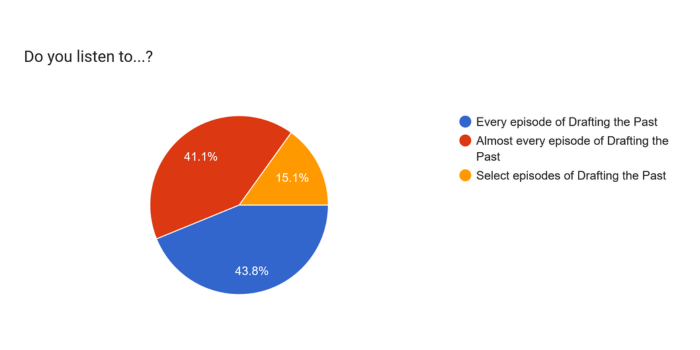
I was not entirely surprised to learn that most of the respondents—almost 85%—reporting listening to every or almost every episode, but it was still gratifying to see. It was also interesting to see that 83.4% say they listen to new episodes within the first seven days. And another number that gave me some warm fuzzies: almost 80% say they have told someone else about the show. At the end of many episodes, I say that telling someone else is the best way to help the show grow—that is absolutely true. Thank you.
How about some more stats?
I asked how people found the show. The top three drivers of new listeners were
Social media posts (35.6%)
Through a recommendation from a friend or colleague (26%)
By browsing an app you use to listen to podcasts (15.1%)
That last one actually surprised me! I love knowing that people are searching for history writing podcasts and stumbling upon this one.
Listeners do a variety of things while they’re listening, but a full 72.6% said they listen while traveling or commuting (the next most common activities were exercising or doing housework/chores). This was not super surprising either, but it was helpful to have this confirmation.
I also asked about other podcasts that people listen to. It turns out, there’s not a lot of overlap in listeners’ podcast preferences! This was a big surprise to me. It also meant this question was a little less helpful than I had hoped, because I thought it might give me some insight into podcasts where I could advertise or pitch myself as a guest to help spread the word. But it was also very fun to see how widespread your interests are—sports, culture, politics, comedy, legal news, science, and some very niche interests! There was a little overlap, and the most frequently mentioned podcasts were The Josh Marshall Show, New Books Network Shows, 99 Percent Invisible, This American Life (duh), Strict Scrutiny, and Sidedoor from the Smithsonian.
Let’s dig into the more constructive feedback, shall we? I also asked what was most likely to make people stop listening or skip an episode. The top three responses:
The guest writes about a time period/region/subject that does not interest me
I find the conversation uninteresting
I do not like the guest
It was a bit of a relief, honestly, that sound quality did not seem to be a major deterrent! I’m always trying to figure out how to improve production value, but this helped me feel a bit less self-conscious. On the other hand, it was very interesting to learn that the guest’s subject matter is so important. More on this below! (I’ll also note that a lot of people indicated they rarely skip episodes, which aligns with the results in that first chart.)
How about another chart?
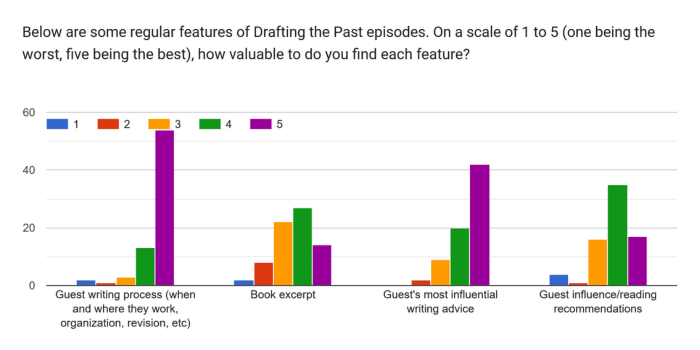
This was the question that I was most curious about. I’ve been wondering for a while if the standard beats of each episode were working for listeners. I was especially interested to know what people thought about the part where I have the guest read an excerpt from their work. Sometimes I feel like that section interrupts the flow of the interview, and in my one-on-one calls, it was the one thing a couple of people tentatively mentioned that they wouldn’t mind doing without. It’s clear in these results that people felt more ambivalent about it than some of the other features, which seemed to confirm my hunch. For now, I think I’ll play around with including an excerpt when I have something specific I want to illustrate and ask about the text, and skipping it other times. We’ll see how it goes!
I’m also going to change up how I ask guests for their influences and reading recommendations. Sometimes these answers are amazing, and other times they’re less helpful. Maybe there’s another way I could get at this question.
Finally, the most helpful part of the survey was one of the last questions, where I asked for open-ended feedback, including ways to improve. As a person who often skips free response questions on surveys, I’m especially grateful that so many people left such thoughtful responses here! There were many, many kind responses that I have written in my “nice things people have said for when I’m feeling discouraged” folder, and I’m deeply appreciative of those. But I want to get into some of the most common suggestions for improvement:
More guests who write non-US history! I hear this loud and clear, and really appreciate everyone who said this. I know this is an area that needs improvement, especially lately, and your emphasis on it lit a fire under more. Similarly…
More guests who work outside the US! Ditto to the above. International guests have made for some of my favorite interviews, too, so I appreciate the reminder to put more effort into highlighting them. I’m hopeful that improving in both of these areas will give more people reason to keep listening and to tell their friends about the show, too.
More variety in interview questions! This was a response that could have stung, but actually made me realize that I need to trust my gut more. I’ve been worried that my interview questions were becoming a bit rote, but I was anxious about changing the formula. These responses encouraged me to be more bold in interviews, follow conversations where they lead, and change things up when it makes sense. My standard “nuts and bolts” questions aren’t going away (I know many of you love them!) but these responses were freeing.
There were lots of other good suggestions included that I’ll be implementing (or researching how to implement), but I thought you might like to see some of the biggest takeaways. Huge, huge thanks again for the feedback, for the kind words, and for the care that you all bring to the show. Even if you didn’t get a chance to complete the survey, please feel free to respond to this email or comment here with other thoughts!


Add a comment: