
A Glimpse Into Dissertation Drafting
A little peek at one of the sources I'm working with this month

The Drafting the Past newsletter is free to all. If you would like to help keep the podcast and newsletter going, you can support Drafting the Past on Patreon.
All month, while I’ve been on hiatus to work on my dissertation, I’ve been thinking about newsletters to write to you. But I haven’t been able to write any of them—in large part because my brain is deep in the dissertation swamp, and it’s a struggle to write coherently about much else.
So, I thought, why not introduce you to one of the sources I’m working with this month?
My dissertation is a history of storm chasing in the second half of the 20th-century United States. It starts in the 1950s and 1960s, with a few intrepid souls trying to track down tornadoes, and follows the development of storm chasing as scientific field research and a hobby with a growing community of enthusiasts.
This month, I”m working on my last chapter. It focuses on 1994-1996, and ends with the release and reception of a little movie called Twister.
(The future book version—which I hope to sell as a trade or crossover book!—will go farther, but I’m stopping here for now in the interest of someday, finally, defending my dissertation.)
Here’s one of the sources I’ve been spending some time with this month:
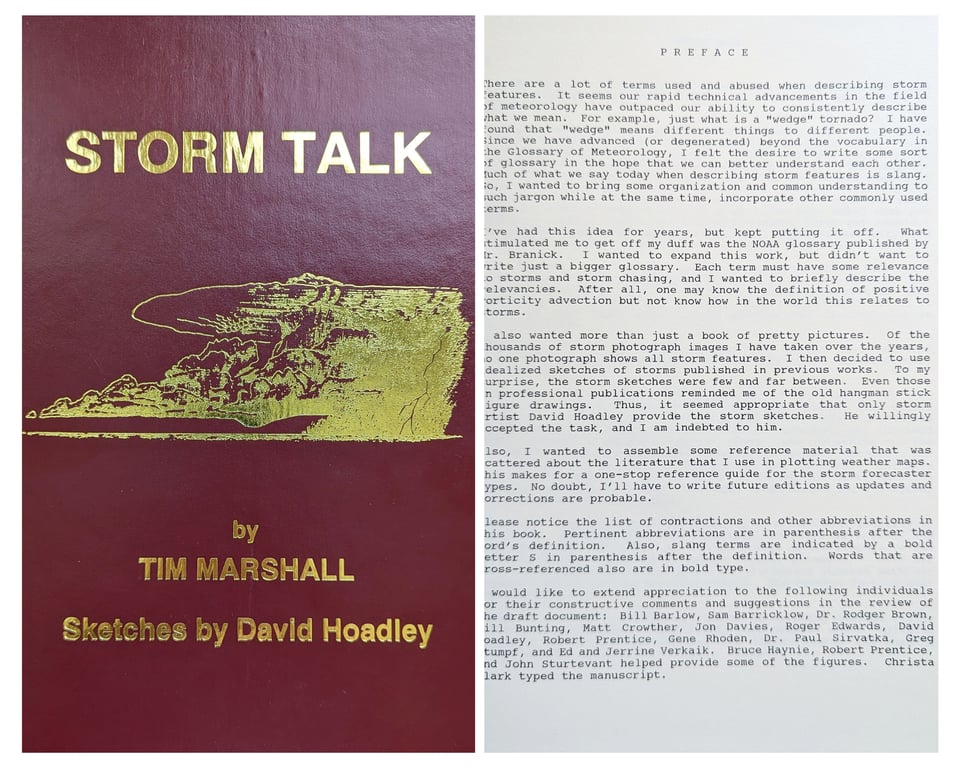
This is Storm Talk, a glossary for storm chasers published in 1995 by a storm chaser named Tim Marshall. Marshall was then the editor of Storm Track, the storm chasing community’s newsletter, which had been founded in 1977 by David Hoadley.
These two men are interesting writers of a glossary for storm chasers because neither is a professional meteorologist. Marshall was an engineer who, in his professional life, regularly surveyed storm damage. Hoadley was an analyst for the EPA who began chasing storms as a hobby in the 1950s, and is largely considered the first storm chaser.1 (Both men are still around—I briefly got to interview Marshall, and I hope reach Hoadley for an interview while I’m writing the book.)
Neither was a professional meteorologist or atmospheric scientist, in other words. In fact, Marshall writes in the preface that he was finally prompted to produce this glossary because an official NOAA publication that was described as “a comprehensive glossary of weather terms for storm spotters” struck him as woefully inadequate. He was especially frustrated that, while the glossary defined terms, it did not always explain what relationship they had to storms. “After all,” he wrote, “one may know the definition of positive vorticity advection but not know how in the world this relates to storms.” Marshall’s glossary, as he imagined it, would give researchers and chasers a common reference point for words that were often vaguely defined. These included not only scientific terminology but the slang that storm chasers regularly employed.
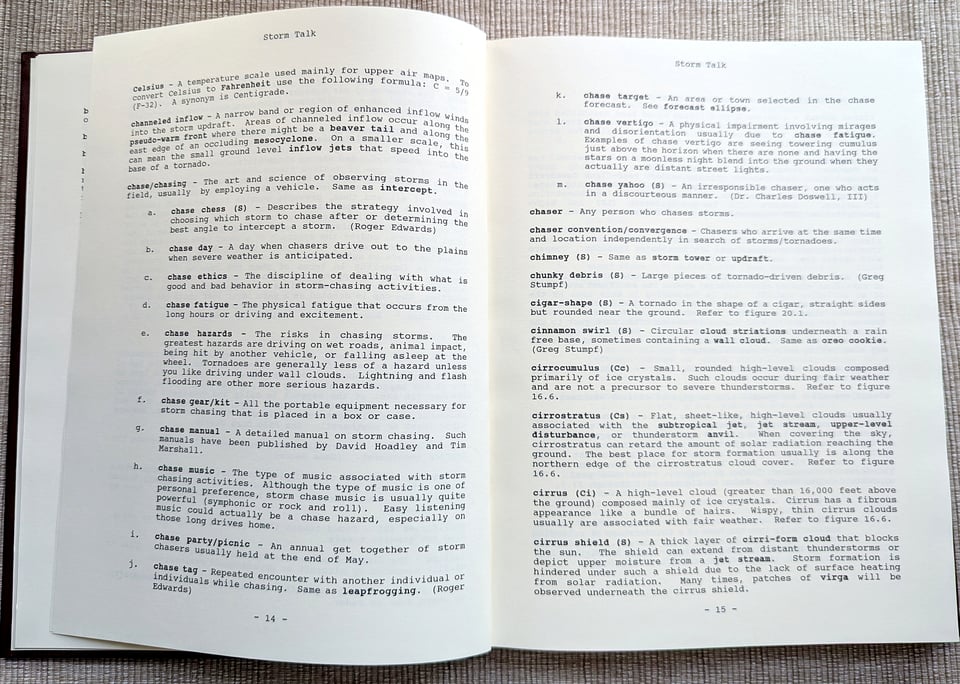

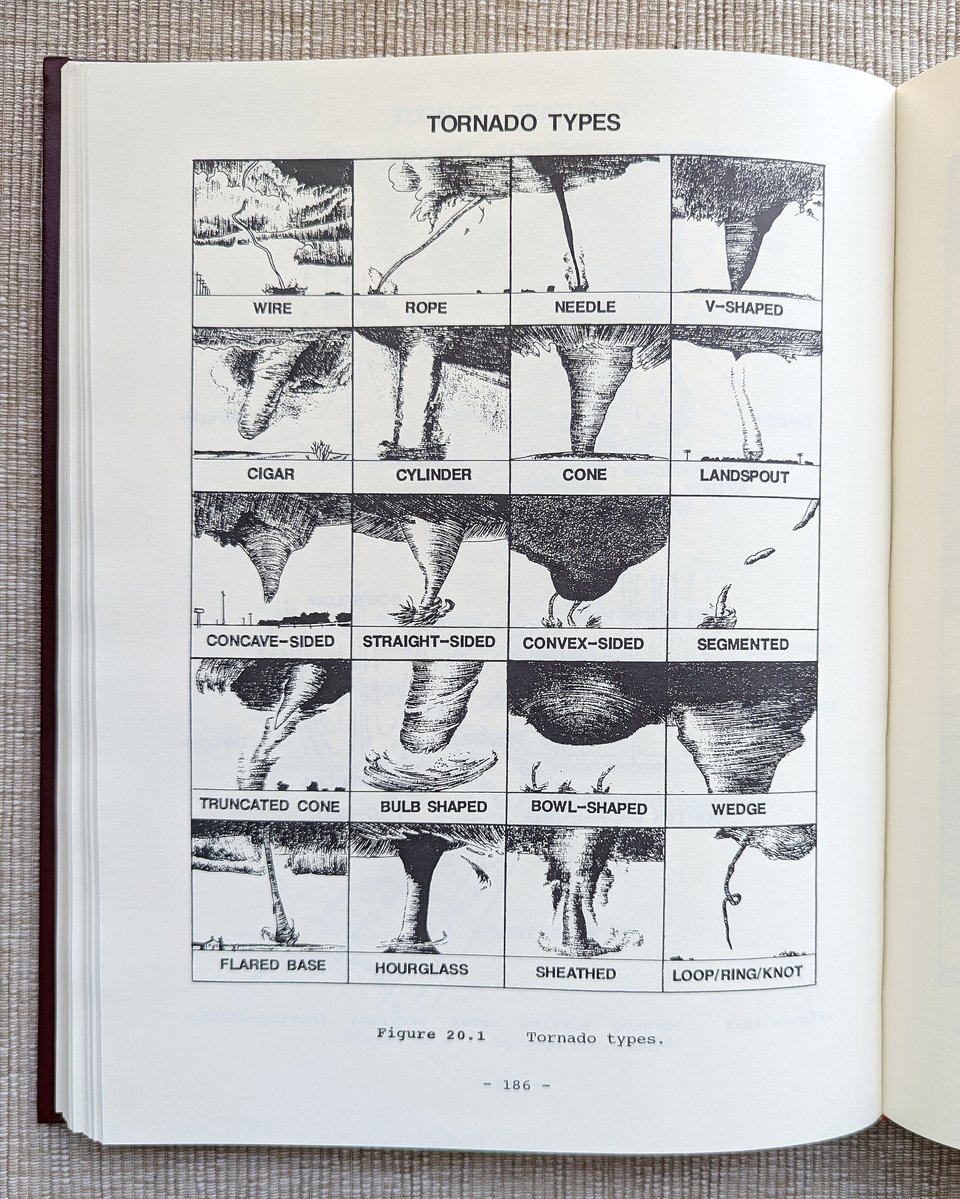
Marshall also hoped to include reference material that would help other storm chasers use data to forecast their own chases and learn more about severe storm features and development. He first thought he would use photographs, but they didn’t quite suit his purposes. Not only did they not produce well, but they rarely clearly showed an idealized version of all the storm features he wanted to discuss. Photographs might be good scientific evidence, but they were not ideal teaching tools. Instead, he turned to Hoadley, who had been illustrating comics and storm clouds in Storm Track since he had first launched the newsletter. Hoadley happily signed on, always enthusiastic about serving the community.
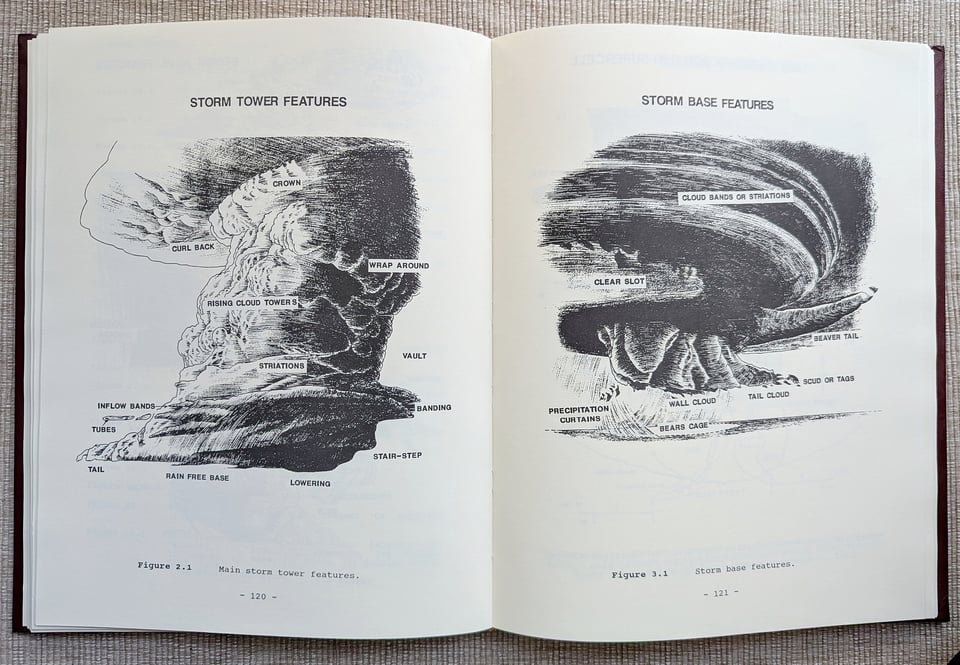
The resulting book is a marvelous text blending scientific and lay knowledge, technical jargon and chaser slang. More than two hundred pages long, it includes 105 pages of glossary (Branick’s glossary was 28 pages) followed by Hoadley’s illustrations and other reference texts. The terms range from scientific meteorological phrases like “outflow boundary” (“the leading edge of of the rain-cooled air from a thunderstorm”) to slang terms like “meat grinder” (“an intense and menacing-looking high precipitation supercell”) or “weedpuller” and “weedwacker” (a tornado and a hailstorm, respectively). In many definitions, bolded words indicated definitions that could be found elsewhere, and the text referenced related phrases and illustrative figures. Some of the slang terms were even attributed to the storm chaser believed to have first coined them. In one book, Marshall educated chasers, especially those who might be new or had been embarrassed to admit they did not know the meaning of a phrase, captured some of the tone of the community, and gathered more storm-related terminology in one place than anyone had done before.
The book might have been conceived for educational purposes, but it went into print just in time to join a wave of projects that storm chasers hoped might allow them to cash in on some of the hype surrounding Twister. In fact, Marshall later said that the production team had purchased ten copies to use as props. He first started advertising the book for sale in March 1995, for $35, and by November 1996 he reported that there were “90 of the 550 original sets left. Once they are gone, they are gone.”3
There’s a copy, labeled number 1/500, in David Hoadley’s papers at Texas Tech University, but I bought this one from eBay so I could have one handy.
And now, back to 1995, where my brain is living this month. See you soon!
Some archival evidence suggests that another man, Roger Jensen, was actually the very first storm chaser, and Hoadley has always been quick to point to Jensen instead of himself. But there have also been some questions raised about Jensen’s storm chasing, and he was not an active storm chaser for very long, so I’m inclined to go with Hoadley for this designation. ↩
You’ll have to read the book for more about chase yahoos and Chuck Doswell, the storm chaser who coined the phrase. ↩
Storm Track vol. 20, no. 1 (November 1996). ↩


Add a comment: