🧠 Understand how social feeds drive loneliness
Social media platforms trade real emotional intimacy for constant digital connection
August 06, 2026
Social media platforms trade real emotional intimacy for constant digital connection
The Deep End
Why Digital Hyper-Connectivity Drives Modern Loneliness Across All Demographics
Social media platforms trade real emotional intimacy for constant digital connection. Studies show youth up to age 25 experience peak isolation levels despite perpetual phone use. Curated feeds fuel social comparison and psychological distance across every demographic. This analysis explores how digital hyper-connectivity replaces genuine human touch with algorithmic anxiety, proving why stepping back restores mental well-being.

Digital hyper-connectivity creates severe emotional isolation across all modern age groups. Young adults under 25 report the highest loneliness rates despite constant platform access. Constant phone reliance replaces real human touch with superficial online interactions. Algorithmic feeds trigger social comparison and degrade overall mental health daily.
Physical spaces provide a direct antidote to algorithmic social media fatigue. Shared public spaces like libraries and theaters rebuild genuine social presence. Offline reading restores mental focus without the psychological drag of endless scrolling. Switching phones to silent restores deep presence in everyday real life.
Key Takeaways:
- Curated social feeds increase personal loneliness by forcing constant upward social comparison.
- Young adults under 25 suffer severe isolation because virtual connectivity lacks physical presence.
- Audit your daily screen usage to replace digital scrolling with analogue public activities.
The Periphery
Why Consumer Trust in AI Is Now Outpacing Traditional News Media
Rising comfort with low-risk tasks drove consumer trust in AI to 62% in 2026, officially surpassing traditional news outlets at 58%. Everyday applications like meal planning build confidence without high failure costs. This analysis explains how media publishers can restore authority by adding visible verification guardrails.
Consumer trust in AI reached 62% this year. That puts algorithms ahead of traditional news outlets at 58%. Media companies now face a severe credibility gap. Users trust automated tools more than human reporters for reliable information.
Key Takeaways:
- Low-risk daily tasks drove AI trust to 62%, officially passing traditional news media.
- Consumer trust in AI doubled to 15% -- users demand low-stakes automation with visible guardrails.
- Implement visible fact-checking guardrails to restore news credibility against algorithmic competitors.
Why AI Compute Costs Are Destroying Traditional SaaS Gross Margins
Per-user inference fees drain cash on every interaction. Average AI product margins dropped to 52% compared to traditional 85% SaaS benchmarks. This shift breaks the classic hyper-growth model. This analysis shows how variable compute costs force founders to adopt usage-based pricing and disciplined unit economics.
Traditional software enjoyed 85% gross margins due to zero marginal distribution costs. Generative AI tools ruined this dynamic by attaching paid inference calls to every user action. Recent ICONIQ data shows AI product margins dropping to just 52%. Software companies now pay real manufacturing costs for every customer interaction.
Key Takeaways:
- Per-call inference costs reduce AI gross margins because every user interaction consumes expensive compute.
- Flat-rate pricing fails because heavy power users generate variable compute costs that destroy profit.
- Audit model routing pathways to direct routine user queries away from costly frontier systems.
How Mimetic Desire Shapes Your Goals and Traps Your Happiness
Unconscious social imitation drives human desire -- from career paths to trendy sweaters. Philosopher René Girard proved people blindly copy their peers instead of picking original goals. This analysis uncovers how social imitation fuels endless envy. You will learn three clear steps to break free from pointless status games.
People rarely choose their own goals. Philosopher René Girard showed how human desires are usually borrowed from peers. You buy the car or chase the promotion to impress specific rivals. This hidden social copying leaves you trapped on an endless hedonic treadmill.
Key Takeaways:
- Unconscious social mimicry shapes human desire because people instinctively copy peer goals and ambitions.
- Relative peer rank dictates happiness -- income quadrupling fails to satisfy when peers quintuple theirs.
- Audit your envies monthly to identify who secretly dictates your personal goals and choices.
How Flat Organizations Replace Management Chains with Scalable Team Networks
Removing middle management fails when leaders confuse flattening with eliminating structure entirely. Research across 200 companies shows successful flat organizations deploy four specific network archetypes. These structures boost profits by 210% -- because clear team boundaries and radical transparency replace top-down control. This analysis breaks down the four models and shows how to coordinate autonomous teams without adding bureaucratic bloat.
Flat organizations do not lack operational structure. Study data across 200 companies reveals two-layer networks replacing traditional management chains. A small executive team sets strategy while autonomous groups manage daily decisions. Transformed manufacturing firms increased revenue by 80% using value-chain team networks.
Key Takeaways:
- Flat hierarchies replace middle managers with customer-facing team networks to maintain clear operational focus.
- Chain-based flat models drove 210% profit increases -- direct worker autonomy eliminated costly supervisory delays.
- Audit internal data access to ensure autonomous teams have full financial visibility for decisions.
The Firehose
AI Software Engineering
- Why Software Teams Need Physical Engineering Discipline to Eliminate Delivery Gaps
- Why Context-Aware AI Code Reviews Beat Traditional Diff Inspections
- How Custom Verification Loops Stop AI Coding Agents From Breaking Production
Modern Publishing and Journalism
- How Elite Political Attacks Dismantled Public Trust in American Media
- How Treating Social Creators Like Columnists Drove Time's Video Growth
- How High School Newsrooms Build Critical Thinking and Student Leadership
- Why Regional Print Magazines Succeed by Choosing Depth Over Scale
Marketing Automation Strategy
- How Automated Instagram Direct Messaging Converts Social Media Followers Into Subscribers
- How Algorithm Shifts Are Turning Media Buyers Into Automation Engineers
- Six High-Impact Adjustments to Fix Leaky Marketing Automation Flows
Cognitive Psychology and Productivity
- Why Embracing AI Productivity Requires Unlearning Traditional Standards of Competence
- How AI Chatbots Quietly Subvert Human Critical Thinking and Judgment
- Why Focus and Motivation Are Exactly the Same Psychological Force
- Why Low-Effort Psychology Tools Prevent Burnout in Overwhelmed Knowledge Workers
- Why Readers Prefer Bad Human Art Over AI Blog Stock Photos
Worth Exploring
- How Smoldering Fresh Herbs Replace Traditional Wood Smoking for Barbecue
- How Principal Component Analysis Builds Inclusive Skin Tone Color Spaces
- How Microstate Counting Bridges Physical Thermodynamics and Markov Chain Entropy
The Unintended Consequence
Why Self-Improving Agent Harnesses Outperform Fixed Coding Assistants
Static agent harnesses force frontier AI models into rigid tool schemas and static prompts. Prime Agent replaces these boundaries with recursive language execution and an adaptable state layer. This shift boosted benchmark scores on complex tasks like ARC-AGI 3 to 95.5%. Discover how programmatic control and online self-refinement unlock autonomous long-horizon performance.
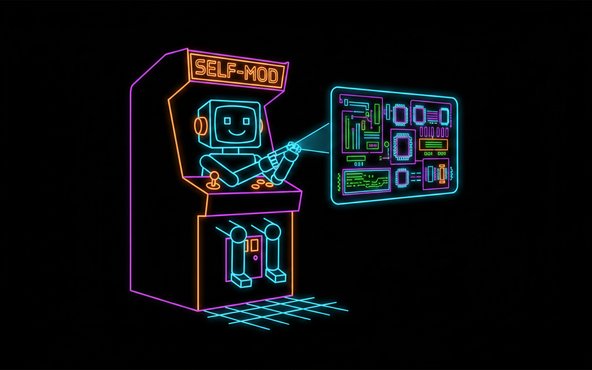
Traditional AI coding agents rely on rigid tool schemas and fixed system prompts. Prime Agent transforms context into dynamic variables inside a persistent IPython REPL session. Sub-agents run directly as programmatic function calls instead of hand-engineered prompts. Prime Agent scored 95.5% on ARC-AGI 3 by reducing unnecessary tool overhead.
The harness continually edits its own state based on past execution history. It converts repeated execution errors into persistent skills and system memories without manual intervention. In long-horizon tests, this recursive design surpassed native model runtimes on complex benchmarks. Developers can deploy this open-source framework today to scale long-horizon developer workflows.
Key Takeaways:
- Recursive model execution treats sub-agent delegation as direct code function calls inside REPL environments.
- Continual harness updates cut token overhead while raising ARC-AGI 3 benchmark accuracy to 95.5%.
- Evaluate recursive agent harnesses to optimize context efficiency in long-horizon software development workflows.