🤔 Why does newsroom translation fail Spanish readers?
After-the-fact translation buries cultural context, leaving major editorial blind spots in loca...
November 18, 2026
After-the-fact translation buries cultural context, leaving major editorial blind spots in loca...
The Deep End
Why Post-Publication Newsroom Translation Fails Spanish-Speaking Audiences
After-the-fact translation buries cultural context, leaving major editorial blind spots in local coverage. Latinos appeared in just 5.6% of racial equity news stories despite their huge civic impact. Integrating bilingual reporters into early story pitches builds deep community trust and drives better enterprise reporting. This analysis shows why publishers must fund direct reporting over automated software.
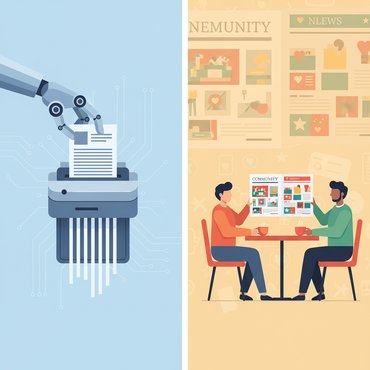
Most newsrooms treat Spanish reporting as a quick translation task. Translation software converts words but strips away crucial cultural context and community nuance. Unintended errors alienate readers and weaken audience trust across local markets. Berkeley Media found Latinos appeared in only 5.6% of racial equity articles.
True bilingual journalism begins during early story pitches, not final edits. Reporters in New York reach readers directly through barbershops, bodegas, and senior centers. Newsroom leaders must hire bilingual journalists to shape core daily coverage.
Key Takeaways:
- Late-stage translation destroys context -- software converts words without understanding local cultural nuances.
- Limited Latino coverage in 5.6% of equity stories stems from monolingual pitching processes.
- Hire bilingual journalists at story conception to build lasting trust with local communities.
The Periphery
Why Scale-First Digital Ad Models Fail Publishers and Investors Alike
Venture-backed media outlets face severe valuation drops as tech duopolies absorb digital ad dollars. Pureplay publishers cannot survive solely on ad impressions because Facebook and Google productized ad delivery for small businesses. This analysis shows why media brands must ditch pursuit of raw scale, diversify revenue streams, and monetize loyal readers directly.
Digital media ad revenues are failing to support pureplay content publishers. Mashable accepted a $50 million buyout after hitting a $250 million valuation. Facebook and Google capture most ad growth by making ad buying dead simple. Publishers chasing pure web traffic quickly run out of profitable options.
Key Takeaways:
- Ad-supported digital scale fails because tech duopolies swallow the majority of ad growth.
- Mashable lost 80% of its valuation when ad revenues failed to match targets.
- Diversify publisher income by launching subscriptions, live events, and branded commerce channels.
How Collective AI Licensing Offers Publishers a Sustainable Revenue Model
One-off AI dealmaking leaves independent publishers behind. Yahoo just signed as the first partner with the Internet Licensing Collective, giving 3,000 publishers a Spotify-like payout system. AI companies pay into product-specific royalty pools based on actual content usage and citation value. This dynamic model could replace declining ad markets by turning scraper traffic into predictable publisher revenue.
Independent publishers are shifting from flat-fee AI deals to collective bargaining. Yahoo became the first licensee for the Internet Licensing Collective, opening access to 3,000 publisher feeds. The agreement routes demand-side revenue straight into segmented royalty pools for AI search features like Yahoo Scout. Mather Economics estimates collective licensing could yield up to 35% of AI company revenues within three years.
Key Takeaways:
- Yahoo joined the Internet Licensing Collective to standardise content licensing across 3,000 distinct publishers.
- Segmented royalty pools prevent niche medical publishers from losing revenue to general search engines.
- Evaluate collective licensing protocols to monetize AI search traffic without individual contract negotiations.
How Personal Agent Protocol 1.0 Connects Autonomous AI Agents to Businesses
Meta and Shopify just adopted Personal Agent Protocol 1.0 to standardize agent-to-business interactions. Platform fragmentation previously blocked personal AI agents from executing complex transaction workflows across business APIs. Poppy solves this by integrating OAuth and standardized extensions across 100 enterprise partners. Learn how v1.0 structures authentication, executes checkout flows, and prepares web platforms for autonomous agent traffic.
Personal AI agents need structured ways to act on your behalf across web services. The new Personal Agent Protocol 1.0 solves this through standardized OpenAPI and OAuth authentication. Meta's Muse agent now scans for Poppy files automatically on every website it visits. Businesses must adapt quickly or risk losing visibility to agent-driven shoppers.
Key Takeaways:
- Native OAuth integration eliminated agent auth failures: Poppy v1.0 standardizes user permission boundaries securely.
- Shopify's default rollout gave over one million merchants immediate access to autonomous agent shoppers.
- Audit your public APIs today to prepare your business endpoints for agent interactions.
How Leading Tech Companies Are Redefining AI Product Management Roles
Tech companies are replacing single-slice product management with specialized AI roles. Analysis of 300 job postings reveals major shifts in team structure, PRD processes, and engineering ratios. Spotify now splits AI product managers across research, model, and experience layers. Learn how these organizational changes impact your product strategy and hiring plans.
Tech giants are dismantling traditional product management roles. Spotify now splits AI product managers into research, model, and experience layers. Amazon and Stripe are changing their engineering ratios to match this rapid shift. Single-slice product management no longer works for complex artificial intelligence stacks.
Key Takeaways:
- Spotify splits AI product roles across research, model, and experience layers to increase focus.
- Shifted engineering ratios force product managers to focus on system evaluations over basic specs.
- Audit your current product job descriptions to align with modern AI engineering workflows.
The Firehose
Digital Publishing Strategies
- Why Publishers Rely on Discounts as Audience Growth Hits Ceiling
- Why Leading Media Brands Reject Platform Traps for Direct Relationships
- How Ten Years of Media Shifts Prove Audience Ownership Beats Scale
- Why Google Claims Its Business Model Aligns With News Publishers
AI Models and Infrastructure
- Why Generative AI Models Leak Copyrighted Novels Through Unpredictable Memorization
- Why Engineering Teams Are Switching to Open AI Models and Dedicated GPUs
Worth Exploring
- Why Routine Maintenance Took Down a Highly Classified NSA Network
- Why Tech Giants Shifted From Standard Rounded Corners to Squircles
- How Staff Engineers Invent High-Impact Platform Work Without Product Managers