📊 What traffic loss reveals about news pivots
Google AI Overviews and algorithm shifts are gutting search referrals, driving traffic down 77%...
August 20, 2026
Google AI Overviews and algorithm shifts are gutting search referrals, driving traffic down 77%...
The Deep End
How Local Newsroom Strategies Pivot to Surpass AI Search Disruptions
Google AI Overviews and algorithm shifts are gutting search referrals, driving traffic down 77% for major outlets. Publishers now build direct reader relationships to survive. Local outlets like SFGate and the Boston Globe are launching ad-free apps and niche games to capture dedicated audiences. This analysis breaks down their paid digital strategies and shows how publishers retain readers when search engines stop sending traffic.

AI search overviews are eroding traditional media traffic across the country. Search traffic fell 77% for Newsweek and 49% for Business Insider this year. Publishers cannot rely on search engines for free reader acquisition anymore. Leading newsrooms now focus on direct channels like specialized mobile apps.
SFGate launched an ad-free paid app to build reader habits. Users now read six articles per visit inside their new app platform. Meanwhile, the Boston Globe reached 313,000 digital subscribers by building custom puzzles and local sports vertical content. Direct digital relationships protect newsroom revenue from future search engine algorithm changes.
Key Takeaways:
- Publishers lost millions of referral hits after search engines deployed inline AI summaries.
- Substack grew 27% year over year by giving creators direct ownership of audiences.
- Audit your organic traffic channels monthly to prepare for ongoing algorithm shifts.
The Periphery
Why Leading Through Depletion Damages Teams More Than Delayed Deadlines
Pushing past initial fatigue builds leadership resilience, but crossing into total depletion triggers a sharp drop in decision quality. Leaders who ignore energy boundaries spread burnout to their teams by modeling unmanageable work habits. This analysis details three immediate load-reduction strategies. It shows how taking one rest day prevents two months of unplanned leave.
Leadership fatigue operates on two distinct thresholds. The first threshold creates mild discomfort that builds resilience when overcome. The second threshold causes severe cognitive depletion. Crossing this line damages critical judgment and breaks team trust.
Key Takeaways:
- Crossing into full depletion degrades decision quality -- your brain forces a shutdown to preserve resources.
- Midnight Slack messages force team burnout by establishing overwork as the baseline organizational culture.
- Audit your calendar weekly to reduce decision fatigue and eliminate non-essential meetings.
Why Goals Must Drive Strategy Before Data Collection Begins
Goal-first planning builds clear strategy because data only measures existing paths. Collecting analytics without a vision wastes time on irrelevant metrics. The Wright Brothers did not analyze weather data to invent flight; they defined the goal first. Learn why vision shapes useful metrics and how to align data gathering with core business objectives.
Data cannot generate your core strategy. It only constrains your choices and measures progress. The Wright Brothers started with a vision to fly before gathering bird flight metrics. Starting with raw numbers leads to vanity metrics without direction.
Key Takeaways:
- Data constrains strategic options because numbers only reflect past and present conditions.
- Blind data collection generates vanity metrics when teams lack a unifying goal.
- Define your core business goals before building data tracking pipelines or dashboards.
Why Technical Leaders Need High AI Exhaust To Set Direction
Delegating AI experimentation robs technical leaders of essential domain judgment. Software development interfaces are shifting rapidly through unproven agentic tools and workflows. Leaders cannot set engineering standards from secondhand reports or vendor demos alone. Firsthand token burn builds the empirical knowledge required to guide engineering teams effectively.
Measuring software engineers by token burn or generated code is flawed. Yet senior technical leaders must actively run AI experiments to guide their teams. Software engineering standards are currently shifting away from traditional IDEs toward autonomous coding agents. Leaders who delegate this early experimentation lose the direct experience required to set technical strategy.
Key Takeaways:
- Delegating AI experimentation degrades leadership judgment because agent workflows require empirical testing.
- Cap agent context windows at 50% because model accuracy drops on longer context inputs.
- Audit your codebase directory structure to ensure search agents can locate components using grep.
Why Political Pressures Are Draining Philanthropic Funding From Independent Media
Foundations are pulling grant money from movement newsrooms to avoid political heat. This shift forces independent outlets into sudden survival mode. Non-profit outlet Prism lost $500,000 in grant support this year alone. Learn how heavy foundation dependency creates extreme operational fragility and discover actionable ways independent publishers can build resilient, community-backed revenue models.
Independent media outlets face an existential funding crisis today. Non-profit publisher Prism lost $500,000 after foundations pulled multiyear grants without warning. Philanthropic institutions are avoiding political heat by cutting grants to progressive newsrooms. Heavy reliance on institutional grants leaves independent media vulnerable to external political pressure.
Key Takeaways:
- Political fear drives foundations to pull funding, costing publisher Prism $500,000 this year.
- Grant dependency creates operational fragility because foundations can cancel multiyear pledges overnight.
- Diversify revenue sources through direct reader memberships to reduce vulnerability to foundation retreats.
The Firehose
AI Development & Agent Architecture
- Why AI Automation Demands Better Understanding of System Logic
- Why AI Code Generation Makes Software Craftsmanship More Essential Than Ever
- Why AI Agents Need Hierarchical Filesystems Instead of Vector Databases
- Why AI Agents Need Specialized Tools to Read Social Platforms
- How Loop Engineering Primitives Automate Repetitive Coding Tasks Safely
AI Infrastructure & Safety
- How System Level Datacenter Design Optimizes Power for AI Workloads
- Why Recursive AI Self-Improvement Depends on Automated Verification Over Data
- How Poisoned Weights Sabotage Safety Removal in Open AI Models
Marketing & Growth Strategy
- How AI Workflows Let Two-Person Teams Ship Twenty Landing Pages Weekly
- Why Running More Marketing Tests Is Ruining Your Growth Strategy
- The Structured System Behind IKEA's Distinctive Product Naming Strategy
- Why Standardizing Marketing Science Creates Room for Bold Creative Risk
Productivity & Team Management
- How to Turn Career Knowledge Into a Portable AI Context Layer
- Why Solitary AI Prototyping Destroys Product Team Trust and Quality
- Why Tracking Time in 30-Minute Blocks Aligns Daily Habits with Priorities
- How to Fix Boring All Hands Meetings and Keep Teams Engaged
- Why Local LLM Wikis Outperform Traditional Note Apps for Knowledge Workers
Worth Exploring
- Why Engineering Controls Fail Against Physical Coercion and Sovereign Threats
- Why Real-World Edge Cases Instantly Destroy Simple Data Models
- How Higher Education Reshapes Journalism Curricula to Survive AI Disruption
The Unintended Consequence
How Bloated Management Hierarchies Crush Operational Performance
Adding management layers to fix operational problems usually worsens overall performance. Corporate restructures often replace front-line capacity with bureaucratic overhead, creating complex reporting lines above fewer actual workers. This analysis examines why adding supervision fails to drive results and shows how leaders should allocate resources toward core execution instead.
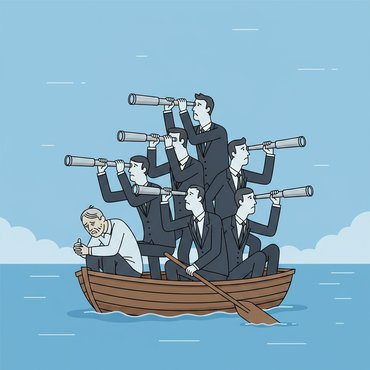
Corporate restructures often solve the wrong problems. Leaders frequently add management layers instead of expanding frontline capacity. One famous corporate parable shows seven supervisors managing a single rower. This top-heavy overhead destroys productivity while burning out frontline workers.
Non-monetary rewards rarely fix deep structural capacity issues. Pushing solo workers harder under extra supervision triggers complete burnout. True organizational efficiency comes from direct operational support over leadership titles. Focus your key resources on the people who do the work.
Key Takeaways:
- Bloated hierarchies reduce frontline productivity by diverting core resources into managerial overhead.
- Non-monetary incentives fail when workers lack the structural capacity to deliver results.
- Reallocate executive funding toward operational roles to improve team execution speeds directly.