How to Leave
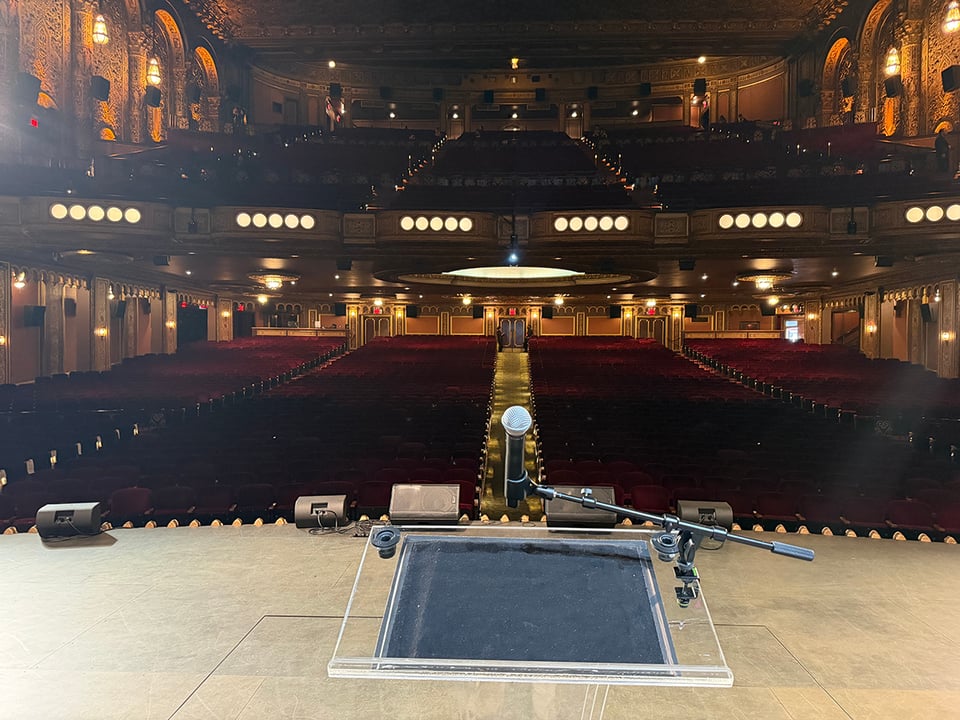
The end of May and the beginning of June mean college and university commencements. New York sidewalks and subway cars fill with graduates in their school’s polyester plumage on their way to ceremonies where they will sit, usually for hours, sometimes in the sun or rain, as a series of speakers laud them and advise about the Real World they are assured they will soon join.
I have become one of these speakers. My current position at my college means that I emcee our commencement — I open the event, provide the first of many welcomes, set the shared table for Why We Are Here Today.
One might think that because the ceremony comes preloaded with its own meaning and emotion, commencement speeches are on the easy side, but they are are deceptively hard to do well. Clichés, always seductive, become sirenesque in the context of a gigantic and familiar rite of passage: “follow your passions” (though you may not have any or have some that threaten to lead you to ruin), “think outside the box”(which box? hard to say), “go outside your comfort zone” (odd given that zones of comfort seem mythological these days). Or, perhaps the phrase most worn smooth from handling: “It’s called ‘commencement’ because it is not an ending but a beginning.” It’s also hard to be funny, especially when the audience spans generations and backgrounds and when so much debt is involved.
True wisdom is rare, and true wisdom memorably woven is a shooting star. Which is why, I think, commencement speakers so often appeal to quotes from others who known for wisdom and craft.
At least that’s what sent me to my favorite books. I’ve tried out a few quotes over the years until I landed on one I like. (Sorry, Marianne Moore; I love “A Carriage from Sweden”, but turns out that you’re too deep of a cut.) Every couple of years I reread Thoreau’s Walden along with Stanley Cavell’s brilliant close reading of it, The Senses of Walden. My last reading overlapped with prepping for our next Commencement, and I lucked into new touch with a way of thinking about the moment when we acknowledge leaving college after finishing.
Walden tells the (supposedly) true story of Thoreau leaving Concord, Massachusetts to build a small house near Walden pond. He spends two years in this house, and then returns to Concord. What sends him into the woods? Thoreau describes his fellow townspeople as “so occupied with the factitious cares and superfluously coarse labors of life that its finer fruits cannot be plucked by them,” as leading lives of “quiet desperation,” preoccupied with gossip, “shams and delusions are esteemed for soundest truths,” ignoring the eternal for the ephemeral. Walden could easily be read, then, as the story of someone (a noted crank) leaving a society that he believes has lost its way, perhaps for good, and to build a new rich, life for himself. He does indeed build a rich life, and the book sparkles with moments of joy, revelations triggered by looking closely at the everyday — the struggles between ant colonies, footprints when snow retreats, ice harvested in the winter to be used in spring.
Understood this way, however, the book becomes a paradox: Why would Thoreau leave the wonderful, fulfilling life he built at Walden and return to an unchanged, still-lost Concord?
Cavell believes that Walden presents a paradox, but a deeper, more interesting one. He writes:
The writer retired to his solitary pond to spend his moulting season. Neither men nor nature told him when to go, when it was upon him; by accident it began on a Fourth of July. Hence he can say, “I left the woods for as good a reason as I went there. Perhaps it seemed to me that I had several more lives to live, and could not spare any more time for that one” (XVII, 4). Of course this is fair warning to those of his readers who will be attracted to his life that they will not find it at his Walden, but must work out their own. … What is definite, or what is to be defined, is that [Thoreau] spent it there, expended it, the whole of it. That was the point of the experiment; not to learn that life at Walden was marvelous, but to learn to leave it. It will make for more crises. One earns one’s life in spending it; only so does one save it. This is the riddle, or you may say the paradox, the book proposes (p. 45).
The college I work at is mainly a commuter school, which means that most students tend to live at home throughout their degrees. Still sleeping in your high school bed while working toward your bachelor’s degree sounds unlike a Walden-style shift. Those able to attend college of any sort go into their own woods, though — like walking out of a long-legged avenue into Central Park until traffic can’t be heard. College is a special time, often difficult and demanding, usually expensive, especially for those who work, are lower-income, or who are first in the families to go. And for the more traditional student, 18-22 is such a wild time, when you must take over the project of selfhood while adulthood walks right in and sits down. Four, five, six years is a long time to devote to something, let alone something difficult. But college also tends to be an incredibly rich experience full of growth, where lifelong friendships bloom, and the responsibilities and vast effort of life generally haven’t yet fully arrived.
Put another way: College is difficult, perplexing, annoying, exhilarating, expensive, special. But ultimately, the point of college is to leave it.
Problem is, we in higher education could do a much better job of teaching students how to leave college. Sure, we lay out milestones and targets — 120 total credits, requirements for completing a major, usually a bunch of general education buckets to fill. We now routinely talks about learning outcomes — teaching students to be good writers, critical thinkers, global citizens, etc. We also tend to talk about student success in terms of retention rates (keeping students enrolled and making progress), graduation rates (how many who start finish on time), prestigious awards, first-destination salaries.
College has become transactional to perhaps most people — admission is a kind of societal sorting, and the credential itself is the point, the true goal, the value proposition. Higher ed has encouraged this perception by responding to doubts about our purpose and value by focusing on satisfying employers — investing in and filling homepages and brochures with coding and STEM while downplaying the Humanities and Social Sciences. This posture is understandable, I suppose, with so many haunted by so much debt.
Cavell says that Thoreau spent the whole of a life at Walden, expended it in the experiment. He did not go into the woods to build a separate life; he went into the woods to determine how one should live, how a new country should be refounded, so that he could leave it to write the story of that life and that re-founding.
I began our commencement this year not by pointing out that it’s called “Commencement” because it represents a new beginning, but rather by reminding students that our college has one last lesson to teach — namely, that they must leave us. But, as Cavell reminds us in his achingly beautiful way, “[o]ne earns one’s life in spending it; only so does one save it.”
We need to teach our students from the moment of their arrival — and we ourselves must remain teachable about — how to leave. Do not dwell on the house you build by the pond but how it can best be built, rebuilt, inhabited, filled. If we have done our job at all well, they will go into our woods, our Central Parks, aware that they are to earn the edifying lives that they can bring back as new stories of the city.
Now go.
-
Beautifully written, as I fully expect when I open your posts. But, I need a little more clarity or evidence or maybe it’s just rhetoric to put me over the edge to fully grasp the message here.
-

Eminently reasonable request, John. Drafting my remarks for my college's commencement ceremony got me to thinking about the common cliche that the ceremony is called "commencement" because it's a beginning and not and ending. Beginning of what? Presumably the rest of your life, or the impossible work of fixing every thing that has been broken, something like that. If we veer to avoid that cliche, we tend to celebrate students' achievement of completing a credential that can get them a good job with a decent salary.
Nothing wrong with getting a good job with a decent salary. But Cavell's understanding of Walden as essentially an attempt to solve a puzzle of leaving made me wonder whether we in high ed help students appreciate what attending, and leaving, college means, how profound of an effort and change it is, and why. College students are imagining and building and trying on whole lives while they study.
I believe that we should help them see, more or less from the beginning, that this building is what they're doing (or should be doing) and that they're doing this building so that when they leave they have a sense of how to build their own life in town — e.g., nurturing deep friendships, remaining alive to hard questions at least some of the time, going to see some art now and then, seeing oneself as embedded in a social context that one has some obligation toward.
How do we in higher ed do a better job of teaching students about leaving? Now THAT'S the truly hard question.
-
Lovely, RM.
-
Thank you, sir. Means a lot.
-
Great topic and one that resonates with me. Leaving is hard. So glad you're helping all of us see the importance of supporting people to do it well.

Add a comment: