
On art and the whole point of money
Or why I'd be a terrible businessperson
When you’re an artist you end up spending a lot of your time thinking about money. How much you do or don’t have, how much more you wish you had, how much your various obligations cost, how much your materials or supplies cost, how much it would take to make your ideas for projects happen, how having just a bit more could sweep away some of the obstacles blocking you from making art, etc.
It’s all very ironic considering that one of the key personality traits of most artists, I think, is a certain disdain for money. It’s very funny to want more of a thing that you think is kind of stupid, to be motivated by something other than money but to be required to make money to do the thing that motivates you, but that’s how it is.
It’s especially sobering when you get deep enough into an artistic career to realize that the ones who “make it” aren’t the ones with the most talent or genius or whatever, but the ones who are able to hang on the longest. “Hanging on” means finding a way to make it work, money-wise, and this is where the career advice out there gets really spotty and unhelpful. A lot of successful artists are the quiet beneficiaries of family wealth, and the rest of us have to make do with day jobs, side hustles, unconventional cocktails of income streams, or convincing strangers on the internet to support us. (Hi, I love you!)
All of this just makes it so galling to watch the world’s most undeserving lottery winners publicly fumble the bag, making it clear to all watching that these people have no idea what money actually is.
A few weeks ago the Washington Post—a newspaper owned by a man who, depending on many feelings the stock market is having on any particular day, is either the richest person in the world or close to it—abruptly laid off enormous swathes of its workforce, eliminating entire news desks. I believe the need for “profitability,” among other things, was vaguely cited. Anne Midgette, former classical music critic for the Post, wrote a little elegy for arts journalism over on her blog. She says:
But art is also a reflection of something beyond the mundane, and something that endures. There’s a lot of mediocre art; a lot of art that won’t outlast the generation for which it was created; and a few pieces, always, that hit something bigger — whether it’s a night at the opera you won’t forget; a book you reread after twenty years; a movie that you play over in your head after you’ve finished watching it. The piece I love may repel you, and someone else may treasure something that leaves us both cold, and that’s part of the beauty of the exercise: simply reaffirming our disparate reactions, asserting the reasons my taste differs from yours, activates parts of our brain that otherwise lie dormant, and illustrates something about what makes us unique, and alive.
It may feel silly to mourn arts journalism—journalists in war zones were fired, for gosh sakes—but every blow to the world of art by lone narcissists with too much money (and therefore too much power) feels like a pointed “screw you” to shared values that run deeper than political or ideological divisions.
I don’t have to tell you how great art is or how necessary art is to a functioning, healthy society—if you’re signed up for a newsletter from an obscure classical pianist, chances are you have general non-negative feelings about art. But I’ll say it anyway: art is expression, it’s critical thinking, it’s boundary-breaking. Above all, art is connection.
If you’ve ever attended a single symphony concert in your life, you know the magic of being in a giant space with a bunch of other people, all marveling at the miracle and emotional resonance of being in the same place at once while something greater than yourself unfolds in all its glory. It is like church for someone creeped out by organized religion (me).
Or if you’ve ever read a book from several hundred years ago written in a different language and been astonished at how clearly and eloquently someone is describing a feeling or social phenomenon you’re experiencing right this very moment (o hai Victor Hugo), you realize how precious and necessary literature is to how we understand the world and ourselves.
And years ago, I was wandering an art museum in London, completely unaware that its galleries were organized by genre (which is why I spent an hour wondering why all the paintings in the place were of Baby Jesus in various states of anatomical correctness), when my eyes locked onto a painting across the room and I had an immediate physiological reaction.
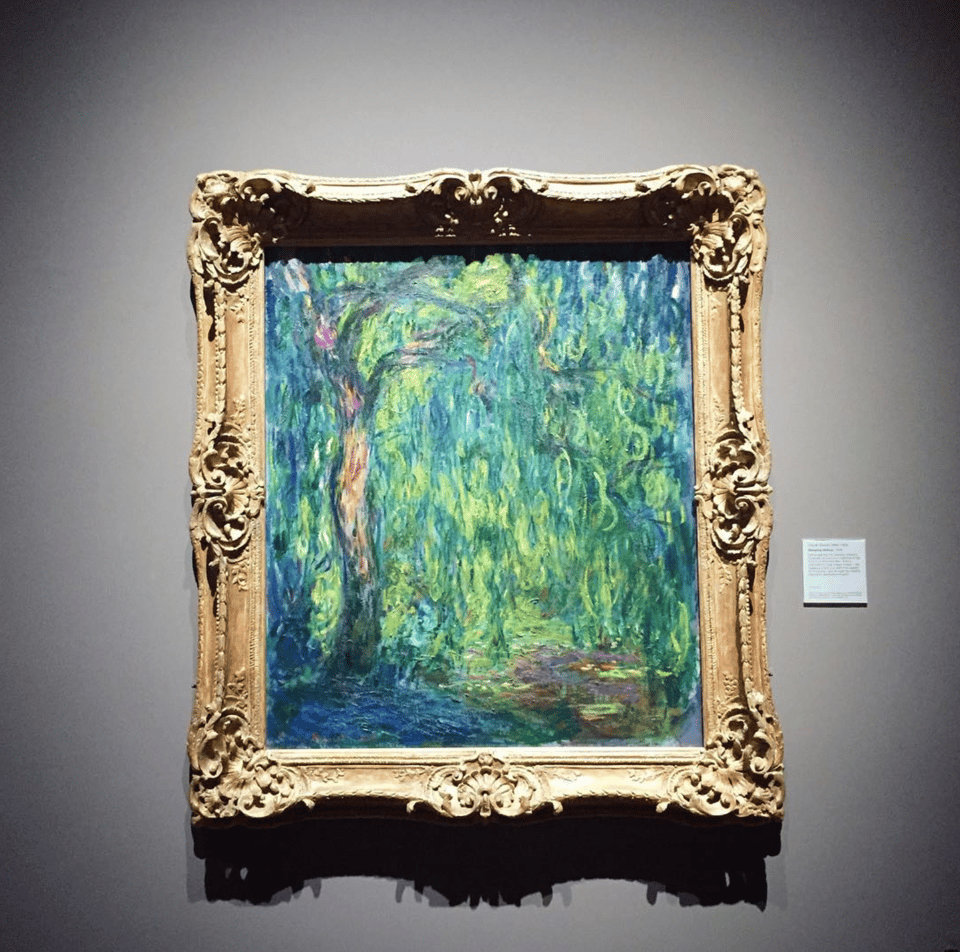
The moment I saw this painting, I felt an inexplicable heaviness in my body, pulling me toward the ground, like someone had suddenly cranked up the dial on Earth’s gravity. I dragged myself closer, looked at the plaque, and discovered that Monet had painted “Weeping Willow” in response to the mass tragedy of the First World War.
I think about Monet’s “Weeping Willow” a lot, especially when people talk about how art is some kind of luxury or frivolity, or, lately, something that AI can spit out in seconds. All this talk devalues art and you can debate the terms of that devaluation all day long, but all I can tell you is what I, a rational non-woo-woo person, experienced: I saw something that a human being channeled their grief into, and without needing words I saw that thing and I received their grief directly into my body. Monet and I communicated, without knowing each other, across space and time and death.
(How much money does time-travel-talking-to-a-dead-guy cost, you think? It’s a fool’s errand to try slapping prices on this kind of thing.)
Every work of art is a chance for connection. And every opportunity for consumption and discussion of said art—whether it’s an arts section in a newspaper or just someone having the means and time to go to a show or museum—is a potential bond for more connection, and in an ideal society we would all be tied together by an infinitely complex web of invisible bonds.
Art connects, and money severs. In The Faraway Nearby, Rebecca Solnit writes:
Before money, [David] Graeber wrote, people didn’t barter but gave and received as needs and goods ebbed and flowed. They thereby incurred the indebtedness that bound them together, and reciprocated slowly, incompletely, in the ongoing transaction that is a community. Money was invented as a way to sever the ties by completing the transactions that never needed to be completed[.] […] Money makes us separate bodies, and maybe it teaches us that we should be separate.
Reading that passage rewired my brain a little. Once you see the molecularly isolating power of money, you can’t unsee it; so often, the exchange of money is a tacit “Thanks, but I don’t owe you anything now.” That’s not to say that I think money and its severances are useless or unnecessary—frankly, I would rather give a sandwich guy $15 for my lunch than owe him a favor—but I think it helps to be aware of money’s potential for social destruction. (I realize that’s a very dramatic way of phrasing it.)
Today I had to run an errand at the recording studio, and on my way there I stopped at a red light under a freeway overpass. A man who had hit hard times—the kind you see everywhere at intersections and under overpasses—stood on the median with a neatly lettered cardboard sign asking for help. With the knowledge that the light could turn at any moment, I frantically pulled a bill out of my wallet and rolled down the window and yelled over the sound of traffic for him to come grab it from me.
I do this often enough—whenever the stars align for me to have cash on hand and a red light—that our brief transaction followed the script it always does. He was polite and immensely thankful, and wished me a good day.
Not in the written script: he lit up in the specific way that a person only lights up when they think they’ve been overlooked and then someone sees them. This is the part that always fills me with both joy and despair. It is always soul-affirming, no matter which side of the transaction you’re on, to know that another person cares. It is also soul-crushing to see how few people display that care to others.
I know none of this money will solve whatever root problem has caused someone to be reduced to standing at an intersection with a cardboard sign, begging strangers for spare change. I don’t know what the money will be spent on, and I don’t care. As far as I’m concerned, the thing I’ve bought is a brief flicker of knowledge for someone else that a stranger sees you and cares for you, which I consider an intangible thing far more precious than money itself. Whenever I’ve experienced a random act of kindness from a stranger, it’s felt like a brief illumination of how beautiful society really is—the immediate knowledge that people in the world are looking out for each other, that there are so many invisible connections between us waiting to be struck—and for a moment it makes the world feel special and holy. If I can give that feeling to someone else for a moment, whatever dollar amount I've just given away is completely worth it.
And that’s the thing I think rich assholes have forgotten about money, if they ever learned it in the first place. You can turn money into something far more precious that actively makes the world a better place, and that’s a wonderful power. You can scatter your money and watch it bloom into a million priceless things. Or you can use money to wall yourself up, as so many choose to do, isolating yourself from the world, and using your money to demand that good things be destroyed because they don't make enough money.
In one of her many blog posts about SF Symphony management skullduggery, Emily Hogstad wrote,
I once heard Kevin Smith, the beloved CEO who oversaw the post-lockout recovery of the Minnesota Orchestra, say something along the lines of, it’s an orchestra’s job to lose money. The function that an orchestra serves in society is to convert dollars into intangible benefits for a community that are otherwise very difficult or outright impossible to access or assign a dollar value to. A major orchestra is a kind of magical currency converter.
Some of the best things in the world are not supposed to make money, because they make something better than money. I don’t think libraries, schools, symphonies, museums, theaters—or anything that provides communal good and human connection, like, say, journalism or the postal service—should be evaluated by how much money they make, because that’s not why they exist. To me—and I realize this is why I will never be in even remote danger of becoming a billionaire—that is the whole point of having heaps of money: so you can funnel it into things that turn those heaps of money into something even better. Anything less is intellectual bankruptcy.
I’m never going to live in a world where I can make art without seeing all the invisible price tags dangling at me in the process, and I’m cool with that. What I would like is for people to push back on the idea that profitability is some kind of objective yardstick for measuring the value of things that generate intangible benefits that are not money. This isn’t even about the Washington Post, or Mackenzie Scott’s ex. It’s about how anyone who engages with art (so, everyone) can think about what really gives things their value.
I’m very tired of what feels like a societal consensus that anything that provides a public good is a failure if it doesn’t make heaps of money. I don’t think institutions (symphonies, newsrooms, nations) should be “run like a business.” When organizations treat the public as customers to bleed and donors as shareholders to appease and artists as machinery that should be maintained as cheaply as possible, they’re letting money sever the connections that their art is supposed to strengthen.
Money and art don’t have to be mutually exclusive. Money severs, but only if we let it.
Hugoposting
My chapter posts on Les Misérables since the last newsletter:
Book 5
Book 6
Book 7
-
1,000,000,000,000 times yes.
-
Thank you so much for this. All the things that need saying in such an authentic and relatable way. We are not “not for profit”…we create community and social capital that cannot be quantified.
-
Eons ago the Royal Academy of Arts in London had an extremely dodgy exhibit called 'Art of the Ancient World' (dodgy because it was pretty clear from the labels that most of the art was picked up on the black market with markers like 'found somewhere near the Black Sea' etc). I think I spent something like six hours walking around that exhibit, and one painting in particular was 2600 years old and looked like it was done yesterday. The humanity behind the expression was so human. It was like on a deep level you felt you could see what the artist was trying to do. There's only been a few times I've felt like this about art, that deep connection, but I remember every single one.


Add a comment: