
Hi and welcome back to “Trust the Process”. The weekly newsletter where I share my own progress over the week and interesting links I found along the way.
After my marathon last Sunday (if you’re interested in that, I wrote about it in detail in my latest post on my blog), I was off work this week. While I tried to take things slow for recovery and still had to finish a few things for uni, I could also invest a bit more time into Morgenblau.
Process
As I wrote in last week’s issue, one of my goals for this week was to finally get a proper landing page for Morgenblau ready. While it’s technically not up and running just yet, I still did make a lot of progress.
I mentioned in previous issues that one of the hardest things about marketing such a product is to position it right.
For now, I identified three target audiences:
- Non-technical (e.g. doesn’t know what RSS is) but burnt out from algorithmic social media feeds
- Already an RSS user but their current reader is maybe not working that well for them (e.g. stressed out by unread counts, no newsletter support, no proper YouTube support, …)
- ATProto nerds who might already use a reader built on the protocol, like Skyreader
To explain Morgenblau to each of these audiences, you have to start at a different point. Later down the road, they will have different landing pages, but for now, I decided to mainly focus on the non-technical group.
Structuring the initial simple landing page around their needs and forcing myself to explain the product from first principles is a good starting point, I think. When the time comes, creating dedicated landing pages for more technical audiences will be easier based on that foundation.
I also read the short essay “Marketing Is an Argument” by Billy Broas this week, which resonated with me. It pushes a narrative that “marketing” doesn’t have to be this thing that feels gross and sleazy. And that always makes you have the feeling that it’s just to sell you something (that you might not even need).
Instead, it flips the script and proposes a worldview consisting of three axioms:
- Humans possess inherent dignity
- Persuasion is argument, not manipulation
- Belief is built through Five Lightbulbs
These Five Lightbulbs, five beliefs the customer needs to have about your product, are:
- “They get me.”
- “The usual ways fall short.”
- “This approach is different, and right for you.”
- “I trust them to deliver it.”
- “That’s the future I actually want.”
In short, you’re not pushing a sale no matter what. You’re just educating them on your approach to solving their specific problem, and you trust in the customer’s ability to come to their own conclusion about whether your product brings value to them or not.
At its best, marketing is a good, true, and beautiful argument.
Through that lens, I started working on a first rough structure of the landing page. The text is mostly a placeholder for now that still has to be rewritten.
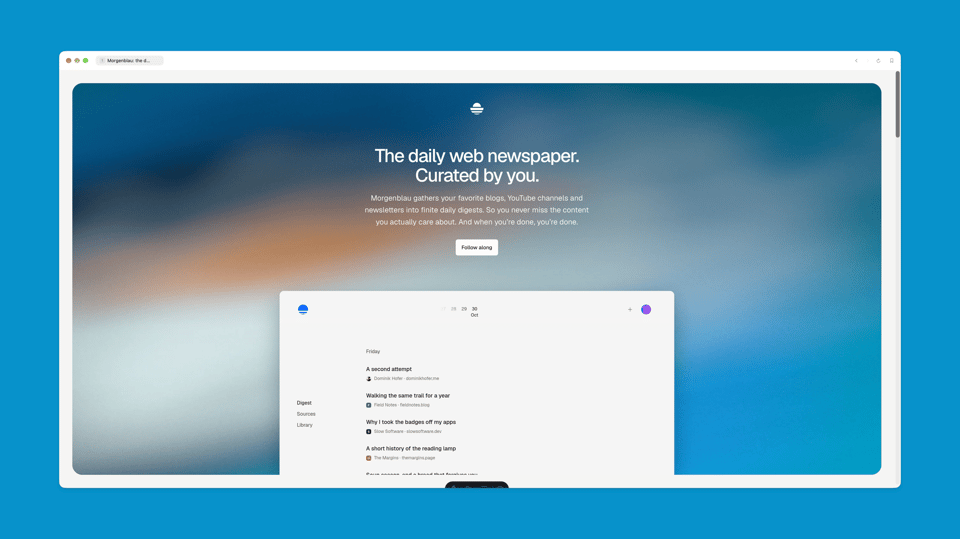
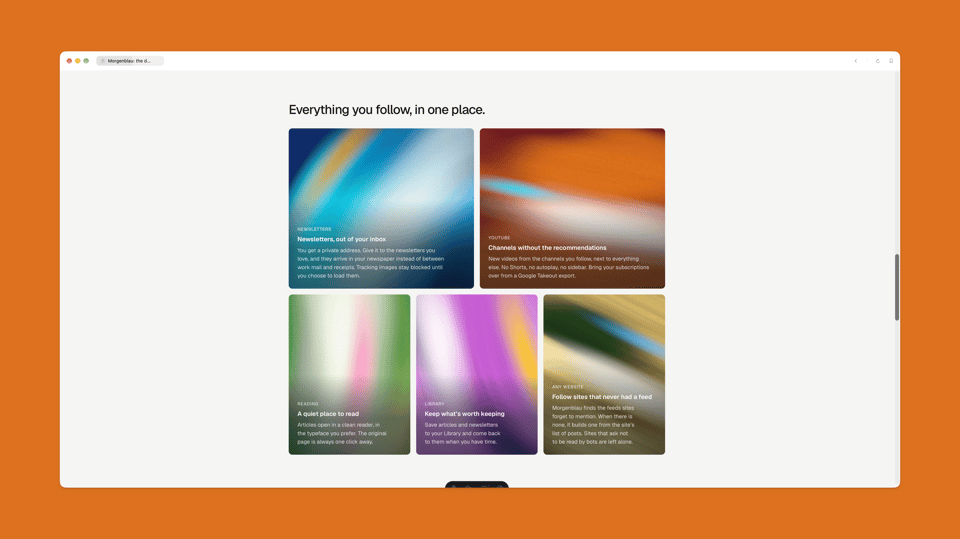
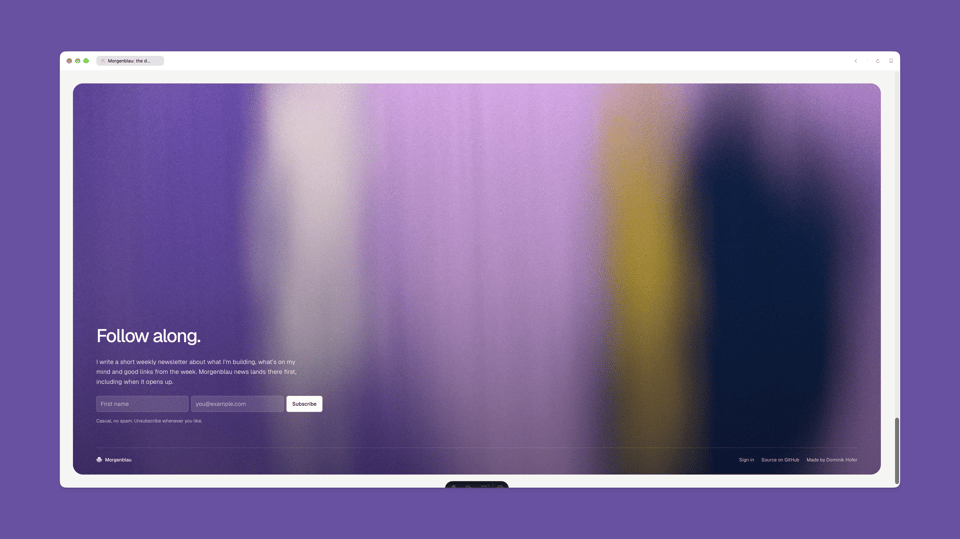
Part of the landing page are these blurry, programmatically generated abstract visuals. I already made a first attempt to create that visual style a couple of months back, but only now do I feel like I found the style that I actually like.
The premise of Morgenblau is that it’s a very calm, “in the background” kind of app that lets the content within shine. Because we don’t really have real content (as in blog posts, videos, etc.) on the landing page or the marketing material in general, I like these abstract visuals as placeholders and metaphors. They also have this dreamy look, kind of like when you’re sitting on a train and watching nature flow outside the window. The exact scenario I imagine a user being in when they open up Morgenblau on their device.
And I just think they look beautiful :)
Because the visuals are generated in code, I created a little tool that allows me to quickly generate lots of variants and pick the best ones. I’m also thinking about building an endpoint so we can generate these images on the fly within the app for posts that don’t have a main visual.
You can check out that tool here.
Other updates on Morgenblau for this week:
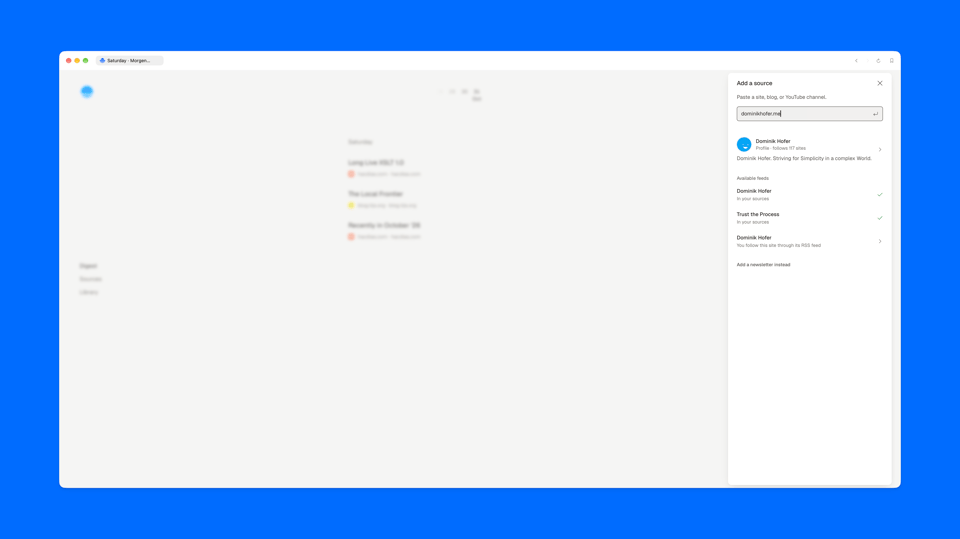
The flow for adding a new source is now way better. Instead of a cramped modal, everything happens in a side sheet. This allows for a whole lot of improvements over the previous design:
- Preview a feed’s latest posts before following
- Tag sources and mark them as primary directly in the sheet
- SocialSpec integration, so personal websites have their own little profile (if a site implements it)
Just to name a few. Here is a look:
YouTube sources now have an option so that Shorts are automatically excluded. What a blessing, let me tell you!
And when you mark a source as “primary”, it now gets special treatment and is always at the top of a digest, so you never miss your favorites:
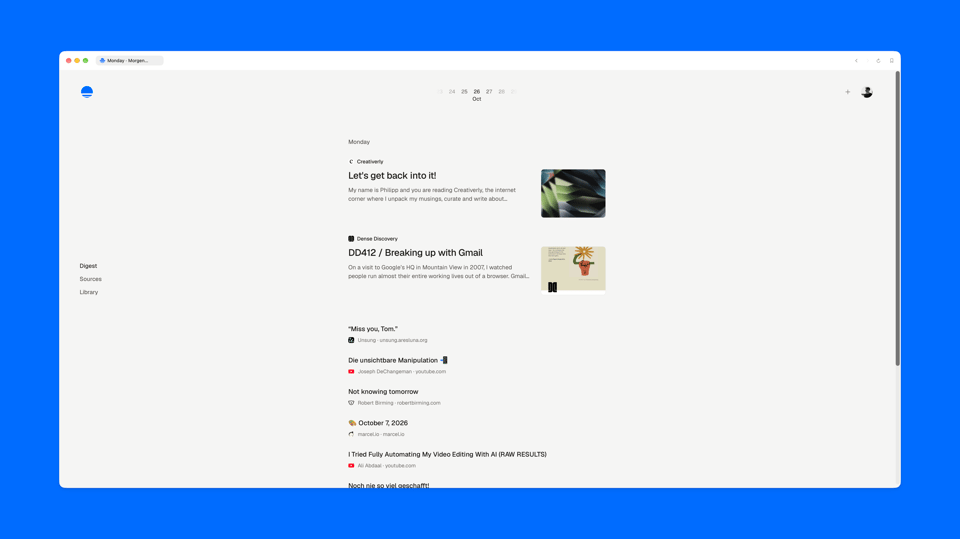
As a short closing note to this section: two people already reached out to get a first glimpse of Morgenblau and use it themselves (thank you!). If you also want to do that, just hit reply :)
Finds
Cool things I discovered this week:
- Marketing Is an Argument: The essay mentioned above, highly recommend reading it!
- Brand is who you are: Goes into a similar direction: a brand is way more than just fancy visuals.
- You could do it alone: Why collaboration with others is still a great idea, even in an age when it’s easier than ever to do everything alone.
- This website is written and built with Linear: And a third one from the same blog, but a really interesting use case for Linear (it’s the CEO of Linear doing it, so not that surprising).
- Design as a garden: Doing creative work has many parallels to tending to a garden.
- Introducing Geist Serif: The Geist font family got a new addition and now supports all styles you could wish for.
- How to be more ambitious: A tutorial for humans with models: Three concrete ways to be more ambitious with your work when you’re using frontier LLMs.
- Fast · Patrick Collison: This was mentioned in the blog post above, a really interesting collection of examples where great work was done fast.
- “Wherever you get your podcasts” is a radical statement. - Anil Dash: An all-time classic and proof that open formats on the web are always beneficial for consumers.
- The case against conversational interfaces: This post is already over a year old, and it’s interesting to see where we already started moving in the direction the article proposes (e.g. agents as meta layers that plug into different products) and where we are still stuck (looking at you, chat interface).
- Hex: local voice dictation: Another local voice dictation tool, but one of the more polished ones I’ve seen.
From the blog
This week I published:
- A second attempt: Learnings from running another marathon.
That’s it for this issue. Thanks for sticking around! If you have any questions, feedback, or just want to say hi, reply to this email and it will land straight in my inbox.
Until the next one,
Dominik
You just read issue #7 of Trust the Process. You can also browse the full archives of this newsletter.
Add a comment: