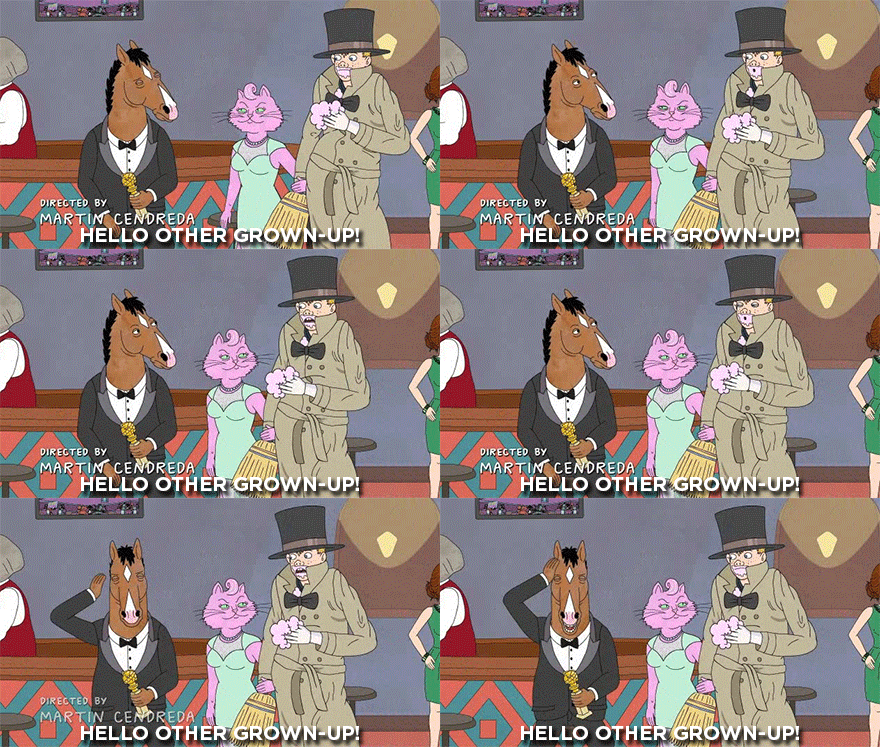
Have you seen BoJack Horseman? Do you remember Vincent Adultman?
The character is literally three kids in a trench coat, serving as comic relief as he struggles to shake hands (his arm is a broom) or smears chocolate all over his face. It’s a classic example of dramatic irony: to the audience, his performance of adulthood is entirely unconvincing, but the characters around him fail to notice.
Last week, I got duped (I guess?) by a real-life Vincent Adultman: a “nonprofit” run by middle schoolers and AI.
I’ve been thinking about generative AI since 2019, when I started working on a dissertation chapter about GPT-3. I also grew up in Silicon Valley in the 2000s, engulfed in a fog of tech hype that, by the time I left, I could see through.
The “entrepreneur” hype of yesterday has been replaced in 2026 by what I’m calling “founder culture.” On platforms like LinkedIn and even Instagram it seems like everyone is founding something. Even coffee shop owners are calling themselves “founders” now. Google Trends reports searches for “founder” are up 90% over last year.
Do all these founders ever stop to ask if people actually need or want the new product they’re building? In 2026, they don’t really need to. Generative AI makes it easier than ever to build and market new products, while the enormous amount of money flowing through venture capital incentivizes starting new tech companies, even if they never make a profit.
Hannah Einbander’s character in Hacks (s5e6, 2026) gets it right when she tells one such founder — appropriately clad in a Patagonia sweater — “People like you always say ‘this is happening whether you like it or not.’ But aren’t you the one making it happen? And you could easily not if we all said we didn’t want it? But you don’t want to give us the choice!”
She continues, “Why should we believe that this app is this inevitable thing that will change the world? You’re the one who stands to get rich from it, so OF COURSE you’re gonna tell me it’s amazing and happening no matter what!!”
The founder in Hacks doesn’t have a strong defense. He tries, unsuccessfully, to reassure Ava (and the show’s audience) that his AI comedy writing tool will live up to his promises.
When I talk to people who have yet to emerge from the AI hype ‘fog of war,’ like this fictional founder, it’s clear that on some level they believe what they’re saying. They think AI will live up to its promise, freeing us from the work we don’t want to have to do.1 Or, they think it’s inevitable, that someone will build it if they don’t or that they don’t have the agency to stop something with so much power and money behind it.
Dramatic irony, once again. The general public sees AI for the Vincent Adultman that it is, while tech and business leaders either talk up its apocalyptic power or its utility. The depth of this disconnect creates some weird situations.
the set up
Using a (legitimate) platform that connects volunteers to organizations needing assistance, I signed up to help a nonprofit write a strategic plan. I figured I could help facilitate some ideation workshops, conduct some interviews with volunteers and staff, and turn that into concrete, actionable recommendations to help them achieve their vision for the future of the organization.
To be clear, that’s A LOT of work to do for free. I’m currently navigating a brutal job market, transitioning out of academia after earning my PhD. This seemed like an opportunity to build my portfolio, demonstrating the value I can bring while helping an organization trying to do good in the world.
What could go wrong?
I skimmed the organization’s website. It was basic, with badly written copy, but it looked too ugly to be AI. The website said it was a student-run organization collecting and distributing donations of clothes, food, and basic essentials.
I received an from the “Executive Director” that was clearly written with AI. That seemed odd, given the degree of oversight and engagement they were asking of us. But, I figured, there are certainly nonprofit leaders out there using AI to draft project plans and communicate with volunteers. I was still willing to give them the benefit of the doubt.
They shared the results of two surveys they’d conducted with staff and volunteers with us. As I looked at the data, I got more and more confused.
the data
Each survey had less than 10 responses. Among other things, they asked the staff to describe their vision for the organization in 2029, and the very first response read:
“from the outside we look like cool kids, from the inside were just 13 and 14 year olds trying to make an impact and get donations”
I did a double-take. I’d assumed that “student-driven” meant college or high school students, or at least adult supervision. Was this literally “just 13 and 14 year olds”?
I looked at the AI-generated emails with a more skeptical eye. I typed the names of all the staff they’d given us into Google, but none of the names I tried had an online presence.
Except, that is, for the two names of staff members at a middle school in Southern California, in the same region this nonprofit organization was purportedly based. Okay, you might be thinking, this must be a school project or club. Here’s the thing, though. One of the survey responses suggested that one thing they could do to improve was to “stop sending emails from [the name of the Vice Principal]. she’s scary”
Now I’m concerned they’re impersonating people, which I can see middle schoolers doing as a joke, but definitely could be seen as fraudulent.
My best guess is that this is a group of middle schoolers trying to found a nonprofit to look good on college applications.
the punchline
(I know, I know, irony doesn’t have a punchline…)
I signed up to help them write a strategic plan, a process that requires uncovering (actual) motivations, goals, and experiences. It requires honesty and transparency.
The middle schoolers’ website says their organization is funded by Hack Club, a nonprofit that exists to fund student hackathons and coding clubs (with help from Elon Musk, whose 6 donations total between 5-10 million dollars).
The tenets of the Hack Club philosophy put what I’ve started calling “founder culture” into words, including “coding is a superpower,” “there’s never been a better time for making” and, most tellingly,
“Start building: Most coding classes teach you programming concepts instead of how to write real code. It's like trying to learn carpentry without any wood. So at Hack Club, you learn to code entirely through building things. You start with no experience and build and ship a project every meeting.”
Building and shipping a project every meeting reveals a real lack of care, intention, and strategy, all of which take time to develop.
Having taught college courses for several years, I know something about pedagogy and how we learn. Learning by doing is a thing, but it can’t substitute entirely for learning from experts.
To be clear, middle schoolers can absolutely start nonprofits. And learning by doing is an important part of being human. But I don’t believe using AI to build and ship “products” in a few hours is teaching them what they need to know to succeed, even within the tech bubble.
Even 5 years ago, in a pre-AI era, my college students would struggle to figure out how to come up with an idea for a project. Learning to brainstorm, to evaluate your own ideas, and to decide what is worth pursuing is a critical skill, all the more so today.
So here’s my strategic plan for these kids:
Be honest with yourself. Why are you doing this? Is it to help people in your community? To get into college? To hang out with your friends? These are all perfectly valid reasons.
You’ve identified your motivations. Those motivations should drive your goals. What would it look like if you succeeded: at helping people? at getting into college? at hanging out with friends? Paint a picture for yourself.
Now ask yourself, and talk to other people you trust: What are some different ways you could go about reaching that goal? What are the pros and cons of each? It probably doesn’t look like starting a club with your friends and using AI to pose as adults and get professionals to come up with a strategic plan for you.
If you want to get into college, maybe your plan looks like figuring out something you’re passionate about, getting the best grades you can, and studying for standardized tests. If you want to hang out with friends, maybe it does look like setting up a club or finding an activity you can all do together.
Finally, if you actually want to help people in your community, you’ll be able to make a bigger difference if you work with existing organizations in your community. I’m certain there are people collecting and distributing donations to families in need. You’d learn a lot more from observing their operational protocols, watching them make strategic decisions, and maybe even gaining a mentor or two.
Building things for the sake of building things is only strategic in the short term (and only if all you care about is venture capital money).
And keep an eye on your kids. Living in the midst of this dramatic irony is confusing, even for those of us with fully developed brains. None of us should have to live in a world bereft of critical thinking, curiosity, and care.
Thanks for sticking with me! Not all my newsletters will be this long. This just seemed like a story I needed to tell.
Neda Atanasoski and Kalindi Vora’s Surrogate Humanity: Race, Robots, and the Politics of Technological Futures (2022) shows how this promise of a future without labor is predetermined by “prior racial and gendered imaginaries of what kind of tasks separate the human from the less-than or not-quite human other” (4). ↩
You just read issue #2 of Divergent Thoughts. You can also browse the full archives of this newsletter.
