
Distillations/Constellations #13: dinner parties and information ecosystems
On epistemic security, and hosting dinners as political actions.
This week, a great report on Epistemic Security for Crisis Resilience was released by the Epistemic Security network over at Demos, a UK-based think tank.
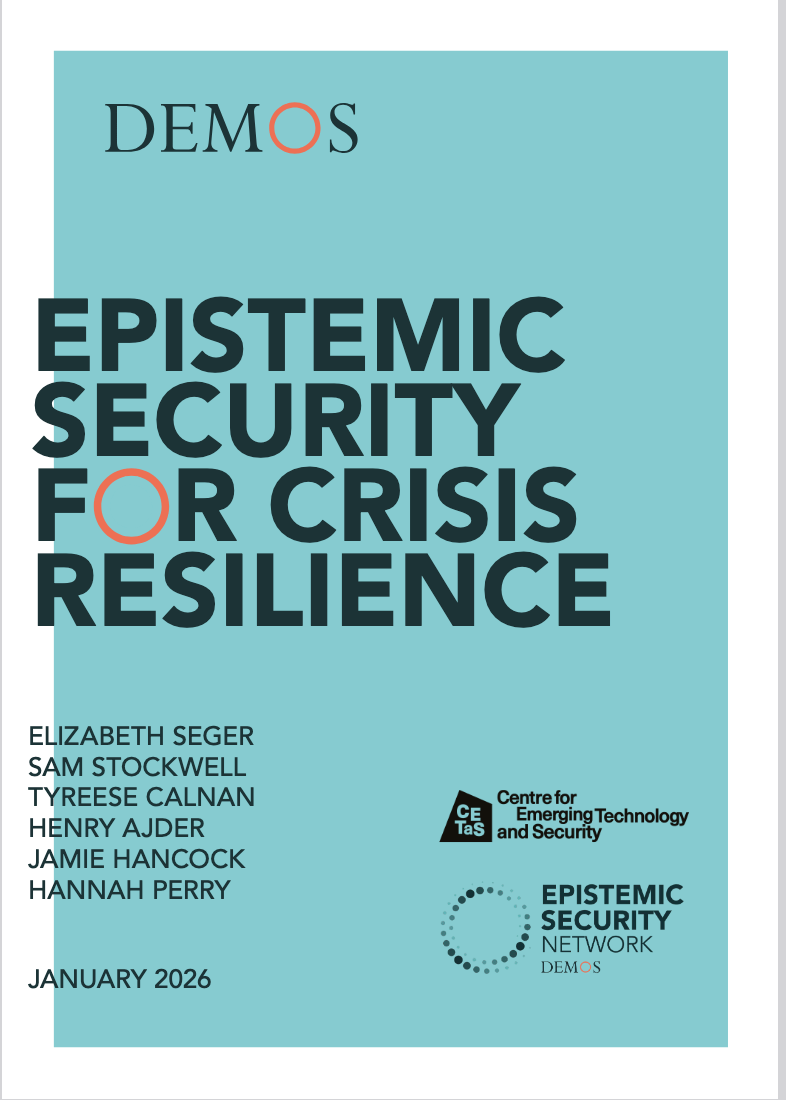
It caught my eye for a number of reasons. First, the term epistemic security was new to me –epistemic, meaning relating to knowledge, and the full term being used to refer to “keeping knowledge safe” – against attacks, dis/misinformation, and more. Knowledge being under threat is, of course, not new – propaganda has long been a tool of authoritarian (and, cough, “democratic”) states, but as the paper explains, digitisation makes those threats easier and faster.
Second, because it’s a great example of foresight work which makes connections across different spaces. The paper refers to some work they completed in 2018 that used scenario planning to come up with ‘critical points of epistemic vulnerability and threat’. One of those scenarios (from 2018) was, would you believe it, a global health pandemic with speculation about the origin, much disinformation, and as a result, increased burden on health services. Sounds… familiar, eh?
This time round, in the research leading to the just-released report, they used a similar methodology – development of crisis scenarios, red-teaming, and identifying areas for intervention.
I used to think about red-teaming a lot, while working on responsible data policies – it’s a practice I first learned about in the context of cybersecurity, where an assigned group tries to think like an attacker in order to identify weaknesses or vulnerabilities of a digital system, organisation or company. It’s often organised by or paid by people responsible for addressing those vulnerabilities, as a way of testing their own defenses before an actual adversary has a chance to. In the responsible data sense, we would think about things like: the absolute worst case scenario for a sensitive data set, and how to mitigate against that happening (spoiler: don’t collect the data in the first place!); or how seemingly non-sensitive data could be combined with other data sources, to make it into something that should be treated with care.
Anyway, back to the report: their findings identify cross-cutting intervention areas that are, obviously, written for government and policymakers, all of which make a lot of sense. Things like building information infrastructure; having crisis protocols for social media platforms; crisis preparedness, and (here’s a big one) rebuilding local and regional news ecosystems.
Incidentally, I’d also be curious what more blue-sky thinking in this space might look like – almost the opposite of red-teaming, taking a realistic but utopian approach, where everything that could’ve been done to address this issue has been done. I wonder what those scenarios might look like, and whether that approach might identify different areas of intervention.
As I was reading the paper, I was reminded of this post by Amanda Litman (the co-founder and president of Run for Something, which recruits young progressives running for office in the US), on her family’s decision to host people for dinner every Saturday for an entire year. She wrote a Q&A about it here, and these lines in particular caught my eye:
I might go so far as to say that having dinner with friends 52 weekends in a row is the most political thing I did in 2025.
I don’t say that lightly. I’m a professional political operative! I spend most of my waking hours recruiting and supporting candidates for office and even outside of my work, I voted in two elections (thanks NYC!), donated money to campaigns and causes I believed in, subscribe to lots of local and independent media, and participate in political discourse.
Hosting dinner regularly as the most political action in a year like 2025, for a person who literally works in improving politics, is quite the statement.
In relation to the epistemic security paper, it seems obvious to me that strengthening our social fabric, the connective tissue between us, would also contribute to increasing epistemic security on a societal level. If people aren’t feeling lonely; if people feel like they belong, instead of like they’re othered; if more bridges are built so that people are in touch with those who are perceived as “different” – they’re less likely to be radicalised, or to fall for disinformation, or to distrust their neighbours. (If you want to learn more about those last two points, check out the amazing Othering & Belonging Institute at Berkeley.)
When I was writing the conclusion of my book, I struggled to come to a really actionable solution, because what I really wanted to say was: the binary nature of digitisation and digital data only serves to pull us further apart, instead of bringing us together. I struggled to suggest really concrete actions given the huge nature of that problem, but particularly in a time of politics and news fatigue, hosting regularly dinners is (in part depending on your life situation) a really accessible thing that addresses this problem, too.
It also strikes me that in many cultures, having multiple people over for dinner regularly is so much part of society that it’s not even considered a noteworthy thing. Yet one more way in which individualised European/US-ian cultures are far behind more collective-focused societies across the continents of Africa, Asia or Latin America.
So here’s to having more people over, more often. Embrace deep casual hosting, or maybe just continue doing it :-)
Links from around the web
A second report was released by Demos this week and is sure to be fantastic – Our BBC: A blueprint for a more independent and future-proofed BBC – written by Sameer Padania, Hannah Perry and Polly Curtis. From first glance, it seems like this is at least in part some of that blue-sky thinking I mention above!
In the EU digital rights space, ‘digital sovereignty’ is everywhere. This interview with Cristina Fallarás talks about feminist digital sovereignty.
If keeping up with protests, petitions or actions against deportations is something you’re interested in (and you haven’t departed from Meta-owned social media yet – I’m on my way out!) – Equinox and others just launched their Instagram-based comms hub called @WeKeep_UsSafe, where they’ll repost and reshare actions against raids and deportations all in one place.
The academic papers I’m appreciating at the moment: Survival of the queerest: queer survival and future possibilities by Laurène Cheilan, and The silicon gaze: A typology of biases and inequality in LLMs through the lens of place, by Francisco W. Kerche, Matthew Zook, and Mark Graham.
If you’re in the UK and part of an under-represented group, the BBC’s 50:50 project has an open call for conributors. Seems like a great way to increase diversity of perspectives and voices in the media.
After a few years of neglect, I’m trying to rebuild my feed reader. If you’re an RSS person, I’d love recommendations on good RSS feeds to follow! (And you can of course add this newsletter to your RSS feed here - yet another reason I really enjoy using Buttondown for my newsletter.)

Add a comment: