
Distillations/Constellations #11: the unknowable
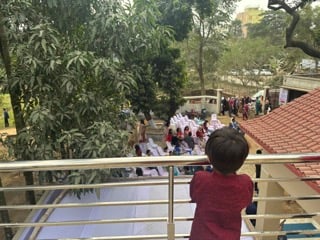
Almost exactly a year ago, I was standing in my ancestral home in Bangladesh, along with nearly 400 relatives, for a family gathering of epic proportions. The place we were in used to be a village in the countryside outside of Dhaka, and now, thanks to the spread of the massive capital city, more resembles a smaller town towards the edge of the city. It was a strange feeling to look around and know that everyone within sight was in some way related to me, by blood or by marriage, even though I’d only ever met a handful before. I soon realised that the easiest way to introduce myself was as “Rina’s daughter” because my mum is the node connecting me to everyone there. Everything was (is) relational, just saying “Zara” didn’t mean anything, really.
Family members had put up a huge family tree on the wall, going back five generations. So many stories were told, and it was pretty incredible to be there, and to introduce my children to the place that their great-great grandfather and his family used to live. Food was provided (so much food!) and there was an assumed sharing of responsibilities, from children running around together, bigger ones looking after my little ones, to making sure elder family members had what they needed. Though that shared responsibility doesn’t negate the huge amount of work a committee of cousins put in to making sure the day ran smoothly!
So much of what I learned and experienced that day is nowhere online, and never will be. It’s only through oral stories, physical sight and touch, the feeling of being there with so many people, that knowledge was shared.
I’ve been thinking about that experience – of what can be digitised, archived and shared, and what can’t, in preparation for an upcoming workshop. In a couple of weeks, we at SUPERRR Lab are organising a series of events at a library here in Berlin, and together with Frederike Kaltheuner, on January 28th I’ll be talking about “What AI can never know about us”.
I wasn’t thinking about AI at all when I wrote my book, but the basic premise applies: digital data is a flattening of our identities, a way of making ourselves and our worlds legible to machines. There’s so much that doesn’t fit in that. All that AI does is draw patterns between existing digital data, in order to make predictions of the future. But that future is built on the assumption that what we want is more of what has come so far, and if we look around at the world today, I think it’s quite clear for many that we need some drastic changes. That future is not the one we want.
We can’t assume that just because a certain set of knowledge is digitised and legible by machines, it’s in some way superior to the knowledge that cannot be known by machines. And while I write that, I also can’t deny that the ease granted by generative AI of being able to access more (even if imperfect) knowledge, is clearly popular with huge numbers of people.
As people rely more and more upon generative AI in particular to do knowledge work (sometimes to the detriment of the work itself…), provide vital health information and more – it seemed necessary, as a feminist tech organisation, to create more entry points for the public to talk about AI in a non-judgemental space.
I’m curious to hear from people about what they’re using AI for, and what the driving factors behind that use are.
Links from around the web
I published my 2025 book round up – lots of recommendations there for books, if you’re looking!
I loved this 39c3 talk by Kate Sim, on ‘child safety, privacy and healing together’ – the reality check she gives on what the actual threats are facing children today, and the work we must do to properly address them, is incredibly important.
This piece in The Cut by Kathryn Jezer-Morton, on ‘friction-maxxing’ has been going around my group chats and I really appreciated the perspective. (Also in relation to what I write above: sometimes ‘ease’ isn’t what we want to optimise for.)
I have a secret love of reading niche and random academic papers and dissertations, mostly from spaces I know relatively little about. Last week, I went to a workshop at Kings’s College, and in preparation I read this paper by the workshop organisers on ‘Using archival versions of apps to understand emerging digital ecosystems’ –and I thoroughly appreciated the examinination of how geopolitical power moves by looking at URLs that are hard-coded in the source code of apps.
What niche academic article should I read next? Recommendations welcome!

Add a comment: