Screen Screams and Market-Share Dreams
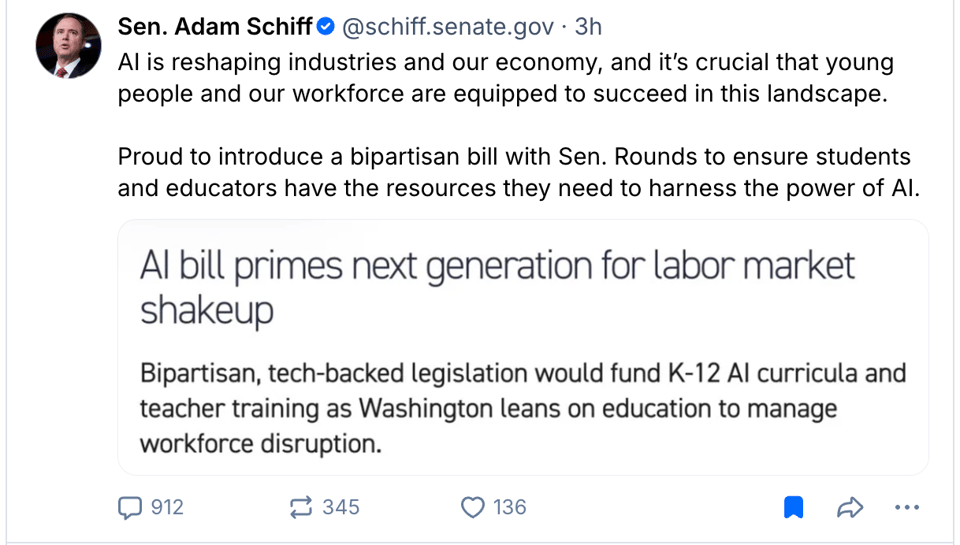
“AI is reshaping industries and our economy, and it’s crucial that young people and our workforce are equipped to succeed in this landscape. Proud to introduce a bipartisan bill with Sen. Rounds to ensure students and educators have the resources they need to harness the power of AI.”
My heart goes out to Senator Schiff in this trying time. I am not without sympathy for his position, chained as he is to an inner tube in the water park of tech trends. There are whitecaps forming on the lazy river, and he’s just trying to hold on. California contains both the concentrated mass of tech companies bent on scaling AI into every aspect of work and life, and the US entertainment industry’s most visible administrative infrastructure. The munitions factories and one of the easiest-to-understand battlegrounds right next door to one another. His position is impossible, yet his conclusions are untenable.
That the legislation is “tech-backed” should tell us all we need to know. Nothing, absolutely nothing that the government does in response to the pumping and dumping of consumer-facing AI tools and “agents” into our society and workforce should give the tech companies pleasure. The tech companies should be locked in pitched battle for every scrap of resource and every penny of public money they can wrest free, forced to account for their bloated marketing language and the biases and disasters that are being found in their code outputs every day. There should be an immediate rollout of an FDA-style agency specifically for handling industry-wide and end-user-facing instances of AI perniciousness. The tech companies should have no business writing legislation designed to respond to the effects of their shambling horrors. Business is their major stake in it, though. They are only interested in propping up their market share as long as possible. What better way to make their products seem inevitable than to “back” the spending of imperial tonnes of public money in the supposed effort to mitigate the damage they are causing and will continue to cause?
Following that little thought experiment through, I ask: how exactly are workers and students going to have access to AIs to train on? Oh! Oh! I know! Massive government contracts with the tech companies, of course! That’s going to make the market happy. But further, how are vast numbers of workers and students supposed to respond to suites of products that are constantly being changed on the back end to suit the whims of corporate overlords high on their own supply? These programs are not static in the way that even operating systems are static. (And we all know how frustrating updates to those are! Every time!)
The very structure of how these programs are designed to keep people engaged makes them necessarily unstable to negotiate with. And it is a negotiation. Just because one side is uncaring, unfeeling, and unthinking does not mean that we can’t judge its utterances on their merits. It is uttering. I have watched someone extract a desired result from ChatGPT and it felt a little bit like witnessing my friend attempt to secure the release of hostages from an incompetent, yet smug kidnapper. Clarice Starling maneuvering against Hannibal Lecter for information in The Silence of the Lambs wasn’t supposed to be a pedagogical exercise for the masses.
And—AI is reshaping nothing. How people in positions of power are deploying AI is reshaping things. These bestriding colossi imagine they hold the hammerest hammer to ever hammer as they gaze out over us, each and every one a juicy little nail. AI itself is the ultimate expression of the passive voice. It has no agency, except that it frequently behaves as if it does. It has no malicious intent, except that its outputs have malicious outcomes. GenAI agents have no mens rea, and in that way they are considered to be perpetual naïfs. But that, itself, serves the uses of their overlords, doesn’t it? An “agent” with no agency. A mere statistically motivated ticker-tape machine, not answerable to any entity legally, or any person ethically. Do I have to duct-tape people to a chair and force them to watch Snow White again? Even when magic mirrors tell the truth it drives their interlocutors mad, and these mirrors are incapable of assessing such trivial human concepts as truth and lies. Generative AI can only generate what has been stolen for it, after all. It cannot evaluate, no matter how it is framed as being able to.
We are asked to accept the premises and promises of AI as if they are the same. And yes, there are defensible use cases for the technology itself. Targeted searching of large datasets, reference work, pattern recognition, okay! But those uses require a problem-haver with expertise. And expertise is the thing that is being hacked away at by the wide adoption of these programs in the first place. If any of the people in charge of the rollout were being thoughtful or measured or living up to their responsibilities as wielders of tremendous power and influence, maybe I would, y’know, care to explore more nuanced uses and issues with those uses. Instead, the corporate overlords each seeking to possess a fleet of superyachts are competitively profit-seeking and people are dying, as if it is a responsibility to the shareholders that clean water become an ever more luxurious commodity.
We are told to sweep any and all reasonable concerns away under the rug, not to be a “naysayer” or somehow too stuffy or set in one’s ways, as if asking industry leaders or even industry followers to defend their thought processes is an insult. And I think it must feel like one if you’ve been talking to Chat or Claude all day, getting your brain laved hotly by your very own sycophantic chorus of Orion slave girls.

I have no sympathy for the plight of the socially Chat-pilled. I can see the appeal of the constantly available reflective surface, perhaps, but I also understand that the pretty lights in the depths of the ocean are anglerfish. If you want sympathy, ask Claude. Maybe it’ll tell you how great you are right before it advocates that you kill yourself, as it has already done in more than a handful of cases, sometimes with tragic results. We are told that if we do not adopt AI, we will be “left behind.” Perhaps in certain tech sectors this is true, simply because of the speed at which certain tasks can be accomplished without those pesky humans—who need breaks and food and hobbies—getting in the way. But that cannot be the whole story, nor can it be treated like the whole story. I must leave the high-level programmers to their own devices, as they are in a walled garden where the available tech is much more genuinely useful. As long as you can still make sure it actually works.
Someone is going to have to fix all of the messes that these tendrilled entities are already causing. If you gut entry-level programming positions and change the entire focus of compsci education—and non-compsci education, according to Senator Schiff!—to a process of, essentially, AI-agent etiquette, so that you can cajole the models into doing what you say you want, how are you going to learn to evaluate the outputs? Our education systems at all levels already struggle mightily to teach critical thinking, and now the idea is that the critical thinking itself can be outsourced to statistical improvisation. If you think it is reasonable that humans be able to create outputs that they don’t understand using inputs they will increasingly struggle to convey because their “education” in such matters is always going to lag behind what the technology is doing… where are we going? This is a nice handbasket, but all the same.
Perhaps even more disruptive thinking is needed here. Perhaps, in a very real way, we are teetering on the edge of a singularity about the nature of human being itself, and we have these emerging (and emergent) technologies to thank for it. What if we equip young people and the workforce to succeed in this landscape by agreeing with the techbros’ central premise and follow it through to its own natural conclusion? If computational power is rendering the great mass of human labor unnecessary, then the great mass of humanity must be untethered from labor.
Is that not the most radical solution to the kind of insignificant problem that tech CEOs are annoyed by the amount of email they get, and wish someone would (badly) summarize it for them? Isn’t this the future partially promised by Star Trek, that computational power is what makes it possible to abolish money and live in harmony with our own best impulses toward exploration and creativity? (I’d love to hear what the dilithium miners thought about that.)
This is never the techbro fantasy, however. We can tell from how quickly that line of proselytizing was abandoned, especially when it became clear that they had stolen from every creative person who had ever committed the cardinal sin of sharing their work with the world. Their fantasy is, as we can see, that the rich will grow richer and everyone else, even more people than ever before, will scrabble below them. This is what gives them a little tingle in their hindbrain, a hindbrain that has become more forebrained than ever before in modern memory, as their critical faculties are being wizened every time they stare into their own friendly little praising abyss.
If you are serious about serving the public good, and, crucially, you actually believe what the multiyachters are telling you, the only possible way forward is UBI. Not shoving the problem into already critically and criminally overstretched public school systems, not pumping huge amounts of money into “curricula and training” to deal with products that are evolving all the time. No. Silo the fundamentals of human safety and well-being off from the technocrats while making them pay for it. It is the only way.
If your political position is that a handful of companies rolling out products at scale that threaten the labor transaction that has (mostly) (badly) propped up society for hundreds of years is fine with you, you should also be advocating for taxing the unholy spleen out of those companies so that you can fund UBI. If the disruption is real, then disrupt something in return. If the duvet is out of the vacuum bag, all right. There have to be some more bags around here we can open. Maybe even some that would be better for people and worse for massive corporations.
If you are content to let things unwind, hoping the whole thing will collapse on its own as more and more datacenter contracts are cancelled amid public outcry that is more principled than you are, then maybe you think the imperial tonnes of public money are a small price to pay in the short-term. And if you are cynically trying to keep the brain-laved yacht-fanciers happy no matter what so that they’ll continue filling your 2030 reelection war chest, I think you should have to wear a little pin of OpenAI and Anthropic’s logos on your lapel instead of the flag.
Here there be monsters, in the paddling pool. The senator from California isn’t quite ready to admit who they are.