AI Weather Models Are Here. The Forecasts You're Getting Are About to Change.
Dirt & Data — Issue #4
AI Weather Models Are Here. The Forecasts You're Getting Are About to Change.
Three things happened in the last 12 months that are going to change how you plan your week, your season, and your year. Google, Microsoft, and NOAA each deployed AI weather models that are faster, cheaper, and more accurate than anything we've had before. This isn't a press release. These models are published in Nature, open-sourced, and already running operationally. The forecasts hitting your phone are about to get a serious upgrade — and some already have.
Let's break down what's real.
The Big 3
GenCast — Google DeepMind
- Published in Nature
- 97.2% more accurate than ECMWF's ensemble system (ENS) for 15-day forecasts
- 99.8% more accurate for any forecast beyond 36 hours
- Generates a full 15-day forecast in 8 minutes on a single chip (TPU v5)
- Resolution: 0.25 degrees — roughly 28km x 28km grid squares
- Google's follow-up, WeatherNext 2, is already 8x faster than GenCast — running hundreds of forecast scenarios per minute on a single chip
Translation: The 10-15 day forecast window — the one you currently treat as a coin flip — just became meaningfully reliable. That changes how you plan spray windows, harvest timing, and field operations at the margins.
Aurora — Microsoft
- Published in Nature (May 2025), then open-sourced (Nov 2025)
- Beats existing models across 92%+ of forecasting targets
- 5,000x faster than traditional numerical weather models
- Trained on over 1 million hours of Earth system data
- Doesn't just predict weather — also handles air quality, ocean waves, and tropical cyclones
Translation: Open-sourced means every weather service, ag-tech company, and university can build on top of it. That's how field-level tools get better, fast. The tropical cyclone and air quality capabilities matter if you're in the Gulf states or dealing with wildfire smoke affecting livestock and crop timing.
NOAA Project EAGLE
- Deployed December 2025 — this is operational, not experimental
- Runs 3 AI models: AIGFS, AIGEFS, and HGEFS
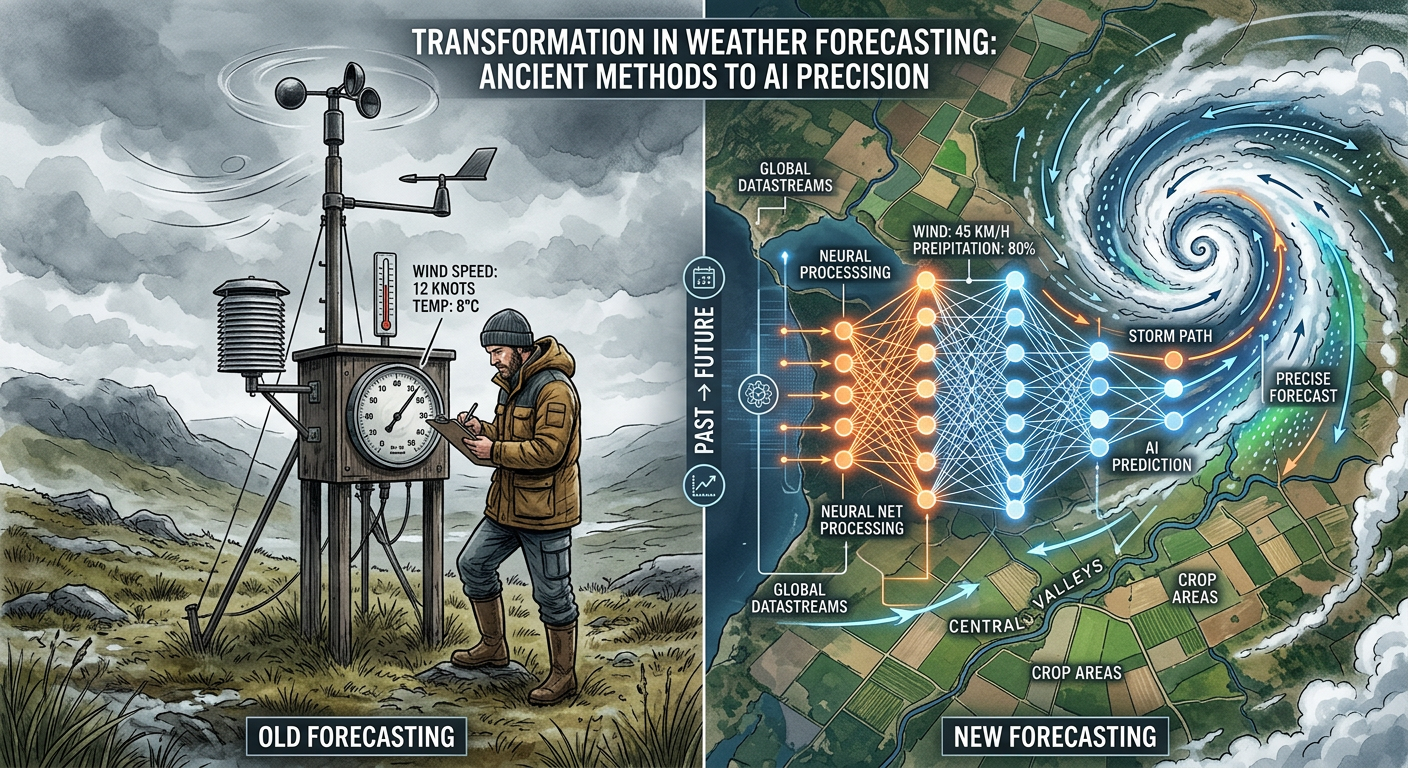
- Built on Google DeepMind's GraphCast architecture, fine-tuned with NOAA's own Global Data Assimilation System (GDAS)
- AIGFS uses 99.7% less computing power than the traditional GFS model
- Produces 16-day forecasts twice daily at 0.25-degree resolution
- Full 16-day forecast generated in ~40 minutes
Translation: This is the one that matters most in the near term. NOAA's GFS model is the backbone of most weather apps and services you already use. Project EAGLE is running alongside it right now. As NOAA validates and integrates these outputs, the forecasts you're already checking are going to improve — no new app required.
What This Means for Your Operation
- Planting windows get wider. A reliable 15-16 day forecast means you can plan fieldwork with more confidence further out. Fewer panic calls. Fewer wasted trips.
- Spray timing gets sharper. If you can trust the 5-10 day window with high accuracy, you're not guessing on wind and rain anymore. That's money saved on reapplication.
- Harvest logistics improve. Lining up custom cutters, grain carts, and trucks 2 weeks out becomes a planning exercise instead of a gambling exercise.
- Insurance and risk management shift. Better forecasts mean better data for crop insurance models. Expect underwriting to start incorporating AI forecast accuracy within a few years.
- Yield prediction jumps. AI-powered crop yield prediction is hitting 85-95% accuracy vs. the traditional 60-70%. Tools like Cropin, Folio3, and Farmonaut are already offering this.
What You Can Use TODAY
You don't have to wait for the big models to trickle down. Hyperlocal forecasting at field-level precision is already available:
- Agrio — 3km resolution weather forecasting
- Maayu — field-level weather intelligence
- PlanetEye Farm-AI — satellite + weather integration for farms
- Cordulus — sensor-driven local forecasting
- Farmonaut — satellite-based crop monitoring with weather integration
- Cropin — yield prediction using 40+ parameters including AI-driven weather data
None of these are endorsements — we haven't tested them all. But they exist, they're live, and they're worth evaluating against what you're currently using.
What's Coming (2-3 Year Horizon)
- AI weather baked into your equipment. Self-driving tractors and robotic harvesters are already integrating real-time AI weather analysis for autonomous field decisions. Expect weather-triggered automation — equipment that adjusts operations based on incoming forecast changes without you touching a screen.
- The market is moving fast. AI in agriculture is projected to grow from $2.4 billion in 2025 to $10.2 billion by 2032 — a 24.5% compound annual growth rate. That money is chasing exactly these kinds of tools.
- Labor realities are accelerating adoption. The ag labor crisis isn't getting better. AI-driven automation — from forecasting to field operations — is increasingly the answer, not by choice but by necessity.
- Forecast resolution will keep shrinking. We went from ~28km grids to 3km in the span of a year. Sub-kilometer, field-specific forecasting within 2-3 years is not a stretch.
One Thing to Try This Week
Pull up NOAA's experimental AI forecasts alongside your usual weather app. Compare the 10-day outlook. You're looking at Project EAGLE's output already blending in. Start noticing how far out the forecasts hold — that window is about to get a lot wider.
That's All for Today
The weather forecast you check on your phone is running on models built in the 1990s. In the last 12 months, Google, Microsoft, and NOAA deployed AI replacements that are orders of magnitude faster, cheaper, and more accurate. This isn't hype. It's peer-reviewed, open-sourced, and operational.
The question isn't whether AI weather forecasting will change your operation. It's whether you'll be ahead of it or reacting to it.
See you next time. The Dirt & Data Team
Sources: 1. GenCast — Google DeepMind (Nature, Dec 2024) 2. Aurora — Microsoft (Nature, May 2025) 3. NOAA Project EAGLE (Dec 2025) 4. AI in Agriculture Market Forecast — Intellias (July 2025) 5. AI Crop Yield Prediction Accuracy — Folio3 AgTech (Aug 2025)
Dirt & Data is an independent newsletter covering AI in agriculture. Written with AI assistance. Straight talk for people who work the land.
