2026 Farm Tax Changes: What Your CPA Might Not Tell You
February 25, 2026

Welcome Back
I spent last week going through the tax code changes from the One Big Beautiful Bill Act so you don't have to. Honestly? If you're running corn and beans in the Midwest, this is probably the best tax year you've had in a decade. Not exaggerating. Let me walk you through it.
Your New Combine Is a Full Write-Off
Here's the headline. If you bought equipment — any equipment — after January 19, 2025, you write off 100% in year one. The whole thing. A $450K combine. A $90K planter. All of it.
Remember how bonus depreciation was bleeding out? 80% in 2023, 60% in 2024, 40% last year. Was supposed to hit 20% this year and die completely in 2027. Yeah. The OBBBA killed that phase-out dead.
| Tax Year | Old TCJA Rate | After OBBBA (bought after 1/19/25) |
|---|---|---|
| 2023 | 80% | — |
| 2024 | 60% | — |
| 2025 | 40% | 100% |
| 2026 | 20% | 100% |
| 2027 | 0% | 100% |
Now here's where it gets tricky. You ordered a used planter back in December 2024 but didn't pick it up until March? That equipment was acquired before the January 20 cutoff. Might be stuck at the old rate. Talk to your CPA about the exact acquisition date — it matters more than delivery.
Bottom line for a 2,200-acre operation: Document every purchase date. The $60K difference between 20% and 100% on a big iron purchase is real money.

The Rest of the Changes (Section by Section)
Section 179 — $2.56 Million Cap
The 179 limit ticked up to roughly $2,560,000 for 2026. Phase-out starts around $4.09 million. Last year it was $2.5M even.
Honestly, for most row-crop guys I know, 179 alone handles everything they buy in a given year. New and used equipment both qualify. The nice thing about 179 over bonus depreciation? You pick exactly how much to expense. More control over your taxable income.
My take: use 179 first. Then let bonus depreciation mop up whatever's left.
Estate Tax — $15M Per Person. No Sunset. Breathe.
This one had estate attorneys losing sleep. The TCJA had doubled the exemption to around $13M per person, but that was set to crash back to about $6.98 million on January 1, 2026. Do the math on a central Illinois farm with owned ground — land alone could push you past that old number.
Instead? The OBBBA set it at $15 million per individual. $30 million for a married couple. Indexed for inflation going forward. And — this is the big part — no sunset provision. It's permanent.
Most family farm operations just breathed a massive sigh of relief. But look, if your estate adds up to more than $15M when you count land, equipment, grain in the bin, life insurance, all of it — you still need to plan. Don't assume you're clear just because the number went up.

QBI Deduction — Permanent Now
The 20% Qualified Business Income deduction was expiring after 2025. A lot of folks didn't realize how close we came to losing it.
It's permanent. Here's what's new for 2026:
- Still 20% off your qualified business income — Schedule F farm income counts
- New wrinkle: $400 minimum deduction if you've got at least $1,000 in QBI and you materially participate
- Phase-out range for married filing jointly got wider by $50K
Run the numbers. On $300K net farm income, that's a $60,000 deduction you're leaving on the table if your CPA isn't calculating it. Every single year now.
CRP Payments — The SE Tax Still Bites
Got ground in CRP? The IRS still says those annual rental payments are self-employment income. Full SE tax — 15.3% up to the Social Security wage base, 2.9% after that.
The Eighth Circuit disagreed back in the Morehouse case, said it's just rent for non-farmers. IRS formally said "nope, we're not following that." They nonacquiesced. Classic IRS.
So if you're pulling in $50K from CRP, expect roughly $7,065 in SE tax on top of your income tax bill. Retirement-age farmers shifting to CRP sometimes wonder if they can argue it's passive rental income. Maybe. But you'd better be ready for a fight.
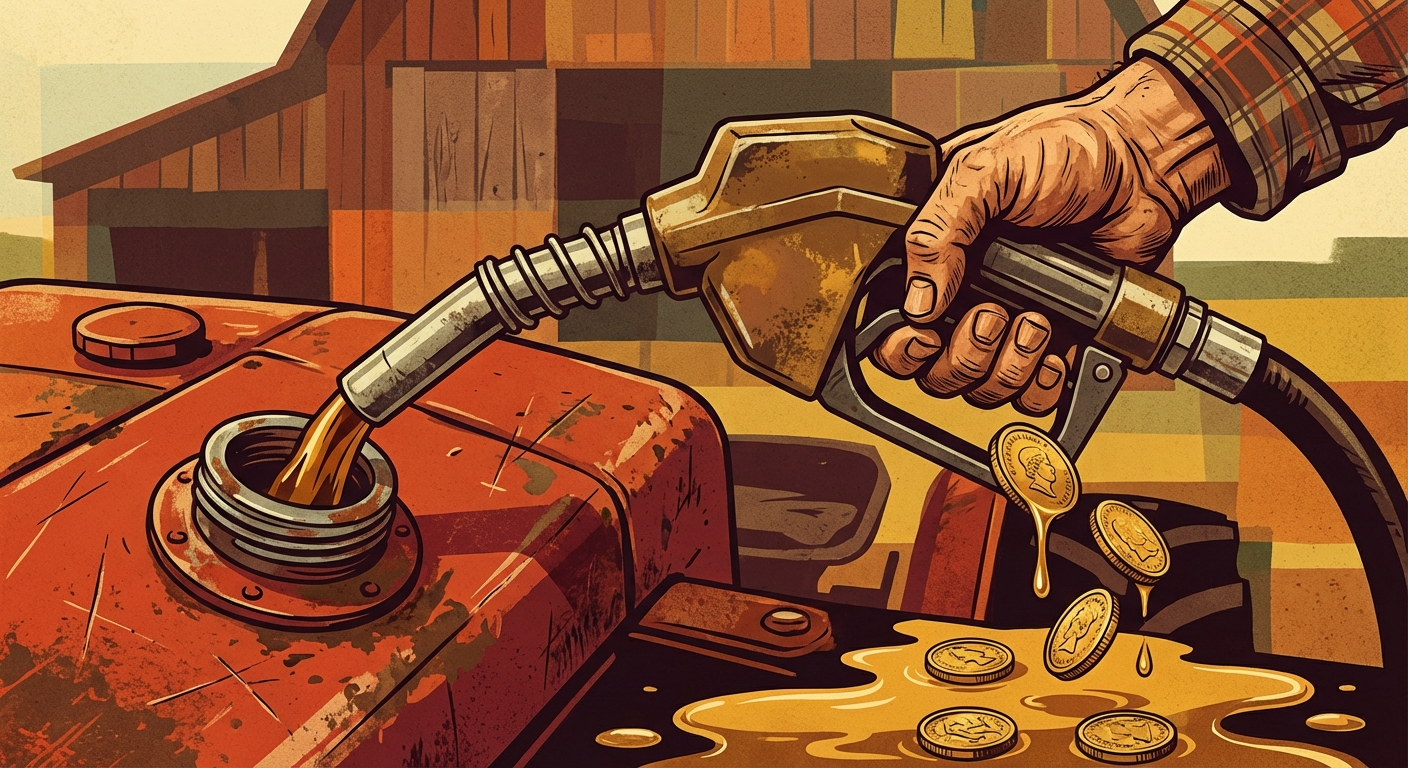
Fuel Tax Credits — Seriously, File This
I'm always surprised how many operations skip Form 4136. The federal government literally gives you back the excise tax on every gallon of off-road fuel:
- Diesel: 24.3 cents per gallon
- Gasoline: 18.3 cents per gallon
These rates haven't budged since 1993. But on 15,000 gallons of diesel a year? That's $3,645 coming back to you. Not on Schedule F — straight credit on your 1040.
Keep your fuel receipts. Bulk purchase records work too. If your CPA isn't filing 4136, that's a conversation worth having.
Conservation Easements — 100% of AGI for Farmers
Qualified farmers who donate a conservation easement can deduct up to 100% of adjusted gross income. Everyone else is capped at 50%. Anything you can't use carries forward for fifteen years.
Now — the IRS is all over syndicated easement deals. They've made that abundantly clear. But a legitimate easement on productive farmland near a growing town? Still one of the most powerful deductions out there if you're land-rich and cash-flow-tight.
Get an independent appraisal. A good one. The IRS audits these aggressively and they look at the valuation first.
What To Do Before April 15
- Dig up every equipment purchase date from the last 14 months. Anything after 1/19/2025 gets the 100% treatment.
- Total up your estate value — all of it, including life insurance. Over $15M? Call your estate attorney.
- Check your return for the QBI deduction. It should be there automatically, but verify.
- Pull your fuel records and make sure Form 4136 gets filed.
- If CRP income surprised you with a big SE tax bill last year, it's happening again. Budget for it.
- Thinking about a conservation easement? Start the appraisal now. These take months, not weeks.
If You Only Read Three Lines
One. 100% bonus depreciation is permanently back for equipment acquired after 1/19/2025. The phase-out is dead.
Two. Estate tax exemption is $15M per person now, no sunset. Most family farms are safe — but verify your total estate value.
Three. QBI deduction is permanent. That's 20% off your Schedule F income, every year, forever.
Written with AI assistance. This isn't medical, financial, tax, or legal advice. Talk to a professional before making changes to your plans.
