
Reverse Engineering AI in 2026: What It Can and Can't Do
Reverse engineering AI, stage by stage: where LLMs and agents help on a binary, where they stall on protected code, plus 2026 GitHub and arXiv data.
AI reverse engineering is the use of large language models and AI agents to analyze compiled software without its source code. This post covers that software meaning of reverse engineering AI, and the honest answer is mixed: it's useful wherever a decompiler already produces readable code, and it stalls where a protector has turned the code into something else. It's also spreading fast. On 18 November 2026 we counted new public GitHub repositories about reverse engineering: 21.3% of those created this quarter mention AI, LLMs, MCP, agents or GPT, up from 2.2% in the first quarter of 2023. This post walks through a reverse engineering job stage by stage and marks where AI pulls its weight, where you have to check its work, and where it stops.
Where your agent stops, Devirt starts: when an AI agent reaches a VMProtect- or Themida-virtualized function, it's reading the protector's interpreter. Devirt recovers that protected scope for files you own or are authorized to analyze, and returns each function with a proof state your agent can cite. Start with a free assessment.
What is AI reverse engineering?
AI reverse engineering is reverse engineering in which a language model or an AI agent does part of the reading. The classic tools still do the extraction: a disassembler turns machine code into assembly, and a decompiler such as Ghidra, IDA Pro or Binary Ninja turns that into C-like pseudocode. The model then proposes function names and types, summarizes what the code appears to do, and drafts notes. An AI agent goes one step further and calls those tools itself, often through the Model Context Protocol (MCP).
The Wikipedia entry on AI-assisted reverse engineering puts the main limitation plainly: code a model generates can carry bugs the original didn't have, so it has to be validated.
Searches for "reverse engineering AI" sometimes mean the opposite job: taking apart an AI model to learn how it works or what it was trained on. That's a separate field of machine learning security, with its own literature. This post is about AI as the tool, not the target.
Can AI be used for reverse engineering?
Yes, AI can be used for reverse engineering, mainly as an assistant to the analyst. A large language model can summarize a binary's strings and imports, explain decompiled functions and suggest names and types, and an AI agent can drive a disassembler or debugger as a tool. On obfuscated or virtualized code it reads the protection, not the program.
The research agrees on both halves. A 2026 review of agentic reverse-engineering systems by Salem Radey, Jack West and Kassem Fawaz examines static, dynamic and hybrid agents. The authors report that the best systems still fail on obfuscation, timing and unusual architectures, and they list token limits and missing guardrails among the constraints. So AI for reverse engineering works best on the parts of a binary a human could already read.
How fast is AI reverse engineering growing?
AI reverse engineering is growing faster than reverse engineering itself. We used the GitHub search API to count public repositories whose name, description or topics contain "reverse engineering", by the quarter they were created. Then we counted how many of those also mention ai, llm, mcp, agent or gpt, with duplicates removed.
- 2023: 29 of 1,142 new reverse engineering repositories mentioned one of those terms (2.5%).
- 2025: 185 of 2,555 (7.2%).
- 2026 to 17 November: 1,642 of 9,641 (17.0%).
- By quarter: the share went from 2.2% in the first quarter of 2023 to 15.0% in the third quarter of 2026, and 21.3% in the quarter to date.
Research shows the same curve. In arXiv's Cryptography and Security category, abstracts that pair "reverse engineering" with language models rose from 2 in 2022 to 12 in 2024 and 27 in 2025. Across all arXiv categories the count went from 6 to 85 over the same years, though that wider number also includes papers about reverse engineering AI models.
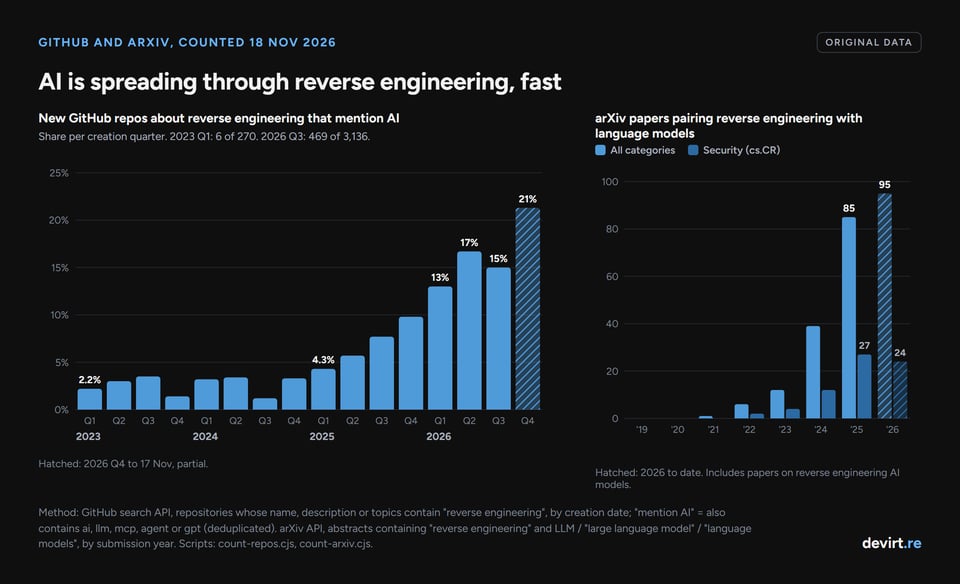
Two caveats keep the counts honest. A repository that says "AI" in its description isn't necessarily good or used, a few term matches are false positives (an "agent" can be malware's agent), and GitHub search matches metadata, not code. Treat the numbers as a measure of attention, not of capability. The method above is all you need to rerun the counts yourself.
Where does AI fit in a reverse engineering job?
AI fits differently at each stage of a reverse engineering job, so a single verdict on "AI for reverse engineering" misses the point. Here is our reading of where it stands in November 2026, from the research and tool documentation cited in this post:
| Stage | What AI does | Verdict |
|---|---|---|
| 1. Triage | Summarizes the strings, imports and headers a tool has already extracted | Helps |
| 2. Identify the protector | Reads the output of signature tools such as Detect It Easy; the tools decide | Tools lead |
| 3. Disassemble and decompile | Rewrites or refines decompiler output; Ghidra, IDA or Binary Ninja produce it | Tools lead |
| 4. Name and explain | Proposes names, types and plain-language summaries | Helps, check it |
| 5. Dynamic analysis | An agent can drive a debugger; timing-dependent behavior is hard | Helps, check it |
| 6. Obfuscated code | Simple tricks can yield; combined techniques defeat it | Mixed |
| 7. Virtualized code | Reads the protector's interpreter, not the program's logic | Stalls |
| 8. Report | Drafts the write-up; each claim still needs evidence behind it | Helps |
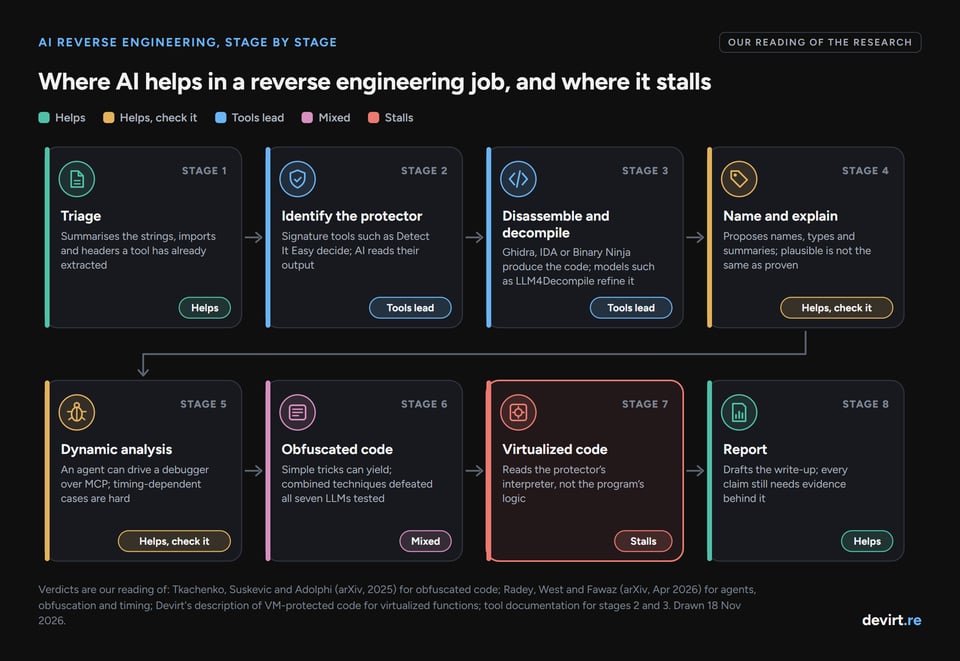
The pattern is consistent. AI is strongest where the input is already readable and the output is language: triage, summaries, names and reports. Extraction stays with deterministic tools. The further the code has been deliberately transformed, the less the model can do with it.
Which AI reverse engineering tools do people use?
AI reverse engineering tools fall into three groups: models trained to decompile, assistants built on top of a decompiler, and connectors that let a general-purpose agent call the classic tools.
- Decompilation models. LLM4Decompile is an open-source model family that decompiles Linux x86-64 binaries into C, and its second version refines Ghidra's pseudocode rather than starting from raw bytes. Its repository had 7,304 stars on 18 November 2026.
- Decompiler assistants. Rev·Deck, one of the repositories Google's AI Overview linked for this query on 29 October 2026, pairs a language model with a headless Ghidra service and requires the assistant's factual claims to cite evidence you can inspect.
- Agent connectors. MCP servers expose IDA Pro, Ghidra or a debugger as tools an agent can call. Our reverse engineering MCP guide shows where that agent loop breaks on protected code.
If your question is narrower, which decompiler to trust for a given file, the comparison of AI decompilers, Ghidra and devirtualization covers that ground.
A good example of the tools-first pattern comes from Faraday Security's write-up on recovering pi32v2, an undocumented processor architecture, with a hybrid pipeline. On a MIPS test binary, where the correct answer was known, the pipeline recovered about 98% of instructions, and roughly 91% of that work involved no AI calls at all. The model filled gaps. Deterministic code did most of the lifting.
Can AI reverse engineer obfuscated code?
AI can reverse engineer some obfuscated code, but not reliably, and the type of obfuscation decides the outcome. A 2025 study by Anton Tkachenko, Dmitrij Suskevic and Benjamin Adolphi, Deconstructing Obfuscation, tested seven commercial language models on assembly protected with four techniques. Results ranged from fully autonomous deobfuscation to complete failure, depending on the model and the technique:
- Bogus control flow: the least resistant.
- Control flow flattening: moderately resistant.
- Instruction substitution: among the most resistant.
- All of them combined: every model failed.
The authors conclude that language models lower the expertise needed for some reverse engineering tasks but still need human guidance on complex deobfuscation. A model will still produce confident pseudocode from obfuscated input. The confidence tells you nothing about whether it's right.
Why does AI stall on virtualized code?
AI stalls on virtualized code because the protected function no longer exists as native code. Commercial protectors such as VMProtect and Themida can translate selected functions into bytecode for their own virtual machine. When the program runs, an interpreter inside the binary fetches each bytecode instruction and a dispatcher hands it to a handler. A disassembler, a decompiler and any model reading their output all see that interpreter, not the logic it's running.
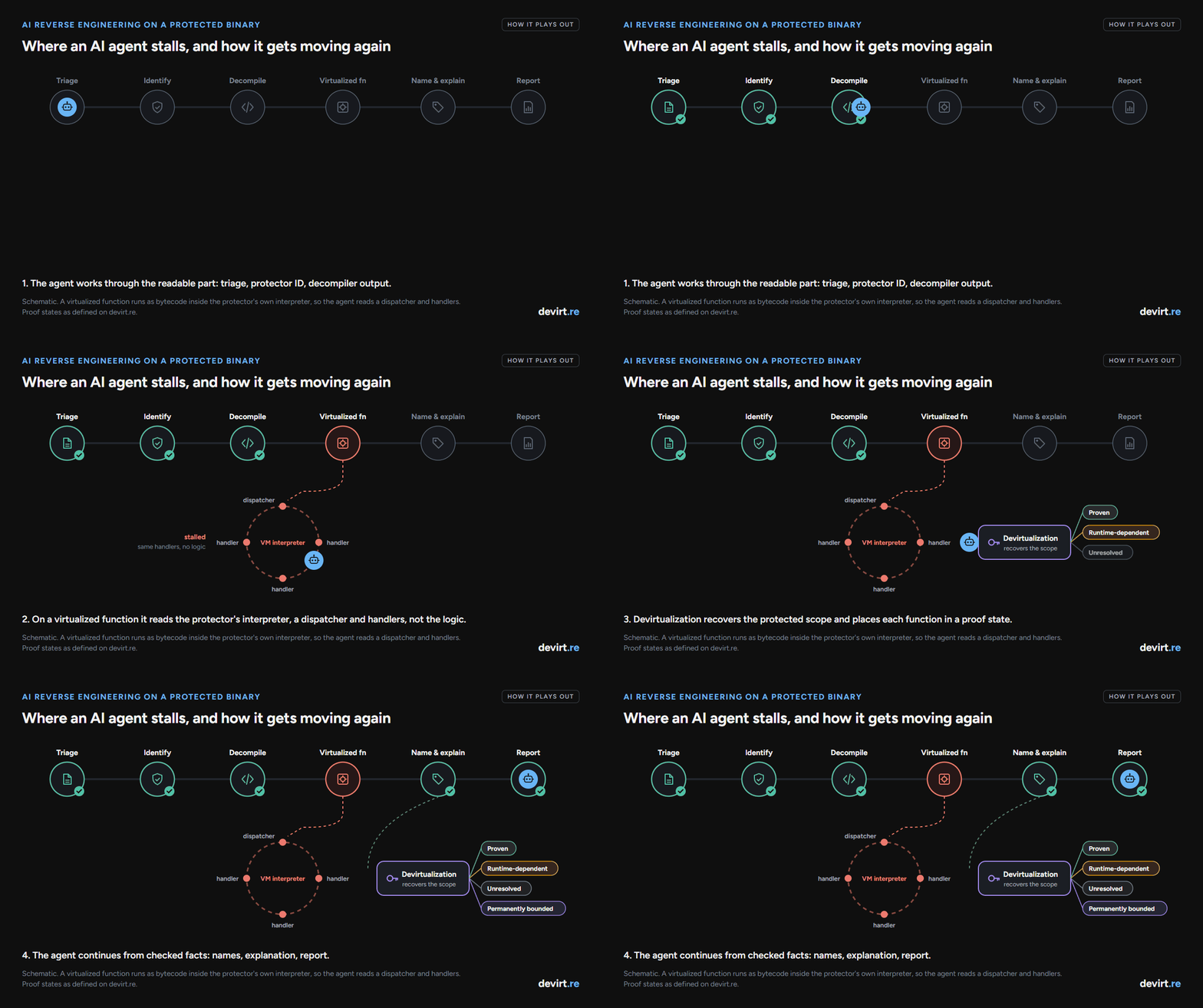
Ask an AI agent to explain a virtualized license check and it will describe the dispatcher, because the dispatcher is all it can see. The protected scope has to be devirtualized first, and only then can a model explain it.
This is the boundary Devirt is built around. Devirt isn't an AI model and doesn't replace your agent. It's the recovery step for AI reverse engineering on protected binaries: it recovers the virtualized scope, and your agent picks the investigation back up with checked artifacts. Devirt's MCP connector is read-only, with six tools that read assessments, jobs and results. None of them can upload a file, start a job, accept an offer or pay.
How do you check what an AI told you about a binary?
You check what an AI told you about a binary by tracing each claim back to evidence a tool produced, and by refusing to let readable output stand in for proven output. Three habits cover most of it:
- Ask what the model saw. If it was reading decompiler output of a virtualized function, its explanation is a guess about code it never saw.
- Separate facts from inferences. A recovered call to a known API is a fact; "this function validates the license" is an inference until something confirms it.
- Count the unknowns. A result that never says "unresolved" is hiding something.
Devirt formalizes the last two. Every in-scope function in a result lands in one of four proof states: proven, runtime-dependent, unresolved or permanently bounded. An agent reading that ledger can cite what was established and leave the rest open, instead of turning a gap into a claim.
Will AI replace reverse engineers?
AI isn't replacing reverse engineers in 2026; it's moving their time from reading to checking. The 2025 obfuscation study found that models still need human guidance on complex cases, and the 2026 agentic review lists obfuscation, timing and unusual architectures as open failures. Someone still has to decide what a model's output is worth, choose which functions matter, and sign the report.
The job is shifting, though. When a model drafts the triage notes and the first-pass names, the analyst's time goes to checking them and to the hard functions: the obfuscated ones, the virtualized ones, and the ones whose behavior depends on the environment.
Is reverse engineering with AI legal?
Using AI doesn't change whether reverse engineering is legal. The answer depends on the jurisdiction, the software license and the purpose. Interoperability, security research and malware analysis are treated differently from copying or cracking. Sending a client's binary to a hosted model can also raise confidentiality questions of its own. This is general information, not legal advice; check with counsel for your situation.
AI reverse engineering is a real gain on the readable parts of a binary and a liability on the parts that were made unreadable on purpose. Knowing which stage you're in is most of the skill.
Written by Devirt, an automated devirtualization service for authorized analysis of protected software.


