
Black boxes and cloud serfs
I'm not a Mastermind, but I've played the game.
I have been told but do not remember that I was reading at a very early age, which must have been a consolation for my parents who were very concerned that I should be good in school. The family still retells the story of how my uncle once spread a newspaper on the floor, pointed at words, and laughed uproariously when I toddled over to read them perfectly. He’d thought I was repeating things, and hadn’t believed that I could read.
As a result of that parental desire for academic achievement, my toys were mostly educational. I can only imagine their relief when I declared I’d rather have books than toys. For years relatives would give Mum money to buy books for me in lieu of buying me a present. Worked out well for me, since I really didn’t want toys.
Mum being a school teacher was definitely a bonus. She chose books with me, encouraged me to read more difficult books and let me read whatever I wanted. She even talked to the librarians and got me access to and a card for the adult section of the local library. I even got to go up there alone, although the librarians would subtly vet the pile of books I wanted to borrow and less suitable ones would disappear.
I’m generally good with words and language. Other kinds of thinking, I’m not so good at.
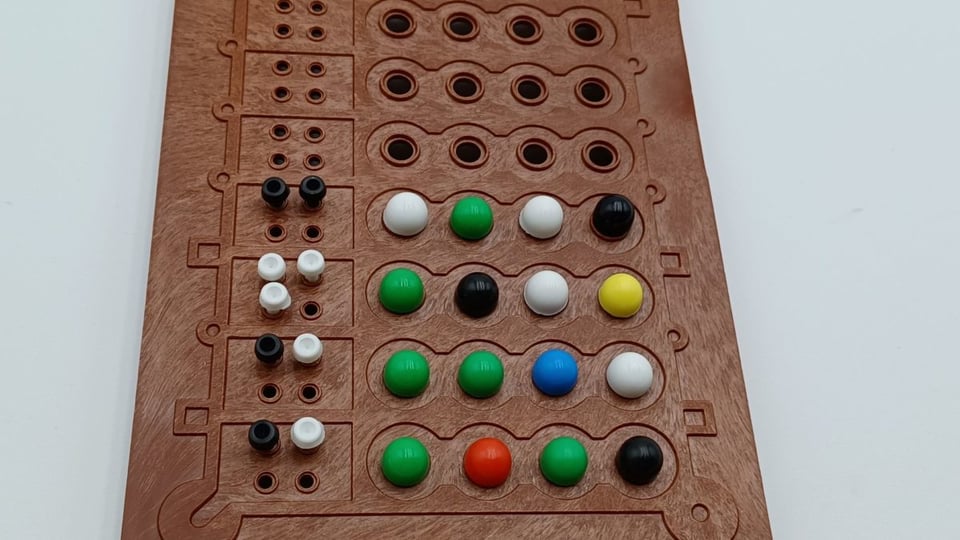
I don’t know if Mastermind was a gift, or whether I chose it. I never played much, because it required a kind of thinking I wasn’t good at. Aside from being the subject of possibly the funniest McSweeney’s Internet Tendency piece of 2025, Mastermind is a games based on the idea of a black box. You put down a sequence of four colours, and get feedback in the form of black or white pins: each white one means that one colour is correct, but in the wrong place, and each black pin tells you that there’s a colour you’ve guessed that’s in the right place. There’s no indication of order and it then becomes a case of deducing the correct sequence of colours before you run out of guesses.
If this sounds like Wordle or one of the many variations, you’d be right. I’m not particularly good at Wordle, either.
The black box part is what intrigues me at the moment, because so many of the systems around me are designed to be exactly that. Take social media, for example. People who do it for a living are constantly trying to figure out “the algorithm” - and the only way they can do that is to post things, and see how well they perform. Put in an input, look at the output, and try to work out what happens in the middle.
I’m not sure that’s what we signed up for. I don’t mean to keep banging on about it, but I find it really frustrating that my posts aren’t shown to people who friend/follow me. But the black box effect happens because platforms choose what you see, supposedly based on personalising the experience. They don’t tell you how, though, and the upshot is that we’re all playing a stupid guessing game.
You should see the number of people on Facebook who’ve taken to posting photos of online content and then putting the actual link in the comments.
This is because Facebook wants you to stay on Facebook, and not go clicking away to something else. But the people who use Facebook want to be able to refer to other online content. “Read this article!” or “Here’s the link to book tickets to the play I’m in, I’d love you to come!” or other things like that. When you want to do things that the platform doesn’t want you to do, the experience of being online becomes unnecessarily combative.
It is entirely possible that social media platforms want something else from their users, though. We know that selling access to attention is the main way that they make money, but there’s also the reality that social media is, for some people, a performance. Plenty of people create content for attention online (some of them even call themselves “content creators”) in the hope of gaining or growing an audience: why else would people sit on Twitter posting nothing but an endless stream of witticisms?
A Facebook friend linked to an article that includes this rather telling paragraph:
In his book Technofeudalism, Yanis Varoufakis argues that the internet has collapsed the distinction between professional and amateur entertainers and made us all into something called “cloud serfs”, labouring in the fields of Facebook and TikTok to entertain each other while the corporations skim the profits. And he’s right. The consequence of that for the creative industries, especially post-pandemic, are now obvious to everyone involved.
How terrifying. I don’t want to be a cloud serf.
And the reality is probably a little more complex than that, even. Some people are trying to build audiences.
Traditional gatekeepers (or more accurately, these days, amplifiers) increasingly expect creators to come to them with a pre-existing audience and extensive proof of concept – more of a “collab” model and less of a patronage one – and that applies across the board from sketch comedy to authorship. Your audience is what’s valuable – it sells books, tickets, TV shows, advertising. Creators have to invest in themselves before anyone will match that stake. Like, share, subscribe.
(Honestly, the article is so intelligent and illuminating that you should read it.)
I’m not intelligent enough to solve the problem, but the situation seems clear enough. There are black boxes that I don’t want to feed, because then I wind up creating content that earns money for someone else. But without doing so, I have little to no chance of building enough of an audience to get people to pay attention to my art.
When I get around to making art, that is, instead of writing an occasional newsletter about things that annoy me.
P.S.
“The American public, then, is left not with a president but with a man who imagines himself master and behaves like a tyrant.” (gift link)
“I have a proposal to make: 2026 should be the year that you spend more time doing what you want.”