Romancing the Vote, Annotated Ninefox Gambit, and More!
In this email: Romancing the Vote (including my offer of an annotated copy of Ninefox Gambit!), on Solaris Books (the publisher of Machineries of Empire), and thoughts on Scandal TV, a.k.a. the show that made me fall back in love with writing.
Romancing the Vote is live! (July 1 to 6, 2026)
This is rather USA-specific in its goals, but Romancing the Vote “is a massive auction featuring your favorite authors, crafters, comic book artists, screenwriters, video game creators, scientists, and more! this year all money raised goes to Vote Riders and the Southern Coalition for Social Justice, two organizations fighting to preserve the right for every person to have their vote counted.” Many auctions will be open to international bidders, though!
I have three auctions listed; feel free to ping me at [email protected] if you have questions about specifications.
Ninefox Gambit: Annotated - Are you dying to know what backstory got cut (entire flashbacks), added on a whim (formation instinct, the spur-of-the-moment invention that warped the entire Machineries of Empire trilogy), whether Jedao was lying/telling the truth/AVOCADO_ERROR for every single statement or where the mathy bits were supposed to go before my husband the astrophysicist told me to cut them? What was behind XYZ keyboardsmash worldbuilding word choice or where the Korean military history references were hiding? You're in luck! I'm offering one (1) typed and/or handwritten (hand health permitting) annotated copy of NINEFOX GAMBIT. The margins are small so you're getting the notes in a separate/companion notebook or volume. Maybe scurrilous explanatory cartoons/character sketches if I'm inspired. You never know!
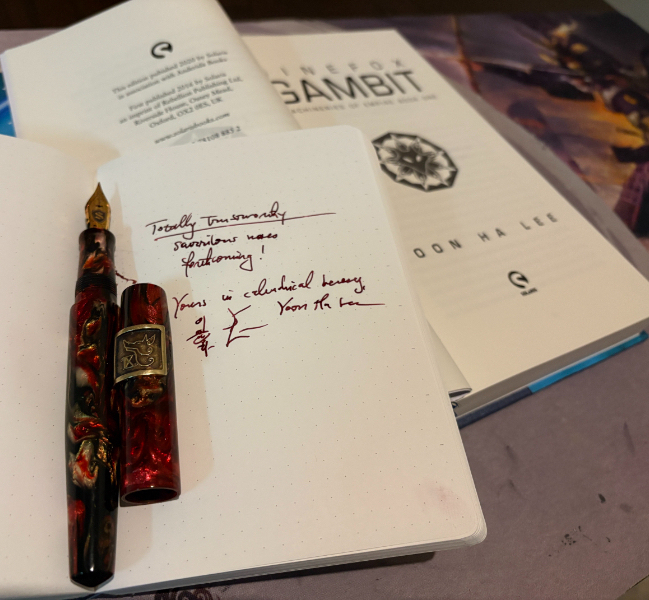
Preview of an annotated copy of Ninefox Gambit (annotations in a separate journal/notebook/printout, have you seen those margins?). Sorry, fountain pen not included! Tarot Art of Your Character! - Digital painting/illustration in an ink-and-wash inspired style; typical examples from the Ninefox Tarot WIP. Digital delivery only.
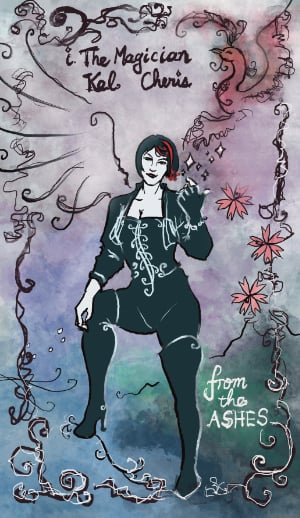
Ninefox Tarot: 1. The Magician (Kel Cheris, “from the ashes”) Bespoke orchestral music - Orchestral composition up to two minutes and mockup using VSTs (my toolbox includes Vienna Symphonic Library, Orchestral Tools, 8dio, Performance Samples, Impact Soundworks… too many to list, really). My music reel has short examples; my Bandcamp, especially the mini-album Trailures and Other Fiascoes, has full pieces if you’d like to explore further. Digital delivery only (for the audio file; this doesn’t include an engraved score).
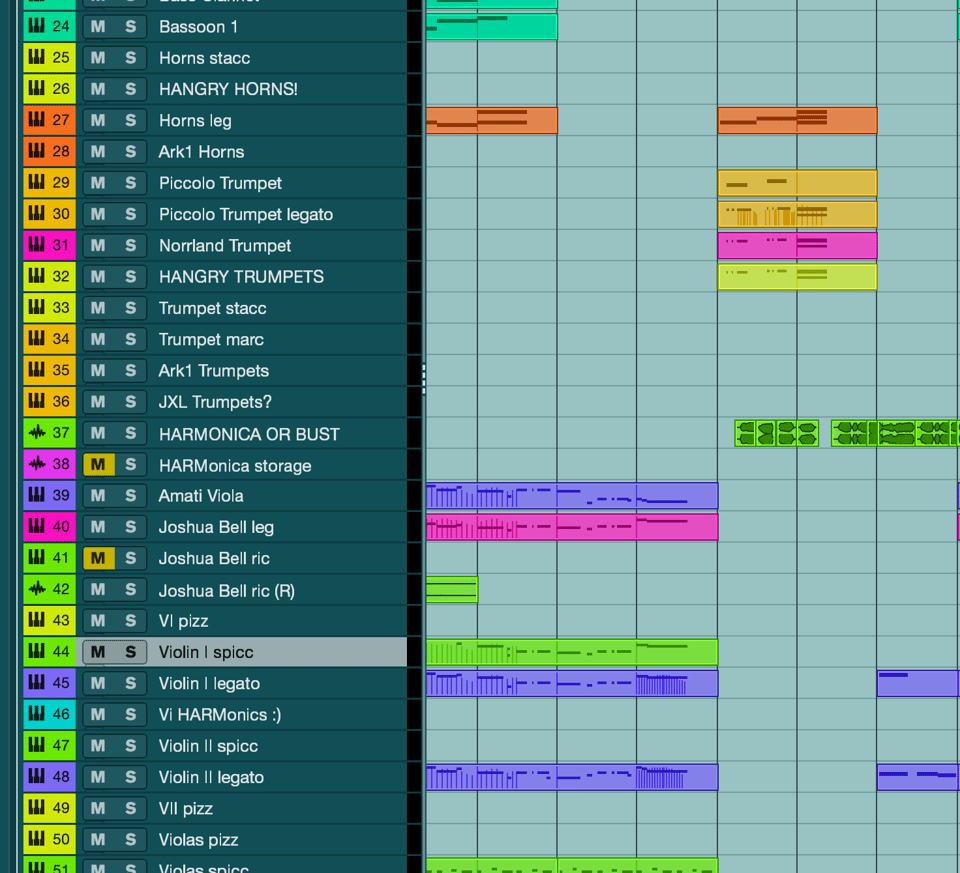
Cubase project screenshot excerpt from an orchestration exercise. I promise the trumpets and horns are okitty! (“HANGRY TRUMPETS” was a pun on the actual name of the VST, Performance Samples’ Angry Brass.)
A selection of other auctions (of the many!) that might be of interest:
Annotated copy of Ursula Whitcher’s North Continent Ribbon - On Nakharat, every contract is a ribbon and every ribbon is a secret, braided tight and tucked behind a veil. I’m biased because I read a number of these luminous, nuanced, thought-provoking science fiction stories, linked by a common culture/setting, in draft, as well as blurbing the book; the collection was a finalist for the 2025 Ursula K. Le Guin prize. Ursula herself is ferociously brilliant across multiple disciplines: mathematician, editor, author, poet, knitter/knitting pattern designer (notably including - I’m biased again - the Jedao gloves pattern!), activist. If you don’t bid on this, I will because I am dyyyyying for deets.
1-Hour Biology/Worldbuilding consult with niqaeli #1 and offering #2 - Who’s niqaeli, you might ask? Among many other things, she’s a friend of mine with a biology degree and she helps me with worldbuilding on the regular. Any handwave nonsense is on me; she’s terrific at logicking through unhinged sci-fantasy/superhero/etc premises so I can decide how much handwave is on the menu. A++, endorse wholeheartedly; of more weight, she’s also endorsed by Arkady Martine and Christopher Rice! :D
1-Hour Copyedit Ride Along with Mia Tsai - I had the intense pleasure of reading Mia’s science fantasy The Memory Hunters (Erewhon Books, 2025) in draft. Ever wonder what a professional copyedit process looks like, demonstrated on up to 20 manuscript pages of your work? Here’s your chance!
The (other) charities I support regularly are a local food bank, the ACLU (American Civil Liberties Union), and Médecins sans Frontières (Doctors Without Borders), as my father used to be a medical researcher and surgeon and the first thing he ever taught me about was the Hippocratic Oath.
Solaris Books
Since this is now public information, Solaris Books (my publisher for Machineries of Empire and the standalone Phoenix Extravagant) has been acquired by Profile Books, which publishes terrific nonfiction (I’ve enjoyed some of their past books!) and is expanding into sf/f. This is exciting, but inserts inherent uncertainty in that Profile Books is new to me (and I to them!) so I have to adjust planning around Ninefoxery accordingly. Solaris’s terrific editorial team remains intact so we’ll see where this goes!
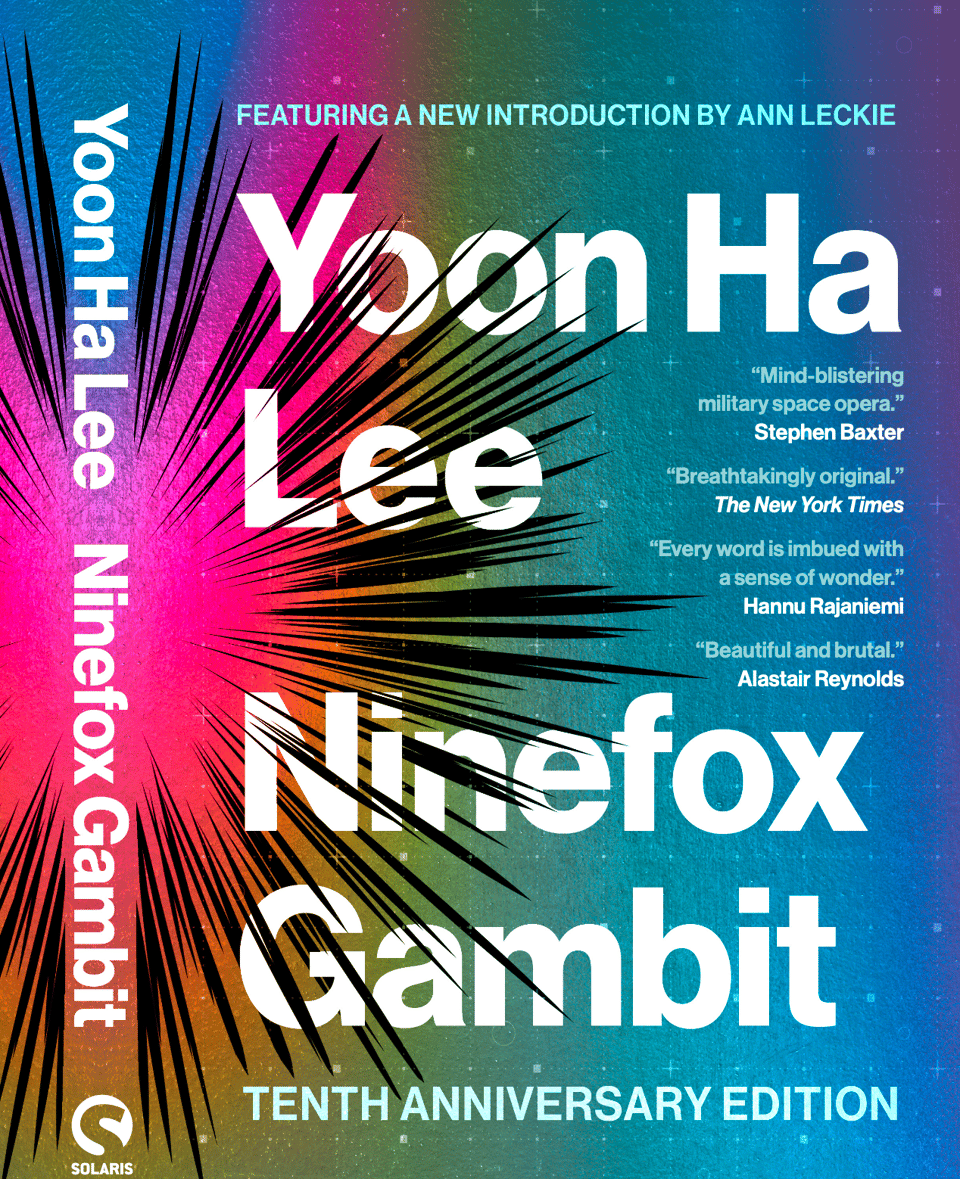
As far as I know, the tenth anniversary (!) re-issue of Machineries of Empire is proceeding as planned. I know folks have had an increasingly difficult time sourcing print copies of those books; the short version is that those books were on a time-limited contract (rather than life of copyright, which is more typical) and we were (in 2025) in negotiations over a renewal to the license. Rather understandably, Solaris wouldn’t have wanted to commit to another print run as the license ran out without a renewal in hand; unfortunately, this is one of those things I can’t tell folks about until after it’s settled due to negotiations/legal stuff.
(When I complain I’m old, my daughter helpfully points out that I’ve always been old lol.)
Scandal (TV), Corruption vs. Redemption Arcs, and One Theory of “Sticky” Characters
I don’t normally do TV reports but I am so obsessed with Scandal (TV) that I finished it and then started rewatching from the beginning. Scandal was the show that made me champ at the bit to resume writing after a hiatus (health + life), even if the end result might never see the light of day.
Scandal’s over-the-top melodrama - married with taut political thriller and razor-serrated commentary on race/racism, class/classism, and US politics - is exactly my jam. Unusually, it has protagonists (in an ensemble cast) who do genuinely villainous things and the show calls them out on it, unambiguously and fiercely, while offering the possibility of redemption, grace, doing better. It gave me clarity on my personal theory of “sticky” characters, the ones who live rent-free in your head (or the author’s); not the only way to create such characters, but one way that has consistently worked for me as a writer (and sometimes as a reader/viewer).
I have always loved corruption arcs, genuinely grimdark corruption arcs, because I love redemption arcs. For me, they are two sides of the same coin. I read more broadly than I am able to write (I have generally failed to cough up a plausible romance), but this is the kind of story I gravitate most toward writing. I prefer to write (and sometimes to read) stories where there’s genuine uncertainty about the outcome. Where I don’t know if XYZ character will paraglide past the moral event horizon or if, in the dark, unseen by the wider world (or anyone at all), they will step up and be the best version of themselves. I live for that!
For me, a redemption arc is most powerful when there’s genuine possibility of failure - and the flip side, the failed version, is the corruption arc.
Readers often hate, or say they hate, the kind of story where characters are randomly and brutally killed off. (Many of those readers keep buying the next book, though, so empirically…) It’s okitty if you don’t want your reading experience ruined by the death of XYZ character! We all read for different reasons at different times; I spent 2020 unable to read anything but fluffy shifter romance.
But the “brutal random death” story hides within its pages the possibility of “actually, against all odds, yet believably, this character survived or did better”; when executed well, especially with a heroic or redeemed character, it’s incredibly energizing. Likewise, the “brutal random corruption” story where everyone is horrible is for me powerful because sometimes, within one of these stories, we get a breath of grace, a soupçon of kindness. Maybe not more than a breath, or a breath that’s snatched away on the next page. But that breath is what I live for, because that’s in fact what we get in life (in my experience of the world, as someone who’s not meaningfully religious): the momentary breath and the everlasting uncertainty.
There will be spoilers below for Scandal. Sorry not sorry!
The biggest reason I’m rewatching Scandal is the treatment of color (not just race as constructed in the USA, but costuming, props, choreography, sets), which I’m sure has seen exegeses by film studies people all over. The other reason is that, over time, Scandal reveals that its protagonists are villains. Not villain heroes (or, if you prefer, asshole heroes); they are, as the main character, Olivia Pope, states in an S7 episode, the villains of the story. The power-brokers, the corrupt politicians and fixers, the torturers, the murderers, the war criminals.
Edgelord “villain heroes” or “villain protagonists” are common at this end of time. I have a side specialty in them, so it’s not like I am here to throw stones. We see more “heroic” inflections in vigilante superheroes (“classic” Batman, I suspect, if I knew more about the DC universe) and “villainous” inflections in deconstructions of superheroes (Alan Moore’s Watchmen, famously; I’m told The Boys goes there as well). Often the “villain heroes” are meant to be a guilty pleasure where readers/viewers can escape into the fantasy of Doing Bad Things But Being Justified, or Doing Bad Things But It’s Okitty Because We Do Them To Bad People After We Get Hurt, because we get a level of assurance from the constructed, multi-viewpoint reality of a TV show that we are not offered in real life.
I started watching Scandal on a whim because a friend of mine loves it and I went in cold. I didn’t realize it was a political thriller (…I thought it was rom-com, quickly disabused) or that it went all-in on political commentary. So I am tiptoeing in after everyone’s left the conversation. I didn’t come in with any inkling that Scandal would go all-in on protagonists who are ultimately framed as villains given a chance at redemption, but not “heroic” villains.
Olivia Pope is initially presented as a “white hat” (the show’s term), a heroic feminist who, in typical thriller/procedural fashion, takes on tough cases for great justice. Her clothing (as well as that of other characters) tracks this from her first appearance. The show itself offers a visual gloss on the moral valence of her actions.
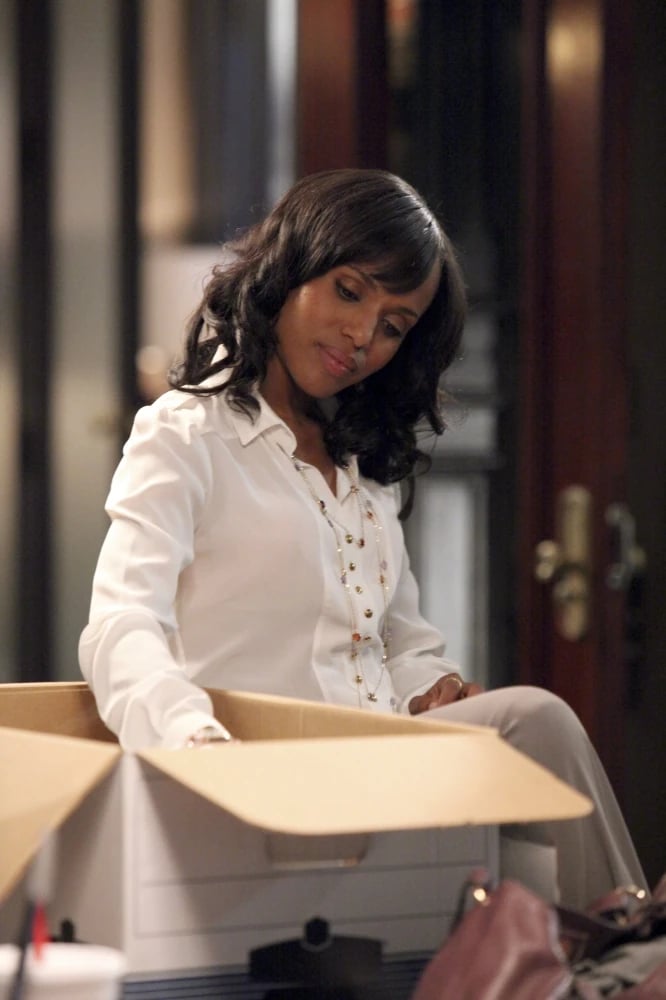
On rewatch, this visual gloss is ragingly clear. I’m not a visual thinker; my husband has been home for hours and right now in the study, I cannot for the life of me tell you what color shirt he’s wearing, only that it existed. Visuals affect me but I don’t consciously mark e.g. color information on a first viewing, so I expect others picked up on this faster. By way of contrast, I am usually dissecting scores for film/TV (“Hey, Joe, I’m positive this bit in Blake’s 7 features a bass clarinet, that’s very old-school orchestration even with what must have been avant garde expensive hardsynths at the time!”).
Whenever Olivia is doing a Good Deed, acting as a “white hat,” she wears white or is framed by white. You can figure out what Olivia in grey means, as she’s tempted to re-enter the dirty dealing of D.C. politics, or Olivia is black. First Lady Mellie Grant often appears in red - red for power, for blood, for sexuality and shame (The Scarlet Letter), especially given the backstory where she was raped by her father-in-law. (Mellie was one of my favorites before I got to that part: “bitchy” ambitious women who are allowed to be ambitious, powerful, and messy/flawed despite patriarchal bullshit are my jam.)
From the first episode, Olivia gets neck-deep in dank, illegal, morally questionable to morally oh hell no bullshit. In the first episode, it’s not yet (entirely) clear that it isn’t “haha, badass villain protagonist pwned that person, it’s okitty for her to blackmail and threaten people in a presumed good cause, amirite?” and that Olivia’s trespasses will be questioned and deconstructed. (Probably it wasn’t all pre-planned by the writers; I haven’t looked into that.)
The show is absolutely aware of the polysemy in this color glossary that it’s set up in parallel with USAn racial politics: where the Black body is (still) an enslaved/subjugated body, a source of shame thanks to racist social constructions and the zombie legacy of the “peculiar institution”; where the white body is a locus of actualized power. One story arc culminates in Olivia being kidnapped and auctioned to various nations and terrorist (etc) organizations, which at first I headtilted at because it was so over-the-top. But I was reacting from a literalist reading of mimesis rather than the biting allegory, which snapped into focus for me in a later episode: Olivia, traumatized by the experience, snaps that she was on the auction block. She’s been kidnapped from her safe, comfortable home and sold to the highest bidder, as a Black woman. Possibly I am naïve about how human trafficking works in reality (I’m not sure I have the stomach to find out), but the point was the recapitulation of the slave trade and its effects on present-day power dynamics.
Olivia wields power to varying degrees, but in doing so, she, like her father, becomes complicit in a corrupt system. I thought a lot about Audre Lorde’s “master’s tools” quote.
Olivia’s father is a fascinating and complicated character in his own right. I was sitting there with metaphorical popcorn every time he launched into one of his unhinged bravura soliloquys, complete with weaponized language (any time he addresses someone as boy) and Biblical allusions (I stopped counting). Olivia’s father the mastermind, a Big Bad who makes Darth Vader look like amateur hour (sorry, Star Wars fans, but Darth Vader wasn’t noted for oratory).
Yet one of the most important hopeful theses of the show is stated by Olivia’s father, for all his faults: that the people worth saving are all the people, We the People; every person is worth saving, including the monsters. That particular moral thesis is the one I love best in narrative theme, so it’s unsurprising that I responded to the show so strongly.
(I appreciate that the show resists making any single character a mouthpiece for its theme(s) and instead distributes this around its ensemble cast; the former approach often backfires for me because I find the designated authorial mouthpiece obnoxious.)
The show ends with a reckoning: the ensemble characters acknowledge that they are the villains and monsters, that they’ve made evil choices and done evil deeds… and they have an opportunity to do better and break the Hegelian treadmill for themselves and, by extension, the United States. Because the real heroes are the people. The villains either face up to who they are, where they’ve been, and what they do next… in some cases, they fail to grow toward the light.
I love one of the last shots of the show’s finale, where Olivia walks away from the corrupt morass of D.C. older but wiser, lambent in white. The unnamed background characters are near silhouettes, dressed in dark colors or black.
I promised I’d talk about applied characterization in relation to this show. One of my ongoing struggles is a baked-in tendency to create a character, state that $CHARACTER has $TRAIT, then two chapters later blatantly show the character acting with $OPPOSITE_TRAIT. We can discuss my gross personality flaws another time, and there are ways in which this characterization process requires a lot of revision. I can’t usually create an ensign and then two chapters later they’re actually a commodore; that’s just a continuity error.
But one reason this instinct serves me is the generation of contradiction/paradox, and the place works is the contradiction/paradox between a character’s aspirational values, hopes, self-concept and how they actually act in the present. That tension - that not-knowing which side of the fence the character will land on - I find tremendously generative. The greater the contradiction, the greater the tension, and the greater the impetus toward the character arcs I prefer to write (and often to read/watch).
I don’t think that other frameworks for characterization are “wrong” or “bad”; they have different use cases. Some of them work for me in my creative process; others don’t. The lens of character agency (commercial fiction likes “the protagonist must protag”), or how sympathetic they are (I rarely write sympathetic characters), or how relatable they are (I have never been an undead general or a shape-shifting fox-child).
The lens of contradiction works best for me. It creates a character who’s on a personal/moral fence. The story comes from figuring out, as the character teeters to one side or the other, which side of the fence they’ll land on. The more drastic the contradiction, the more powerful the tension; the harder it is to look away.
Scandal abounds with such contradictions:
Olivia, the “white hat” fixer whose career involves cover-ups for the corrupt élite and a wildly privileged lifestyle. Olivia claims her one rule with clients is to tell the truth; but Olivia’s entire career is corrupted by the fact that she fixed a presidential election without the candidate’s knowledge. (Not that the candidate is guilt-free. No one in Scandal is guilt-free!)
Olivia’s dad, the “shadow power” who claims to protect the Republic yet acts as a tyrant, torturer, manipulator. The phrase quis custodiet ipsos custodes comes to mind! He’s forward-thinking, smart, ruthless, arrogant, manipulative; publicly self-effacing, tender, ferociously (if unhingedly) protective of Olivia, a paleontologist who’s fascinated by dinosaur bones, unable to escape his own past.
“Huck,” Olivia’s right-hand man, who loves his estranged family and cares about doing right, but who enjoys his black ops work as a former torturer/hit man/hacker and keeps “backsliding” (one of my faves as well).
Melly, “bitch” queen GOP First Lady, who cares about women’s rights because she was raped by her father-in-law; brilliant (notably better qualified for President than her husband), dedicated, self-sacrificing, regal, but also manipulative, high-handed, self-indulgent, a galloping snob.
This framework of contradiction is generative for me, and sometimes “stickier” (in the sense of characters sticking in readers’ heads) because there is room for debate or interpretation. A character powered by contradiction is a puzzle, and many readers are driven to solve puzzles.
Is the mass murderer really well-intentioned underneath the war crimes, is he manipulating the heroine because he’s a dangerous control freak, is he protecting her by byzantine means with the only tools at his disposal, is he in love with his bullshit Freudian excuse martyrdom, does he secretly get off on his kills, is he in denial about it, did he do the worst of it while in a psychogenic fugue, did he murder as a last resort instead of a less destructive path to reform after the “less destructive” route led to his being raped, is violence his first resort? Is the heroine nice to robots to assuage her guilt over participating in genocide (literally the first thing we see Cheris doing in Ninefox Gambit), have the robots cultivated her since childhood as a fifth column agent, does she like math because of its beauty or because it connects her to the family religion she’s rejected or because she yearns to move the frontiers of research or because it offers her the sense of order and structure that her minority status denied her? Every reader has to decide what their reading is; every reader has to solve the puzzle in the way that makes sense to them.
Yours in calendrical heresy,
YHL
Add a comment: