
The State of Context Engineering
Hi all,
October was a busy month, with plenty of events and irons in the fire. We revisited context engineering, taking a moment to check in and see if the idea remains relevant as models continue to improve. I think it does.
Figuring out what we want, and how best to express it to a model, will never be a solved problem. We even have trouble doing this with humans we know – forget the robots. Product builders keep improving memory systems, and labs are chasing models with greater intuition, but many everyday problems still resist easy AI fixes.
This issue comes at this problem from a few angles: law, context, tests, and an artist who shipped his work as instructions.
Applied AI is More Like Legal Case Law than Games
AI grew up playing games. In 1997 IBM’s Deep Blue bested Garry Kasparov, and in 2016 AlphaGo defeated Go champion Lee Sedol. Another decade on, benchmarks pit agents against Doom, Pokémon, and Civilization to see how they fare. Games—both board and video—have been a continuous proving ground for AI, demonstrating its superhuman capabilities.
But life is not a game. Games come with fixed rules, bounded choices, and an agreed-upon definition of success. And that’s not how life works.
Precisely instructing agents what to do isn’t like playing a game. It’s more like making law. Not interpreting laws (as many AI tools do rather well), but drafting, negotiating, enacting, and testing them…
Read the rest of my “Thesis Statement” for Every.
The State of Context Engineering
Recently, I gave a short talk at AGNTCon titled “Context Fails & Fixes,” which functioned as a sort of “State of Context Engineering.” How did context engineering emerge, where has it gone, and where might it go in the future? As model makers target new capabilities, they inadvertently create challenges we, as users and harness builders, must overcome.
Context Inertia: Sometimes the Right Move is to Forget
Speaking of context engineering, a new failure mode landed this month: context inertia. During long-running tasks, the model fixates on side-quests and already-tried solutions, while exploring less.
In one week, a bunch of people put their finger on this, including some researchers at Anthropic who built a custom harness that deletes the agent’s context every 1.5 hours (they cutely named it “Memento.”)
How can the agent continue when the context is gone? Simple: the state is stored in the harness and environment as code, files, and more. (And btw, compaction doesn’t help.)
Dive in here, there’s tons of great data.
Side-quest: Turning Qwen into a Nintendo
This one is weird: Divyansh Agrawal prepared Qwen weights so they behave just like a RISC-V CPU. It’s a slow (yet functional!) proof of concept… Which led me to wonder: could one make Qwen weights that behaved just like an original Nintendo?
Yes, yes one can: meet nesformer. It’s a ~1GB model that you can point at a Super Mario Brothers ROM file and it just works (slowly):

What’s wild about this is that this took two prompts with Opus 5.5.
It feels insane, but it’s really a testament to conformance tests: tests exhaustively detailing expected inputs and outputs from a system. With conformance tests, the agent can continually debug its work and deliver a program that works perfectly on the first shot. (We last talked about such tests back in January, when discussing whenwords, my open source library with no code.) Opus found a conformance test, assembled by the emulation community, with >3,000 example instructions and used that to develop nesformer.
Art Break: Sol LeWitt
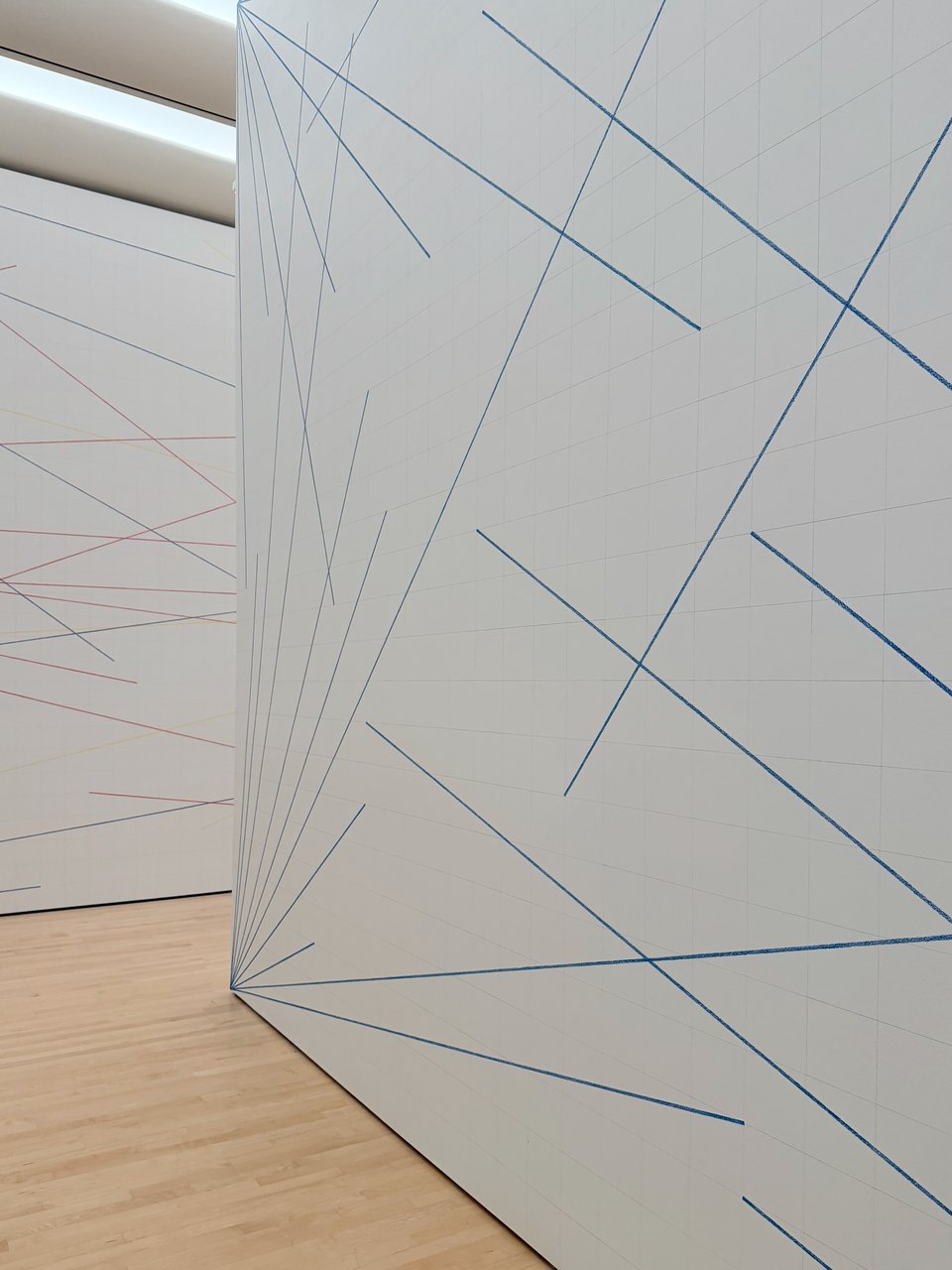
I had never heard of Sol LeWitt, until our oldest and I ran across his work at SF MoMA. I try to make these art breaks, well, “breaks”. But we’re continuing the instruction following theme with LeWitt. His works were shipped as detailed instructions, not completed artifacts. The piece above, Wall Drawing #273, is also titled:
A 6-inch (15 cm) grid covering the walls. Lines from corners, sides, and center of the walls to random points on the grid. First wall: Red lines from the midpoints of four sides. Second wall: Blue lines from four corners. Third wall: Yellow lines from the center.
Fourth wall: Red lines from the midpoints of four sides, blue lines from four corners. Fifth wall: Red lines from the midpoints of four sides, yellow lines from the center. Sixth wall: Blue lines from four corners, yellow lines from the center. Seventh wall: Red lines from the midpoints of four sides, blue lines from four corners, yellow lines from the center. Each wall has an equal number of lines. (The number of lines and their length are determined by the drafter.)
These instructions were used to “install” the work at the MoMA.
Elliot and I took copious notes and pictures as we explored the gallery, but I couldn’t resist putting this into an agent. You can view the results here.
Until next time,
Drew


