
Salvation in the Shadows
What is Christmas to those living in a land of deep darkness?
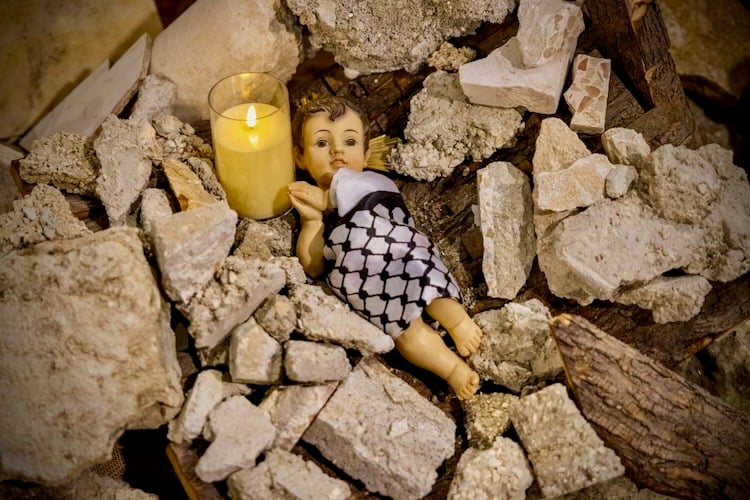
What follows is the sermon I preached on Christmas Eve. May we each know the presence of the God who enters our shadows.
“The people who walked in darkness
have seen a great light;
those who lived in a land of deep darkness—
on them light has shined.
You have multiplied exultation;
you have increased its joy;
they rejoice before you
as with joy at the harvest,
as people exult when dividing plunder.
For the yoke of their burden
and the bar across their shoulders,
the rod of their oppressor,
you have broken as on the day of Midian.
For all the boots of the tramping warriors
and all the garments rolled in blood
shall be burned as fuel for the fire.
For a child has been born for us,
a son given to us;
authority rests upon his shoulders,
and he is named
Wonderful Counselor, Mighty God,
Everlasting Father, Prince of Peace.
Great will be his authority,
and there shall be endless peace
for the throne of David and his kingdom.
He will establish and uphold it
with justice and with righteousness
from this time onward and forevermore.
The zeal of the Lord of hosts will do this.” (Isaiah 9:2-7)
What is the meaning of Christmas when federal troops are patrolling our streets? When families are being torn apart and children are left behind as their parents are disappeared? What does Christmas mean when church attendance in immigrant communities dwindles as a result of the threats from a so-called Christian presidential administration, when refugees are turned away from our borders, when asylum-seekers are sent back to persecution and the possibility of death, when Black women by the hundreds of thousands have lost their jobs under the current economic policies?
How, on this Christmas Eve, are we to think about the birth of Jesus? This year we’ve blinked away tear gas, we’ve blown into whistles to warn neighbors of the threat of abduction, we’ve watched powerful people gleefully claim the right to racially profile those they’re stalking. This year we’ve learned names which had previously been unfamiliar to some of us, only to forever associate them with tragedy: Altadena, CECOT, Kharkiv, Camp Mystic, Goma, Gaza City, North Darfur, Sumatra, and Bondi Beach. You could add to the list your own litany of places and people who’ve broken your heart this year.
Tell me, is it cognitive dissonance, religious paradox, or straight-up blasphemy to sing about angels and stars, to surround ourselves with gifts and lights when some who claim the name of the Christ child ignore the cries of Palestinian suffering, cheer the demonization of Black and Brown asylum-seekers, and delight in a government which twists Holy Scripture to serve its appetite for domination and humiliation?
Traveling in the United States late last fall, Palestinian pastor and theologian Munther Isaac wrote, “I was amazed by the amount of Christmas decorations and lights, all the… commercial goods. I couldn’t help but think: They send us bombs, while celebrating Christmas in their land. They sing about the Prince of Peace in their land, while playing the drum of war in our land.” Pastor Isaac’s response to the devastation rained down on his people, devastation funded by your tax dollars and mine, was to erect a nativity scene at the entrance to his church formed from broken concrete and other rubble, symbolic of the obscene destruction unleashed upon Gaza. “Christ in the Rubble” is how the nativity scene came to be known and it seems to me that any honest answer to the question of the meaning of Christmas in 2025 must pass directly through the wreckage in Gaza, the terror in Little Village, the civil war in Sudan, the malice being plotted in Washington D.C., as well as the subtler shadows consuming our hearts and hopes.
Isaiah found himself purified by divine fire and commissioned to prophesy to his people about their own land of darkness. Having struggled a hundred years as a nation divided, Judah and Israel now trembled under the looming threat of Assyria. An empire unlike any other, Assyria seemed to be constantly at war, consuming other, weaker nations and exacting crippling tribute. What chance did little Judah stand against the imperial machinery of war? Very little, it would seem. Comparing Assyria to a swollen river overrunning its banks, Isaiah foretold, [8:8] “it will sweep on into Judah as a flood and, pouring over, will reach up to the neck, and its outspread wings will fill the breadth of your land.”
Tonight, some of us know all too well what it feels like to have shadows of trouble and suffering “reach up to the neck.” Some translations of 9:2 describe the people of Judah as those who have lived “in the land of the shadow of death.” The land of the shadow of death is an apt description not just of life in the grip of imperial cruelty and creeping authoritarianism; it’s the personal, intimate stuff too. Among us tonight are those experiencing the dreaded first Christmas without a precious friend, a devoted parent, a grandparent who has always filled your memories. Here too are the bewildered and the shook, wondering how one year could take so much: friendships, jobs, mental health, savings accounts, marriages. We examine the things and people we’d assumed to be permanent only to discover it all crumbling like so much dust and detritus through our fingers. We find ourselves knowing far more about the land of death’s shadow than we ever wished to know. In a poem written to his unborn child, Clint Smith admits, “some days, I worry / that we are welcoming you into the flames / of a world that is burning.” (Above Ground)
We may not be under Assyrian siege but we are familiar with burdensome yokes and oppressive weights. Into these familiar shadows came notice of salvation, though God’s promise through Isaiah must have provoked as much confusion as it did hope. Isaiah prophesied that a royal child would rescue Israel, like light piercing the deepest shadow. “For a child has been born for us, a son given to us.”
Judah’s kings had proven inept and idolatrous for generations, but a child? Over the past few weeks I’ve greeted four brand new infants, born to families in our church. Each one is indescribably precious, gifts from God and reflections of God. And they are vulnerable, so vulnerable. Their mothers and fathers are discovering that most of their parental responsibilities involve simply keeping them alive. In a world marked by dominating power, insatiable greed, and bloodthirsty empires, a newborn infant might be a welcome distraction but is hardly a reason for hope. In the rubble of divorce and downsizing, depression and despair, death and more death, we can be forgiven for wondering if Isaiah’s prophecy is anything other than the typical Christmas sparkle which fades quickly as one year succumbs to the next.
But Isaiah isn’t naïve. He is uninterested in escapist religion and fleeting spirituality. His vision of salvation includes the downfall of material inequity: [3:15] “What do you mean by crushing My people and grinding the faces of the poor?” says the Lord God of hosts.” Salvation for Isaiah includes the demise of deceptive propaganda: [5:20] “Woe to those who call evil good, and good evil.” No otherworldly prophet, Isaiah expects God’s salvation to, [9:7] “establish and uphold [a kingdom] with justice and righteousness from this time onward and forevermore.”
In other words, coming from Isaiah, we ought to linger over “a child born to us, a son given to us.” There is something here that those of us formed by a cynical and violent age might initially miss. To see it though, to press more fully into the meaning of the Christ child, we’ll need to venture even more deeply into the shadows.
Because it turns out that the vision of salvation in Isaiah’s prophesy includes more than deliverance from the international menace of Assyria or the national peril of greedy and corrupt leaders. As early as 1:4 a more intimate threat comes in to view when God first addresses his people, “Woe, sinful nation, people laden with iniquity, offspring who do evil, children who act corruptly, who have forsaken the Lord, who have despised the Holy One of Israel.” The shadows from which the people needed to be saved were closer than Assyria looming outside Jerusalem’s gates. They were closer than the self-serving kings and self-righteous clergy who had betrayed their charge to protect the people. Death’s shadow lurked far closer, clouding minds and motives, obscuring righteousness and concealing justice. Though the people clamored for salvation from their enemies, Isaiah understood that a successful rescue would have to account for a more tender and persistent weakness.
I wonder, are we willing to hear in Isaiah’s warning an invitation to confess our own susceptibility to sin’s ancient shadow? [1:16] “Wash yourselves; make yourselves clean; remove your evil deeds from before my eyes; cease to do evil.” It is right that we lament the terrorizing presence of ICE in our city. It is appropriate to raise our voices in opposition to the spread of racialized nationalism and xenophobic scapegoating. But if our righteous dissent stops there, we have underestimated our peril. “A protest meeting,” wrote Wendell Berry, “is not a convocation of accusers, it is a convocation of the guilty.” (Think Little)
Are you willing to associate yourself with the convocation of the guilty? If not, Isaiah’s prophesy of a vulnerable infant whose birth would herald peace will remain the stuff of fantasy, a sort of emotional bypassing to distract us from life’s heartbreaks. The meaning of Christmas, of Mary and Joseph’s helpless son born into vulnerability and obscurity, always escapes those who will not confess their inability to hold back the shadow of sin. This is the paradox of grace– only those honest enough to confess, in Isaiah’s words, that [3:9] “they have brought evil on themselves” will know God’s comprehensive salvation. Only those humble enough to recognize that the shadow of death has not just manifested in that political party or that disease or that abuse of power or that betrayal or that corrupt system… only those humble enough to see the sinful complicity of our own hearts will recognize the meaning of God’s salvation as “a child born for us, a son given to us.”
The shadows we need saving from are not just the inequities and injustices shaping and shifting societies and systems. No, we need to be saved from our own sinful shadows. If this were not the case, perhaps God would have met force with force, power with power, empire with empire. Perhaps God would have brought about the world’s salvation with a spectacular display of military prowess or a government precisely tuned to justice or a ruler good and strong enough to achieve lasting peace. But what God declared, what Isaiah knew, and what the humble still confess is that the deep darkness is not only out there, it is here too. The shadows are here too.
I left off a portion of the Clint Smith poem to his unborn child which I quoted earlier. “[Some] days, I worry / that we are welcoming you into the flames / of a world that is burning.” And then, “Some days, I am afraid that I am / more kindling than water.” The shadows are here too.
And it is here, with this contrite confession, that the meaning of Christmas becomes clear to a people who have walked in darkness, who have dwelt in the land of deep darkness. To a people who recognize that they cannot rescue the world because they cannot rescue themselves, Isaiah’s news of a child born to us is good.
What is the meaning of Christmas? To Mary and Joseph, to the shepherds terrified in a Judean pasture, to the righteous Simeon and the prophetic Anna, and to each one of us who know what it is to live in a darkness we cannot escape, the meaning of the Messiah’s birth is as simple as it is profound: Salvation has entered our shadows.
Salvation has entered our shadows as a child, God en-fleshed in every one of humanity’s vulnerabilities. On us a light has shined. Surrounded by shadows outside and in, we have seen a great light.
Two summers ago, I drove to northern Michigan for a solo camping trip. On the first evening, I walked from my campsite to the lake shore as dusk disappeared into night. Arriving at the beach, I made myself comfortable in my folding chair and watched as the stars slowly flickered to light. As time passed and darkness settled, I began peering down the beach to my right and left, wondering if anyone else was out so late. Nothing. No one. Now the lakeside scene shifted. My perspective leapt from the beauty of the night sky to the depth of the darkness which had surrounded me. Something that tasted like loneliness crept into my consciousness. I was tempted to grab my flashlight, collapse my chair, and stumble back to my tent. But then, way down the beach, a light caught my eye– a campfire that a group of people had kindled in the sand. It sounds irrational, I know, but immediately my body relaxed. I sat back in my chair, stretched out my legs, and noticed again the beauty of my surroundings.
We each know the comfort of a light shining into our darkness– a child buried under the covers is soothed by a nightlight in the hallway; a late-night commuter is comforted by the streetlight halfway down the block. But the light of the Christ child, according to Isaiah, would be infinitely greater than any other light we’ve known. Unlike that far-off campfire, Christ the light does more than provide comfort from a distance. Writing his gospel, Matthew applied Isaiah’s words to Jesus as he began his ministry with a proclamation that the Messiah had come near. [Mt. 4:16] John also associated Jesus with light: [Jn. 1:3b-5] “What has come into being in him was life, and the life was the light of all people. The light shines in the darkness, and the darkness did not overtake it.”
Into a world overtaken by shadows of our own making was born the Light of the World. The infant wrapped in cloths and lying in a manger would be revealed as the Wonderful Counselor, Mighty God, Everlasting Father, Prince of Peace– divine, saving light pushing back the shadowy forces of sin, death, and the devil. But for your sake and mine, the Messiah’s salvation did not obliterate the shadows; for who among us could withstand that righteous fire? The zeal of the Lord of hosts did not focus his beam on annihilating evil from a distance; for which of us could survive that inferno?
No, the Light which entered the world came in the tenderness of human flesh, embodied in each of our vulnerabilities. And yes, his authority would frighten the Herods and Pilates of his day just as his reign threatens authoritarians and bullies today. His kingdom subverted the corrupt religious and political regimes then and it does the same now. As it is today, those who would make violence their means and domination their end had to twist themselves into knots trying to appropriate Jesus for their profane agendas.
But first, before Jesus of Nazareth would be lifted high on Calvary’s hill crowned with thrones beneath a placard deriding his kingship; before emperors and their empires quivered before the news of a crucified and resurrected Messiah; before Mary’s song about her son was banned by the rulers who figured out that they were the proud who would be scattered, the powerful who would be brought down, and the rich who would be sent away; before struggling Filipino women and men found in their Savior Jesus the courage to politically organize in resistance to an oppressive regime; before American citizens of African descent found a narrative of liberation running from Exodus through Calvary which inspired generations of emancipation; before our Latina and Latino neighbors found Christ to be a foundation solid enough from which to stare down state-sanctioned terror; before this world quaked and trembled and before principalities and powers bowed down and before sin was subverted and the devil was demolished and death was given a terminal diagnosis… what I mean to say is that before anyone knew any better, Jesus came quietly, tenderly as light into our shadows, “a child born for us, a son given to us.”
The implications are endless but let me end with just one. “You have multiplied [the people’s’] exultation,” said Isaiah about the Messiah’s birth, “you have increased its joy.” By now we know not to imagine a scene of sentimental spirituality. No, the people rejoicing in the shadow-shattering light are besieged. They have known “the bar across their shoulders.” The shadows around them are thick. But such is the power of this divine child’s birth that no shadow of oppression or sin is so deep as to dilute the joy of his salvation.
Into Bethlehem’s silent night, joy was born. Into the suffering of empire and exile, joy was born. Into religious and political corruption, joy was born. And while much has changed in the 2,000 years between the fulfillment of Isaiah’s prophesy and today, this has not: The light still shines in the darkness, and the darkness still has not overtaken it. The light shines in your shadows, and the shadows have not overtaken it, do not overtake it, will not overtake the “Son of God, love’s pure light.”
Child of God, take courage. Our shadows are deep, but there is no shadow so deep that the light of Christ cannot pierce it beginning to end. Your sin is great, but there is no sin so great as to overcome the Savior whose reign of grace knows no end. Our world’s suffering may seem endless, but there is no suffering so entrenched that it can withstand your Lord’s justice and righteousness, established and upheld from this time onward and forevermore. The zeal of the Lord of hosts will accomplish this. The zeal of the Lord of hosts has accomplished this!
The View From Here
Merry Christmas! As always, thanks for following along with this little newsletter. Especially this topsy-turvy year, I’ve been grateful for those who are committed to the way of Jesus through it all.


