
Reconciliation and More (and More) Truth
In a polarized society, reconciling churches offer a unique gift.
Back in January, in the first newsletter of 2025, I began what turned into a 10-part series about the racial reconciliation movement. As I wrote then, these reflections were provoked by two observations.
Most obvious are the hostile circumstances embodied by the president-elect and his many vocal Christian supporters. It’s hard to describe unless you’re in a church like ours, but the rise of white Christian nationalism and the adaptation of white evangelicalism to a form of dominating partisanship is felt strongly by many in multiracial congregations. A particular stress and strain is being exerted on these tender communities. What, I’ve wondered, does the reconciliation movement look like as racial antagonisms are provoked and leveraged for political power? Especially when those wielding that dominating power share our Christian identity?
The second reason for wondering about multiracial churches right now has to do with my sense that we’re living through a new iteration of the reconciliation movement. I’ve written about this for Missio Alliance, my understanding of the phases the movement has gone through: invisible, idealized, and interrogated. (Parts one and two.) And after interrogation? Well, I think that’s where we are now, in what I think of as a space for re-imagining the multiracial church movement.
As the year draws to a close and as we’ve lived through almost a year of the administration’s hostility, I found myself returning to these reflections, wondering how they held up in the harsh light of state-sanctioned racial profiling, lawless law enforcement, presidential race-baiting, and more. You can find links to each reflection below but, as a whole, I believe this theological vision for reconciled and reconciling churches doesn’t ignore any of the horrors we’re living through. For example, in “Reconciliation and Warfare” I wrote,
The acknowledgement of evil, of the spiritual warfare intrinsic to confronting systems of cruelty, inequity, and exploitation, is critical to a Christian understanding of racial reconciliation and justice. It’s not inanimate societal structures or uniquely wicked individuals who are the source of the opposition we face. As we represent God’s righteousness in unjust situations and systems, we find ourselves battling “against principalities, against powers, against the rulers of the darkness of this age, against spiritual hosts of wickedness in the heavenly places.” (Ephesians 6:12)
In my almost twenty years of multiracial ministry, never have I so regularly been reminded of this fact.
With a bit of distance, I notice something I didn’t do in this series was to specifically note the many gifts of racially reconciling congregations. Some of those gifts occasionally surface in the reflections. In “Reconciliation and Joy” I mentioned how encouraging our church potlucks and service at a local community garden have been to our community.
When we align our priorities and decisions with Christ’s reconciliation, we are doing more than just agreeing with God's good purposes; we are wading into the river of God’s joy. Delicious potlucks and bountiful garden harvests are small expressions of the kingdom of God which, as the King James puts it, is “righteousness, and peace, and joy in the Holy Ghost.”
Earlier this week I was reminded of another one of the reconciling church’s gifts, and I thought it would be a good note to wrap-up this series with. I’d been invited to speak to a church group in the western suburbs about discipleship and politics. During our discussion, a theme which came up a few times was our ability to know the truth. We were talking about the impact of partisan polarization and one man shared about the push-back he gets from friends about current events. He’ll share an article from a newspaper which, in this case, describes how immigrants are being treated by the federal government only to be met with, “That’s not actually happening.” He admitted that these reactions have made him wonder about the trustworthiness of his news sources.
Another person bemoaned a similar dynamic after I shared the recent report from Pew Research which found that “Eight-in-ten U.S. adults say that when it comes to important issues facing the country, Republican and Democratic voters not only disagree on plans and policies, but also cannot agree on basic facts.” Nodding vigorously, she told the group that this has become her regular experience, even with long-trusted friends and family members.
And then, as I was getting ready to leave, an older woman who I’ve known for many years gave me a goodby hug. “It’s just hard to know,” she lamented, “how to know what is true any more. It doesn’t seem like anyone can agree on what’s happening.”
Hearing the sadness in my friend’s voice reminded me of one of the gifts of racially reconciling churches which I’m most grateful for. This gift is built on two theological convictions. First, Christians don’t lie. As followers of the Truth called to bear credible witness to the Truth, we speak truthfully to the best of our ability about everything: God, the world, and our own experiences. Second, Christians are more closely related to those who’ve also been submerged beneath the baptismal waters than with anyone else, including with those whose hereditary lineage we share.
Taken together, these two convictions provide an important way to discern the truth: We believe our sisters and brothers in Christ.
There are all sorts of ways this doesn’t happen in the wider church. I’m always confused by the U.S. Christians who remain staunchly supportive of the policies of the nation of Israel despite the stories of displacement and violence shared by Palestinian Christians. Closer to home, how is it that so many U.S. Christians go along with the administration’s lies about the criminality of migrants when, in fact, most who are subject to deportation share our Christian faith? And how many times over the years have I overheard white Christians speak authoritatively and pejoratively about communities of color despite no relational proximity to those communities? It’s no wonder that so many of these Christians find themselves subject to truth-obscuring polarization.
But the view from a multiracial, reconciling community is different. Here, exposure to wildly different experiences and perspectives is normal. Members of these communities have access to the truth about societal dynamics which haven’t obviously impacted them, to historical events which they hadn’t previously known about, to hopeful possibilities which they’d previously assumed to be impossible.
All of this is available to members of reconciling churches because they’ve been etched into a trustworthy community of truth-tellers whose experiences, aches, and wisdom are a prism of diverse lives reflecting a fuller version of truth than any of us can access on our own.
Racially reconciling churches have a bunch gifts to offer its members but, in these deceitful days, perhaps none more so than the confidence which comes with knowing more and more of the truth.
You can find previous reconciliation reflections here: Reconciliation and New Creation, Reconciliation and the Preferential Option, Reconciliation and Repair, Reconciliation and Warfare, Reconciliation and Prophetic Witness, Reconciliation and Politics, Reconciliation and Joy, Reconciliation and Place, Reconciliation and Truth, and Reconciliation and Undermining the Racial Binary.
(Photo credit: MART PRODUCTION)
Speaking in 2026
As of this week, I’m done with speaking and preaching engagements for the year. I’m grateful for the privilege of sharing with different communities and I’m looking forward to a few quiet weeks. Early next year, I’m speaking a couple of times at the Evangelical Covenant Church’s Midwinter Conference in Chicago and I’ll be in Phoenix in February with some good friends. I hope to see some of you at either of these… though I’ll be more impressed if you travel to Chicago in January than Arizona in February!
The View From Here
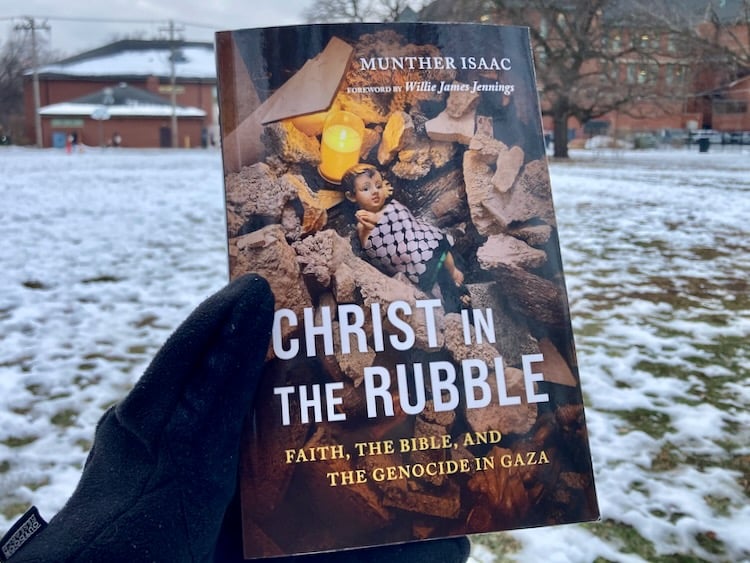
Yesterday, on my regular afternoon walk to pick up our youngest son from school, I stopped by The Seminary Coop to pick up Munther Isaac’s latest book, Christ in the Rubble. Has anyone read this yet?


