
Protesting in Church
Exposing hypocrisy and inviting repentance
Two weeks ago, the Cities Church congregation in St. Paul, Minnesota was interrupted in the middle of their Sunday worship service. In the thick of the cruel immigration raids that had been unleashed on their region, protestors learned that one of the church’s leaders works as the “acting director of ICE’s field office for enforcement and removal operations in St. Paul.” Chanting “ICE out” and calling out the church leader by name, the protestors shut down the worship service.
Responses came quickly as news of the protest spread beyond Minnesota. The Billy Graham Evangelistic Association described the protestors as a “mob” who “invaded” the church. Albert Mohler labeled the protestors “leftist agitators” who traumatized the congregation’s children and teenagers. Joe Rigney, one of Cities Church’s founding pastors, wrote that the “brazen invasion of a Christian worship gathering demonstrates the lawlessness of the modern left.” To Pastor Jentezen Franklin, the protest was "a form of terrorism toward Christians and their families."
Even those who have opposed the ICE raids around the country were critical of the protest. While Pastor Brian Kaylor thinks that having a pastor who is also an ICE official is “a serious moral failure,” he also believes that it “would be very alarming if we come to see this become a widespread tactic across the political spectrum.” While visiting Minneapolis, Episcopal Bishop Mariann Budde, who asked President Trump to show mercy to the vulnerable during the inauguration prayer service last year, said that no one “should fear for their safety or security in a house of worship — whether they are members of Cities Church or immigrants afraid to enter for fear of detention.”
While this protest has provoked a lot of strong, public responses, journalist Sarah Einselen helpfully points out that it is not the only church-related protest in recent years. While speaking at Emmanuel AME Church, President Biden was interrupted by protestors demanding a ceasefire in Gaza. During a visit to a church in Philadelphia, Vice President Harris was disrupted while sharing remarks with the congregation. Pro-Palestinian protestors were arrested after disrupting the Easter Mass at St. Patrick Cathedral in New York City. Outside the same cathedral, pro-choice protestors were arrested on a Saturday morning. Here in Chicago, another group of pro-choice protestors disrupted the Mass at St. Joseph Catholic Church. And in Florida, groups of conservative protestors disrupted Sunday worship services at four theologically progressive churches.
This quick summary reveals that, while Christian leaders across the ideological spectrum have largely criticized or condemned the protest at Cities Church, this kind of event is not especially unique nor can it be easily associated with either partisan side. Ideologically liberal and conservative protestors have both chosen to target churches in order to amplify their agendas. While someone like Denny Burk identifies the protestors as a “group of leftist radicals” who committed “ungodly sacrilege… a desecration of worship,” the precedent of selecting houses of worship as sites of protest is messier than he acknowledges.
In fact, it’s a much older precedent I’ve been thinking about since first learning of the Sunday morning protest in St. Paul. In the early 1960s, at the height of the Civil Rights Movement, historically white churches in the American South faced the prospect of having their segregationist racism exposed as protestors called for racial integration everywhere, from lunch counters to public transportation. Why not churches?
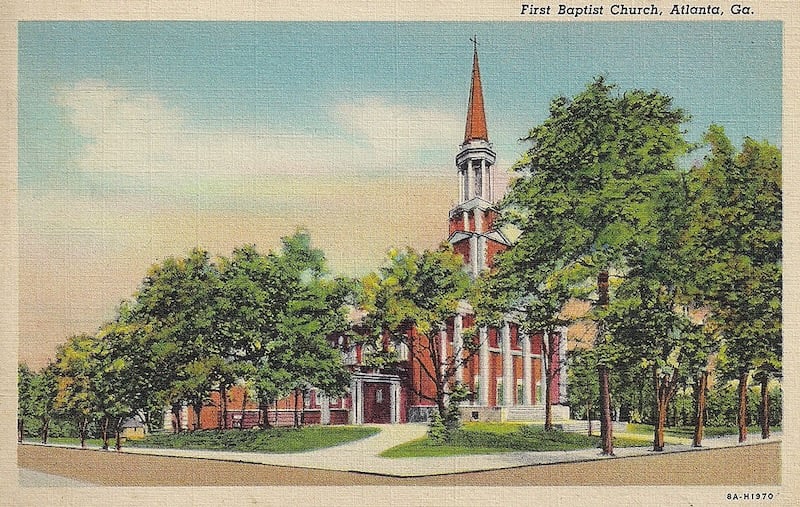
The first “kneel-in” protests occurred in white Atlanta churches. Small groups of Black young people visited segregated churches throughout the South, asking for the same hospitality which would be extended to them had they been white. Protestors would often be turned away at the door. Other times they were ushered to a balcony or back row and a deacon was stationed next to them throughout the service. At First Baptist Church, the young people were confined to the lobby.
[Ruby Doris] Smith later recalled that, while she was prevented from entering the main sanctuary, she could still see the worshipers inside. Some looked at her and quickly averted their eyes, while others glared for a long time. The kneel-ins had begun to make churchgoing into a more self-conscious practice, as excluded African Americans were now in sight just beyond the sanctuary doors. Smith decided on a course that both marked her as a sincere Christian and also criticized the attitudes of those within the church proper: ‘I pulled up a chair in the lobby and joined in the singing and worship services which I enjoyed immensely.’
Echoing some of the response to the Cities Church protest, the chairman of the ushers said of the young women and men, “They were just a bunch of agitators.”
Watching the protests from Decatur, the local Presbyterian Church attempted to head-off controversy by adopting a motion on integrated seating. “The ushers,” read the document, “are to reserve the back pew of center section for seating any colored visitors until 11:15 o'clock and after this hour they may not be admitted if this space is occupied by others.” The motion went on to state that in “case any negroes apply for membership” they would be referred to another church and assured parents that there would “be no intermingling of white and colored boys and girls” in Sunday School.
Other historically white churches responded to the kneel-in protests by removing their overt racially exclusionary barriers, some more quickly than others. Even First Baptist Atlanta, just before Christmas 1963, voted to integrate the congregation. Whatever their actual motives or theological convictions, the sight of Black Christians being forcibly barred from entering their church buildings was simply too embarrassing for many white congregations.
So, do the kneel-in protests during the 1960s shed any light on how Christians can think about the protest at Cities Church? There’s one tactical difference and one strategic similarity that I’ve found helpful.
The tactical difference between the kneel-ins and the response to ICE is significant. The Black young people who visited white churches made the point to not disrupt worship services with anything other than their presence. Everything the protestors did, had they not been singled out by race, aligned with the norms and attitudes of the congregations they visited. In contrast, the protestors at the worship service two weeks ago were purposefully disruptive. We can imagine a different scenario in which the protestors wore “ICE out" t-shirts while otherwise participating harmoniously in the service. They chose a different tactic.
While the tactics are different, there is strategic resonance between the two forms of church protest. In his Letter from Birmingham Jail, Martin Luther King, Jr. asked of the segregationist white churches, “What kind of people worship here? Who is their God?” As Joseph Kip Kosek points out, by their very presence in those churches, the kneel-in protestors “called the question.” The Black protestors revealed how white churches had betrayed their identity as God’s reconciled people.
Nekima Levy Armstrong, one of the organizers of the Cities Church protest, described the action in similar terms. “I believe,” she said, “that if someone professes to represent the Gospel of Jesus Christ and to preach it, that they should not be allowing ICE agents to drag people out of their homes.” In other words, from Armstrong’s perspective, by allowing one of its pastors to persecute, intimidate, and terrorize people in its community, the congregation failed to be who it claimed to be. The disruptive nature of the protest and the the quieter tactics of the kneel-ins point in the same strategic direction– uncovering the harmful hypocrisy of those who claim to worship Jesus.
So, how do you think about the church action in St. Paul? Given the vantage point provided by the kneel-in protestors, here’s where I land. While vehemently disagreeing with those who’ve labeled the protestors as invaders, terrorists, and agitators, I wouldn’t have chosen their disruptive tactics. The images of cowering children and confused worshipers distract from the message the protestors wanted to communicate.
But, given the pervasive and amplified association of Christianity and nationalism, I think we need to consider the strategic goal of exposing the hypocrisy which hides behind theological language and church facades. Those who’ve normalized this hypocrisy – racism, nationalism, etc. – are never going to welcome the bright light shined by protestors. It’s easier and frustratingly effective to slander these voices than to consider the invitation they’re offering. True, the Black youth who courageously entered white southern churches were making a way for themselves in a segregated society. But, importantly, they were also offering the white congregations redemption. By providing the opportunity to choose hospitality instead of exclusion, these churches were being given then chance to be who they had long claimed, and failed, to be.
Similarly, the women and men who disrupted worship on that cold January morning in St. Paul, whatever you think about their tactics, were inviting the congregation to grow more closely into the image and likeness of their Savior. What an amazing witness it would be for that church to reconsider its tacit support of the harassment of their neighbors. To repent and align themselves in word and deed with their Savior who is, even now, to be found among their terrorized and besieged neighbors.
Whatever our tactics, may this kind of radical repentance and reconciliation be our strategic goal.
Racial Reconciliation and Healing Video Series
Speaking of Baptist churches, last year I joined Pastor Travis Collins of First Baptist Church in Huntsville, Alabama for a video project he was working on. Honest Conversations: Seeing Race, Speaking Truth is an eight-part video series which is available now from InterVarsity Press.
The View From Here
We got a bit more snow yesterday which always brightens up these grey January days, including the view of my son’s elementary school as I walked to pick him up.


