
November Ephemera, Etc.
Elections, AI, and acorns
Back in September I shared a few things that had recently invited my attention. Here in Chicago, with yellow and brown leaves collecting under the trees and gusts of icy rain blowing through the city, we are deep into autumn and it seems like a good time to share some more attention-worthy items.
{1}
As Mississippi was still counting its votes, Richard Wilson, an author and one of our church’s leaders, reflected on the possibility of the state’s first Black senator since Reconstruction.
More than a century and a half separates Hiram Revels from Scott Colom. Generations were born, lived, labored, and died within that distance, their rights promised in one decade and denied in the next. We call this progress, perhaps because the alternative would require a more uncomfortable accounting.
And so I return to the history I have been attempting to give life to on the page. To Hiram Revels and the brief flowering of Black political power after the Civil War. To the constitutional promises made during Reconstruction and the determined efforts to render them meaningless. To the men and women who planted hope in Southern soil knowing full well that others were preparing to tear it out by the roots.
History asks more of us than to marvel at how far we have come. It asks whether we will tend what others planted at such terrible cost, whether we will mend what was broken and guard what was won, whether we will leave to those who come after us a world less burdened with wounds.
Richard goes on to connect these historical events, fraught with justice deferred, and the gospel Christians proclaim under such circumstances.
This is the peculiar burden of Christian hope. We proclaim an empty tomb while standing in a world still crowded with suffering. We speak of resurrection, of a kingdom coming, while despair remain stubbornly alive among us. We cannot repair every injustice or bring about God’s kingdom by sheer force of human will. But neither can we use that limitation as an excuse for doing nothing.
{2}
In response to last week’s newsletter, When White Christians Lose, I heard from some white Christians on social media who accused me of being a political liberal and others who thought I’d accommodated the political conservatives. Social media is a terrible environment for discussions and debates but it does provide a space to model the sort of faithful, Christlike posture we try to embody. This was my reply to the critiques.
In response to something I wrote about the recent election, some white Christians warned me about capitulating to the progressives and others scolded me for accommodating the conservatives.
Missing from these critiques was any appreciation for the sisters and brothers who've always endured outside the social-political-theological binaries which define white Christianity.
We’re not chasing lukewarm centrism. No, the goal is vigorous disinterest in white Christianity's predictable enemy-making. The goal is joyful solidarity with the members of Christ's Body who exist beyond the protection of the progressive-conservative binary. The goal is singular allegiance to the Son of God who still scatters the proud and exalts the lowly.
Moments of political upheaval provide Christians the chance to critically reflect on where our hopes have been placed, who claims our ultimate allegiances, and which sisters and brothers have formed our empathetic imagination.
{3}
I continue to scratch my head at the rapid adoption of AI technologies by Christians and our churches. Protestants and Evangelicals, perhaps unsurprisingly given our history of treating new technologies as value-neutral tools which can be appropriated for spreading the gospel, seem especially eager to jump into the deep end of the AI slop, uh, I mean, pool.
As I’ve been trying to find some wisdom for our AI moment, it’s been a mix of older along with more recent books which have proven helpful. In his 1985 book about the cultural impact of television, Amusing Ourselves to Death, Neil Postman goes back to an even earlier communication technology. About the telegraph, Postman writes about the radically new idea, “that transportation and communication could be disengaged from each other, that space was not an inevitable constraint on the movement of information.”
The advent of “context-free information” turned “information into a commodity, a ‘thing’ that could be bought and sold irrespective of its uses or meaning.” I think you can easily trace Postman’s new idea through the development of social media and, now, especially to AI. After all, what better encapsulates a world of context-free information than systems of so-called intelligence which scrape the internet for information, remove them from their particularities, and then produce a mash-up of information for users who’ve been formed for so long by space-transcending technologies that we hardly notice how weird it all is.
{4}
In place of my typical Sabbath walks through Jackson Park, this fall I’ve often used my Tuesdays to drive over to the nearest trail at the Indiana National Lakeshore. The Paul H. Douglas trail winds through an oak savanna which was hit especially hard by one of the big windstorms which swept through our region this summer. I mention the storms and downed trees because there seem to be an inordinate amount of acorns on the ground this fall. (In a book about oak trees I read this summer, I learned that oaks trees occasionally produce a bumper crop of acorns, a phenomenon known as masting. Could this, rather than the storms, be the cause of the acorn abundance?) During my walk through the savanna to Lake Michigan earlier this week it seemed like every blue jay and red headed woodpecker in the area was feasting on the downed acorns.
One particularly hungry family of deer could hardly be bothered to move off the trail as I passed by. When I got home, after consulting the Law’s Guide to Nature Drawing, I made my first attempt at sketching one of those distracted deer. I’m not brave enough to share it here but I don’t think my rendering was completely terrible.
The View From Here
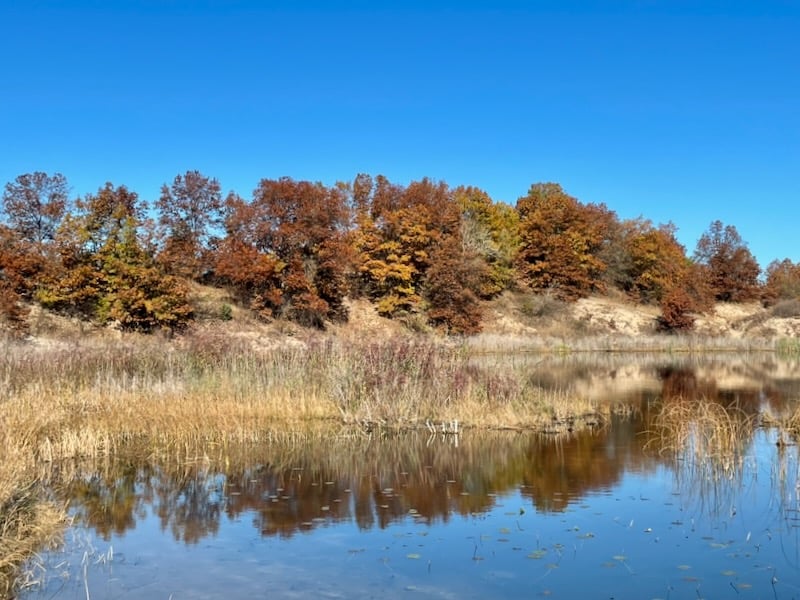
Speaking of the Indiana National Lakeshore, here’s the last stretch of the trail as you leave the forest for the dunes before reaching the lake. How great are those muted autumn hues?


