
Deeply Rooted Action
On beginning to belong to our places

The following is a lightly edited talk I recently gave at a conference in Phoenix, adapted from the themes I discuss in Plundered: The Tangled Roots of Racial and Environmental Injustice.
Introduction
I’m an activist by nature. Along with other Chicago clergy, I’ve organized marches and protests in response to local and national injustice. We’ve prayed outside of police headquarters, shut-down a major interstate, and laid our bodies down in busy intersections. A couple of summers ago, I invited faith leaders to join me outside of a notorious gun shop. Just across the state line, this one shop was responsible for selling most of the guns used in violent crimes in our city. We laid down on the sidewalk, blocking access to the store, and prayed through a bullhorn asking God to close down the shop and protect vulnerable lives.
I’m also a doer. In addition to helping start our church 16 years ago, I also founded our nonprofit which utilizes restorative justice practices to address youth trauma in our community. Through peace circles, a community garden, an annual back-to-school fair and other neighborhood activities, New Community Outreach gets to serve hundreds of young people each year as we build strong community attachment together.
I’m starting with my orientation to action not because it’s unique; many of you are also activists and doers. No, I mention it because I don’t want you to misunderstand what I’m about to discuss. Action matters. Doing justice matters. Following Jesus involves proclaiming the kingdom of God in word and deed. It involves loving all of our neighbors as ourselves. Following Jesus, as we’ve been reminded recently, can mean literally laying down your life for your vulnerable neighbor. The fact that you’re at this conference means I probably don’t need to convince you about the Christian obligation to act justly in the world.
But there is a connection to action that many of us do need convincing of– belonging. Let me say it like this: Many of us are working for God’s peace and justice in our communities without belonging meaningfully to those communities. Or we are advocating on behalf of our neighbors without actually experiencing friendship with those neighbors. Or we are seeking justice for God’s creation without considering how our local ecosystems and watersheds are sustaining our lives. In other words, our actions are often untethered from belonging.
So, I want to make the case for belonging – including why it’s hard for most of us but also why it’s possible – and how we can nurture belonging so that our actions have roots deep enough to sustain us for the long-haul.
Created for Belonging
Genesis 2:8 tells us that “the Lord God had planted a garden in the east, in Eden; and there he put the man he had formed.” In the garden humanity is fed by creation, is in relationship with their fellow creatures, finds fellowship with each other, and knows intimacy with God. Eden is a vision of harmony, of interdependence sustained by the love of God. “The definitive relationships in the universe,” writes Wendell Berry, are “not competitive but interdependent.” Adds Pope Francis, “Creation is of the order of love. God’s love is the fundamental moving force in all created things.”
God created us for relational belonging with God, one another, and creation itself. Each autumn my family drives an hour east into Indiana to visit the Pavolka Fruit Farm. It’s a small, well-kept farm which has been in the Pavolka family for over a hundred years. I love walking down the hill into the apple trees, plucking varieties unknown to most grocery stores: Northern Spy, Winter Banana, Turley Winesap, Arkansas Black, 20 Ounce Pippin, etc. Walking back to our car, our reusable grocery bags loaded with fruit, I feel a sort of belonging between this place and the people who’ve tended it for so many years. It seems to me an echo of what we were made for.
Fundamental to being human is belonging to God, one another, and our places. When I claim that belonging is necessary for sustainable acts of justice and mercy, I’m not suggesting a method or a tactic. No, the claim is deeper: we were created for belonging. All of our witness to Jesus and our work with Jesus is meant to be sustained by relationships of belonging– with God, one another, and our places.
Severed from Belonging
While many of us have understood the importance of relational belonging with God and, perhaps to a lesser extent, with each other, most of us don’t have this kind of relationship of belonging with our places. For example, do you know where your water comes from? Who harvested your produce? What is the source of your electricity? Who are your neighbors? Do you know why does this group of people has access to safe neighborhoods and well-funded schools while this group of people doesn’t?
We think of this sort of ignorant disconnectedness as a benign fact of contemporary life. But, if we were made for belonging, we should expect something more unsettling about our rootlessness. As those created for relational belonging with God, others, and creation, it is our sin which has fractured each of these. Now our relationship with our places is characterized by Genesis 3:23, “So the Lord God banished him from the Garden of Eden to work the ground from which he had been taken.” Our posture toward creation has shifted, from loving interdependence to toil, competition, and mastery.
We tend to think of sin individualistically– I sin against God, my neighbor, and creation. But sin doesn’t only impact individuals. After all, who structured our societies, invented our technologies, and built our neighborhoods but sin-fractured, sin-uprooted people?
For example, in the 1930s, the federally backed Homeowner’s Loan Corporation created real estate maps for 200 cities around the country, documenting which neighborhoods were safe for home loans and which ones were deemed to be too risky. On the maps, neighborhoods shaded by red were deemed to undesirable to receive mortgages. In Phoenix, the neighborhoods where Mexicans, African Americans, and Asian Americans were allowed to live were all redlined, which led to generations of disinvestment.
As is the case in cities around the country, those neighborhoods which experienced government-supported segregation generations ago often continue to struggle to attract the infrastructure which other neighborhoods take for granted. Quality of local schools, proximity to pollution, access to healthcare can all be mapped onto those old real estate schematics from the 1930s.
Rather than inhabiting the world as those who belong in loving relationship with it, we have treated creation as a resource to extract and our neighbors as people to exploit. Through our invention of race, we placed some groups of people higher on our social hierarchy and others lower. The intention behind this hierarchy was exploitation, treating others as commodities whose land and labor could be stolen because they were less human than those higher and whiter on the hierarchy.
By treating creation not as a gift from our Creator but as a resource to plunder, we’ve organized the world into, as Daniel Castillo has written, “zones of extraction and accumulation. So, we have spectacular wealth bordering degraded watersheds, toxic pit mines, and mountaintops exploded for the elements hidden beneath. The mother of environmental justice, Hazel Johnson, described her majority Black housing development on the South Side of Chicago as “the toxic doughnut” for the way it was surrounded by polluted air and contaminated soil.
One of the results shared by most of us as a result of our societal sin is that we have been severed from belonging to our places. Some of us have been severed in the pursuit of the promises made by a society built on extraction and exploitation; we move frequently for a better school, job, or climate. Others of us have faced the more violent side of a world arranged by extraction and exploitation: refugees fleeing climate fueled disasters, asylum seekers driven from war, migrants leaving family behind in search of work, neighbors forced to leave generational land by toxic waste and polluted water.
You likely have a heart for the flourishing of your place. You want the best for your town, city, or suburb. You’re probably already working, serving, or ministering to see God’s shalom spread through your place. But how deep are your roots? Many of us are seeking the welfare of our places without actually belonging to them and, until we do, until we are reconciled to our places, all of our efforts toward justice and peace will fail to thrive.
Re-created for Belonging
Are we destined for this severing? Is this the best we can hope for in a world remade by systems of exploitation and extraction? This is a discouraging season for many of us. We’re watching societal sin be exacerbated in the forms of ICE raids, discarded environmental regulations, attempts to disenfranchise voters, and more. The temptation to cynicism can be strong. Christians who’ve limited Jesus to individualized and spiritualized salvation have little to offer in a moment like this. We find ourselves accepting the status quo as inevitable, content with private piety to get us through the worst of it.
But Jesus is more than our personal Savior. “All things,” according to John 1:3, “came into being through him, and without him not one thing came into being.” Adds Paul in Colossians 1:20, “through him God was pleased to reconcile to himself all things, whether on earth or in heaven, by making peace through the blood of his cross.” As Athanasius understood, there is nothing small or detached about the salvation Jesus accomplished. “What is most wonderful, even at his death… all creation confessed that he who was made known and suffered in the body was not simply a human being but Son of God and Savior of all. For the sun turned back and the earth shook and the mountains were rent, and all were awed. (On the Incarnation)
In Jesus, what sin had severed – our relationships with God, one another, and creation – has been restored. Though we live in the wreckage of extraction and exploitation, we have been freed from sin’s captivity to join God in restoring all things. And this begins with reclaiming what sin stole from us, nurturing the roots of belonging in the places to which God has called us.
Interlude
To review, we have been created for belonging– belonging with God, others, and creation. Sin, including its systemic manifestations of exploitation and extraction, has severed us from this belonging.
Considering the restless transience of many Americans, Robin Wall Kimmerer writes, “The problem with these new people is that they don’t have both feet on the shore. One is still in the boat. They don’t seem to know whether they are staying or not.”
Many of us are attempting the ministry of reconciliation while leaving our own un-reconciliation unattended. We’re advocating for migrants and refugees who’ve been forced to flee their homes but we haven’t learned how to make a home of our own places. We’re calling our elected officials about the latest industrial desecration of the environment, but we’ve yet to make friends of the ecosystem and watershed which sustain our places. We’re posting on social media about how the SAVE Act currently being debated in congress will disenfranchise people of color, but the racially segregated patterns imposed on our places continue to shape our friendships and congregations.
Instead of being nourished by roots sunk deeply into the soil of our places, many of us have worn ourselves out seeking mercy and doing justice by conforming to this world’s severing patterns.
But Jesus has reconciled all things! Jesus, wrote Athanasius, came that we might be “recreated.” Which means that the good work God has invited you to doesn’t have to deplete you, doesn’t have to use you up. Jesus, the Creator and Re-Creator, has reconciled us to God, to one another, and to Creation itself. The severed, rootless, transient life which characterize our post-industrial world doesn’t have to define us. We can learn to belong.
And it is from that belonging, from a reconciled and healing relationship with our places and their communities, that we get to love mercy, do justly, and learn to walk humbly with our God. Not in abstract, individualized ways but as those who are learning to truly see and love our communities.
Beginning to Belong
Here, then, is my claim: If we are to contribute to communities of flourishing, we must first learn to belong to our communities. Does that sound underwhelming? We want to change the world. We are aware of the scope and scale of the forces ripping the world apart. We are acquainted with suffering and sorrow. And my invitation is to… make a home
But considered from the wreckage of a world torn apart by sinful extraction and exploitation, what could be more unlikely? To choose to nurture roots in a particular place, among a particular people, attuned to a particular history of pain and possibility. To stand against the insatiable forces plundering the world by choosing persistent solidarity with your particular community of creation. To refuse conformity to our society’s sinful patterns which benefit a few while crushing so many others. As underwhelming as it might initially sound, the decision to allow Jesus to reconcile us to our places, to become people of belonging is radical in the true sense of the word: having roots.
Let’s assume that you’re with me so far. You believe that we’re made for belonging and that, despite the power of sin to sever us from the belonging God created us for, Jesus – the Creator and Re-Creator – is more powerful by far, and we can nurture the holistic belonging which is the soil for our rooted justice and mercy in the world. Let’s assume, as well, that most of us don’t have a memory of this kind of redeemed belonging. Hopefully the vision of deep roots in your place is attractive to you, but where do we start? For those shaped by cultures of extraction and exploitation, let me suggest three practices that can help us begin to belong.
First, we cultivate attention. Societies built on extraction and exploitation are structured to keep us from seeing their collateral damage. The persistent displacement of Palestinians in Gaza and the West Bank was fueled by the lie that the land was empty of inhabitants. Similarly, in our country the destruction of Indigenous people was justified by narratives of God’s judgment on so-called heathen people who hadn’t properly developed their land. On my family’s drives through the Pacific Northwest during my childhood, our view of miles and miles of clear-cut stumps was obscured by rows of trees just deep enough to provide the illusion of a forest. After years of living in a wealthy suburb, my wife began working at a nonprofit located in an out-of-the way neighborhood filled with low-income housing. It was here that the suburbs lawn-care workers, home healthcare providers, and restaurant cooks and serves made their homes, tucked away from the illusion of evenly distributed affluence.
We can’t belong to a community that we haven’t seen accurately. Farmers and gardeners show us what attention looks like. Over time they learn about the quality of their soil, they come to recognize the weather patterns others ignore, and they understand how to honor the grade of their land. The best of these agrarian caretakers demonstrate not just attention but also affection. It is their love for their place which allows them to see it most accurately.
Second, we learn names. I remember, the year before we started the church I pastor, my friend Michael driving me around the neighborhood and speaking important names to me. Over there is Pilgrim Baptist Church where Thomas Dorsey developed gospel music. That’s Metropolitan Community Church where the Pullman Porters organized in the basement. Now we’re passing Ida B. Wells’ house, where she raised and family and continued her anti-lynching journalism after being chased out of Memphis.
People who belong to their places know the names which shape their places, including the names of plant and animal life, of historical figures, and of locally known heroes still remembered by long-time residents. Each of these names opens a world of belonging.
Third, we honor margins. Christians often talk about serving those “on the margins” or caring for the “marginalized.” But learning to belong means honoring the margins. All that is left if the tall grass prairies which used to cover Illinois are a few remnants. Typically, these can be found under high voltage power lines, alongside busy highways, or in old cemeteries. Not most people’s idea of idyllic nature, these marginal spaces provide a reminder of what was and a vision of what could be.
Margins can be found in the places overlooked or discarded by our exploitative and extractive society. They are the in-between places. To belong to a place is to learn to see, honor, and be shaped by its margins. It is also to declare allegiance to the margins and those who’ve long made their homes there. Planting roots in the margins, worshiping in the margins, and developing friendships in the margins is evidence of truly belonging to a place.
By cultivating attention, learning our place’s names, and honoring the margins, we will find ourselves beginning to belong. Our roots will slowly descend into the soil which can sustain our peace-making and justice-seeking.
Conclusion
Friends, the good work of seeking justice and making peace to which we have been called in Christ requires deep roots. Whatever particular expression of God’s Kingdom you’ve been called to represent is generational work; we measure in decades. Do your roots go deep enough?
And this good work is meant to be good for you! Coming to belong to your place and its people is good. Contrary to the assumptions of this plundering society, seeking the good of our communities is not meant to use you up or wear you out. We are neither extractable commodities nor exploitable resources. No, we are God’s image-bearing creatures, created in Christ Jesus for the good works of mercy and justice.
So, may the Spirit of God draw our roots deep into the places to which we have each been called. May we learn to make of our places a home. May our commitment to our communities be a witness in the wreckage of extraction and exploitation that Jesus is re-creating the world. So that, with the psalmist, we might sing, “I believe that I shall see the goodness of the Lord in the land of the living.” (Psalm 27:13)
(Photo credit: Ylanite Koppens)
Reading
When we make, we invite the abundance of God’s world into the reality of scarcity all about us… I have come to believe that unless we are making something, we cannot know the depth of God’s being and God’s grace permeating our lives and God’s creation.
- Makoto Fujimura, Art and Faith
The View From Here
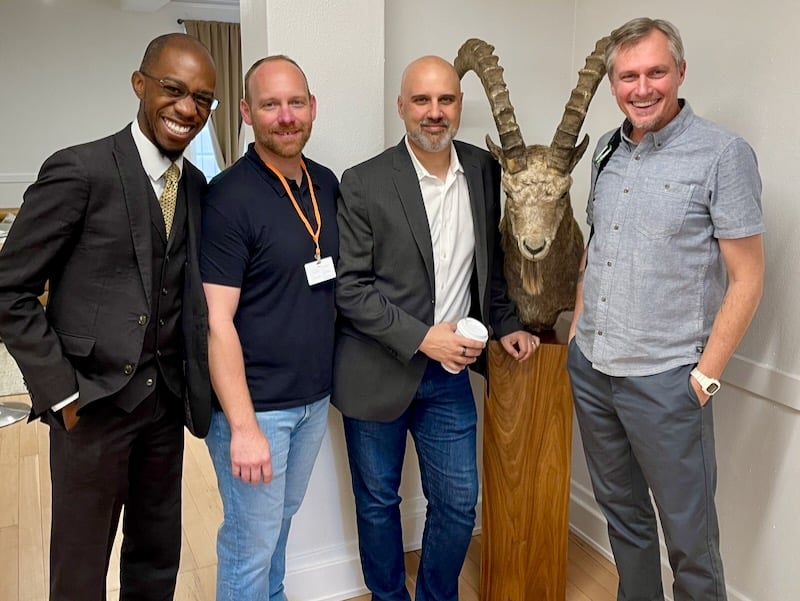
Despite the heat – 90 degrees in February?! – it was great to be in Phoenix last weekend with friends like Malcolm Foley, Caleb Campbell, Skye Jethani, and this impressive mountain goat.


