
Against Inevitability
The future has not been foreclosed

“This is just the ways things are going. There’s only so much we can do about it.” Over the past few months, I’ve been trying to understand the developments in the field(s) of Artificial Intelligence. Even after reading a bunch of articles, listening to podcast interviews with A.I. experts, and instigating some conversations with people who know way more about these technologies than I ever will, I’m still less than a novice. But I’m starting to notice some themes and the sentiment expressed above – an amalgam of different conversations, usually expressed with a sigh and a shrug – captures one of them. Any concerns about A.I. are irrelevant, this attitude suggests, because its advance is inevitable. Better to just get with the program.
Toward the end of their recent New Yorker profile of OpenAI founder and CEO Sam Altman, Ronan Farrow and Andrew Marantz note just a few of the concerning characteristics of different A.I. applications. “We increasingly rely on A.I. to help us write, think, and navigate the world, accelerating what experts call ‘human enfeeblement’; the ubiquity of of A.I. ‘slop’ makes life easier for scammers and harder for people who simply want to know what’s real. A.I. ‘agents’ are starting to act independently, with little or no human supervision.” The authors go on to mention the A.I.-generated robocalls impersonating President Biden which encouraged voters to sit out an upcoming Democratic primary, the lawsuits alleging that “ChatGPT prompted several suicides and a murder”, and the ways that A.I. is being integrated into military actions including in U.S. operations in Venezuela and Iran.
Despite these anti-human outcomes, Altman and OpenAI have moved away from focusing on safety protocols and, like other A.I. firms, are charging as quickly as possible into a future they believe is predetermined. “My definition of winning,” Altman told the New Yorker reporters, “is that people crazy uplevel–and the insane sci-fi future comes true for all of us.”
I’m not sure what it means to “crazy uplevel” but I think I’ll pass. Same to “the insane sci-fi future” of Altman’s tech-addled imagination.
But do we get to pass? In my attempt to understand how it is that A.I. companies have come to dominate societal priorities and determine our collective assumptions about the future, I picked up Shoshana Zuboff’s 2019 The Age of Surveillance Capitalism. Set in the years before A.I. came to dominate the tech world, Zuboff explores how tech giants like Google and Meta structure their platforms to capture our “behavioral surplus”– basically anything about us which can be suctioned up from our online activity and then sold to corporations who, using this stolen and sold personal information, then market their wares back to us.
Zuboff is keen to understand why we have collectively submitted to being increasingly surveilled and having the most intimate stuff of our lives become the grist for some corporation’s marketing. One of the effective strategies employed by the titans of tech is what the author calls “inevitabilism.” For example, about the tech leaders of Silicon Valley, Zuboff writes that “there appears to be universal agreement on the idea that everything will be connected, knowable, and actionable in the near future: ubiquity and its consequences in total information are an article of faith.”
Inevitabilism is “the opposite of politics and history,” but, as propaganda, it effectively enlarges corporate bottom lines. When interviewed by the author about how their employers describe the future, Silicon Valley data scientists “regarded inevitability rhetoric as a Trojan horse for powerful economic imperatives, and each one of them lamented the lack of any critical discussion of these assumptions.”
Beyond cloaking corporate greed and distracting us from how the technologies we’ve come to depend on treat us like commodities, inevitabilism serves as a powerful deterrent to those who’d prefer not make their homes in Sam Altman’s dystopic future. “This kind of historical framing,” warns Zuboff, “conveys the futility of opposition to the categorical inevitability of the march toward ubiquity.”
But if inevitabilism is an invention than it isn’t inevitable. Altman’s version of utopia isn’t a foregone conclusion, even if his investors want us to think it is. Though we’ve largely acquiesced to the intimate extractions of surveillance capitalism, we didn’t have to. A future in which our doorbells, speakers, and televisions are spying on us, stealing from us, and then selling what they’ve plundered back to us isn’t inevitable. “Inevitability rhetoric,” according to Zuboff, “is a cunning fraud to render us helpless.”
But we aren’t helpless and Christians, of all people, know this. We are not the sort of people who, with a sigh and shrug, submit to what someone else has decided is inevitable. “Do not be conformed to this world,” urges Paul in Romans 12:2. We conform to what appears to be inevitable but, through minds which have been made new, we can see through the deceptions of inevitabilism to the “good and acceptable and perfect” will of God.
The transhumanist future imagined by Silicon Valley isn’t inevitable. Neither is a world in which we surrender more and more of ourselves to algorithmic theft. The destruction of Gaza, the young people recently gunned down in my community, the hundreds of thousands of Black women who’ve lost their jobs during this presidential administration, the skyrocketing fortunes of the ultra-rich during wartime, the families continuing to live in fear of separation and deportation, our global neighbors who’ve grown sick and died since U.S. aid has been stopped… none of it is inevitable. And to continue their destruction, all of these atrocities require collective conformity to the myth of inevitability.
But on the other side of the resurrection of Jesus Christ, nothing is inevitable. If death’s victory is no longer inevitable, than neither is anything else. So, contra the utopian demands of the high priests of tech, I’m against inevitability. It’s a less comfortable way to live; it requires asking awkward questions and peeking behind the glittering veneers of efficiency and prosperity. Still, compared with the nightmare of an uplevled sci-fi future, I’m happy with my choice.
(Photo credit: Panchon in Motion.)
Deeply Rooted Action
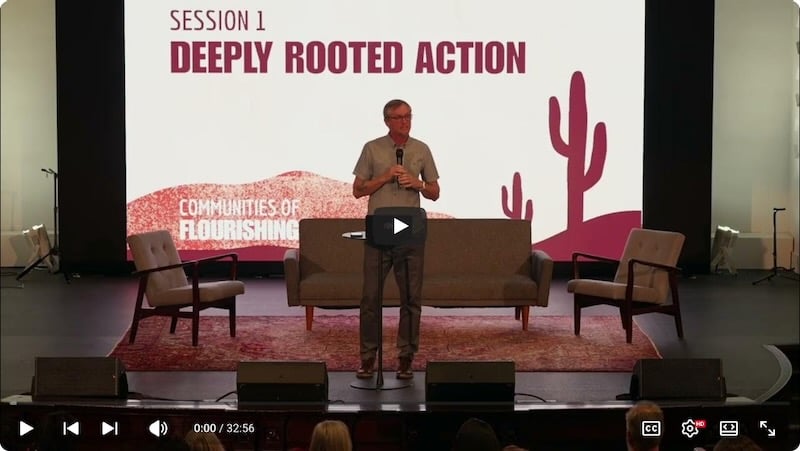
My talk from the recent Communities of Flourishing Conference in Phoenix has now been posted. Drawing from Plundered, I make the case that, in order to be holistically good, Christian action in the world must be deeply rooted in place.
Race Against Gun Violence
A huge thanks to Sue, Dale, Will, and an anonymous donor for contributing a total of $500 toward my $3,000 goal for the upcoming Race Against Gun Violence. All of the funds I raise will go to New Community Outreach, the nonprofit I helped organize nine years ago which creates restorative spaces for healing, reconciliation and flourishing in our community. Can you help me reach my goal?
The View From Here

It was nice to be welcomed by the Cascades as I arrived in Seattle yesterday. I’m spending the weekend with a really special group of people learning together about God’s desire for the reconciliation of all things.


