Five Links #120
1. X is bad, though
With decreasing subtlety over the past few weeks, John keeps pointing out that there’s a lot of fun to be had over on X, culminating in his piece today that “X Once Again Marks The Spot.”
His point, as I see it, is that yes, Elon Musk is awful, but the X algorithm no longer shoves his posts into John’s feed, and new Apple CEO John Ternus is posting there (along with other Apple executives), and that there are interesting people who post on X and not elsewhere.
That all may be true. But it’s not the point.
I appreciated Lex Friedman’s rebuttal to John Gruber’s recent glib statements about X. Friedman posted a follow-up to tackle the inevitable whataboutist responses, too:
Then there’s the bigger argument behind John’s question: You can’t avoid every bad billionaire, so why bother avoiding this one? Take that seriously and it’s an argument for never doing anything at all. Every line I draw is imperfect.
2. The race to the bottom feels inevitable…
This feels like a helpful perspective at a time like this:
We can justify most moves to the bottom while they’re happening, but the problem with this race is that you might win.
With effort, you might not get to the top, but without resolve, you’ll certainly find yourself at the bottom.
(via Marc)
3. The "Disability Dongle": Why Silicon Valley hates me and you.
I feel this disconnect every time a "Tech Bro" tries to sell me on the latest smart-glasses or haptic-feedback belts. I pick these things up, and they always feel the same. Cheap, clammy plastic. zero buttons except for the power button. They get hot against the skin after ten minutes. They hum with that constant electronic whine that gives you a migraine by noon.
It seems to me that “Disability Dongles” sit in the accessibility washing category, and Silicon Valley increasing leans on these examples when they’re pushed on the general harms of their products.
See also: “aren’t you excited about the potential of scientific and medical advances from AI?”
4. Most of what AI says about your brand, you didn’t write
Schema, llms.txt and mass-produced AI content have all been sold as ‘GEO tactics’. Which are a waste of money, and why do they keep selling?
All three, if you’re paying for them as citation tactics. Ahrefs looked at 1,885 pages in May and found AI Overview citations fell 4.6% after schema was added. SE Ranking found no relationship between llms.txt and AI citations across about 300,000 domains last November. Mass AI content is the Lily Ray finding I mentioned.
Over the last year or so, I’ve seen a lot of GEO ‘best practice’ recommendations that seemed a little sketchy. It’s good to see Ahrefs sharing data that backs up my hunch that GEO recommendations are largely snake oil.
Most of it is good SEO, good PR, and a product people actually want to recommend, with a new name and a bigger invoice. The spend is running well ahead of the proof. Chatbots send very little traffic, the measurement is shaky, and the tactics sold as GEO-specific mostly don’t move citations. What does work is being the brand that trusted third parties write about, and that was already true before anyone coined the acronym.
5. How to detect AI slop
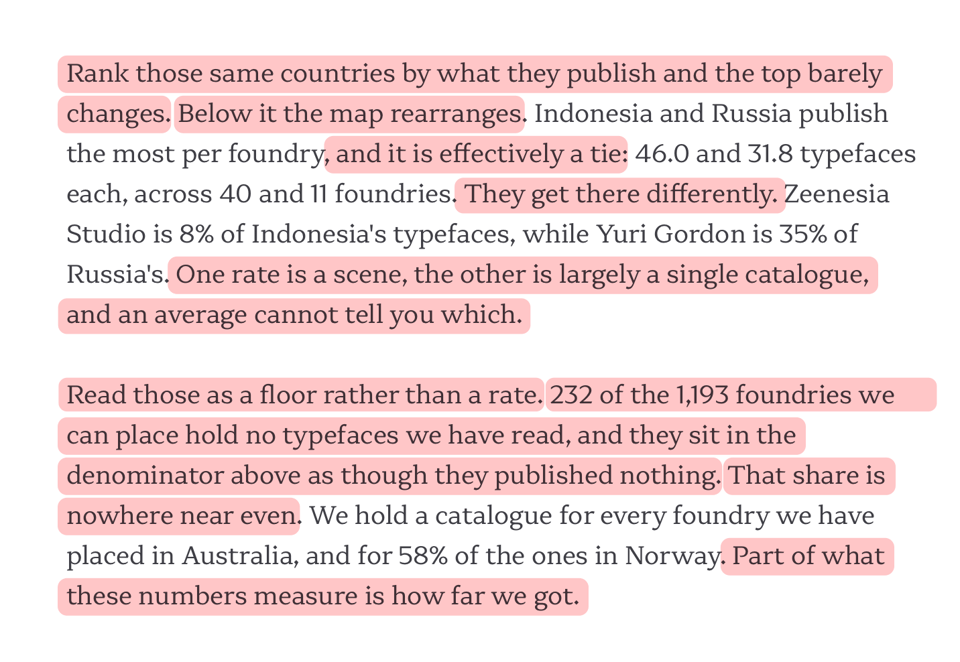
Last week I’d bookmarked a link to share, but when I started reading it I realised it was full of AI. Here’s a screenshot of two paragraphs – I’ve highlighted the bits that felt like AI to me:
As an AI-abstainer, I’ve largely been slow to pick up on LLM phrasing trends. That changed recently thanks to an interaction with some extremely long, terse and weird writing. At first I thought it was strange, then I started seeing that phrasing in AI-labeled writing, and I realised that what I’d been reading was all AI output.
One of the challenges with us all becoming AI Detectorists is that LLMs are trained on a lot of good writing devices: where do we draw the line between a common phrase and LLM use? This video does an incredible job of explaining the difference.
It also articulates something I’d felt about LLM output but couldn’t label: LLMs frequently use incoherent and/or mixed metaphors/concepts in a sentence.
We can see examples of that in the excerpt I shared earlier:
- “One rate is a scene, the other is largely a single catalogue”
- “Read those as a floor rather than a rate”
- “Part of what these numbers measure is how far we got”
I think this incoherence is partly what makes AI output so difficult to read, parse and interpret.
What am I up to?
- I’m testing something new: pairing sessions for developers tasked with design work and designers asked to push code to production. I can help identify all sorts of issues that an LLM won’t pick up and pose the questions it will never ask. The first session is free with no commitment.
- New design process interview with Emma Burr. Interesting to read that Emma has a strong preference for the process to not be totally remote: I really like this idea!
- My next available Unoffice Hour slot is 11 November (there are only three more Unoffice blocks until the end of the year!)
If you enjoy discovering the links in the emails, please tell other people about it: give it a share or forward it to someone you think might like it. If you were forwarded this email, you can subscribe here.
Until next time,
Dave
You’re receiving this email because you subscribed at davesmyth.com. If you would prefer not to receive these emails, you can unsubscribe.