2025: DARCest Year in History
Since launching DARC last April, it’s safe to say 2025 was intense: OpenAleph development, deep-dive data analysis, research projects, and speaking gigs around the world. It still feels pretty surreal that your support allows us to do what we love every day.
We’re a bit late with our ‘year in review,’ but figured it was worth waiting until everyone had settled back in after the holidays (which we hope were amazing!). So, without further ado, let’s dive in:
OpenAleph's Moment
OpenAleph had a big year. It officially came to life when we forked its now-sunset predecessor and fully committed to the open source community we love. In September, we shipped the major OpenAleph 5 release, then closed out the year with a small but mighty 5.1 update, sneaking in a few more features ahead of OpenAleph 6 later this year. Here's what 5.1 brought to the party:
- Sharper name searches: A toggle next to the search bar expands queries to include culturally and linguistically accurate name variants, like Vladimir / Владимир, powered by OpenSanctions’ improved matching logic.
- Team-friendly document tagging: A new shared tagging feature lets users label documents (like “to review”) and filter by tag, making it easier for teams to coordinate research.
- Better guidance for deploying and upgrading: Updated documentation now covers full deployment and administration instructions, plus migration guides for upgrading from OpenAleph 3.X/4.X or OCCRP’s now-sunset open-source Aleph.
What else did OpenAleph bring in 2025, you ask? Here are a few of our faves:
- Searchable audio & video: Transcribe and search media locally with Whisper. AI content is clearly flagged.
- Entity images: Wikidata pics give people and entities a “baseball card” look for faster recognition.
- Geocoded addresses: Map addresses as entities and spot shared locations and patterns.
- Discovery dashboard: See the most frequent names, companies, and places in a dataset at a glance.
- Smarter search suggestions: Find related names and entities that often appear together.
What Else We've Been Up To
We’ve onboarded a handful of new clients and jumped into some exciting projects, big and small. Just last month, we supported DER SPIEGEL, ZDF Frontal, and Paper Trail Media by making leaked emails from one of Jeffrey Epstein’s personal inboxes (courtesy of our friends at Distributed Denial of Secrets) available and searchable in OpenAleph. Using this leak, they reported on German victims, Epstein’s methods for luring women into his exploitative circle and the reach of his global network.
We also ran some very cool analysis on images from the Damascus Dossier, a massive journalistic collaboration led by NDR and ICIJ that exposes the inner workings of former Syrian president Bashar Assad’s regime. This super-nerdy deep dive breaks down how we extracted data from 100,000 highly graphic photos without anyone having to look at them. Ahh, using tech to protect journalists and let them actually do their work. Our love language.
We got to travel and speak... a lot
We filled the year with tons of speaking engagements and networking events at some of our favorite conferences around the world. We presented as DARC for the first time at DataHarvest, led a workshop on tracking ships and planes at Netzwerk Recherche, and joined a Full Stack Journalism live podcast panel to talk about why we run our own servers, to name a few. We finished the year strong:
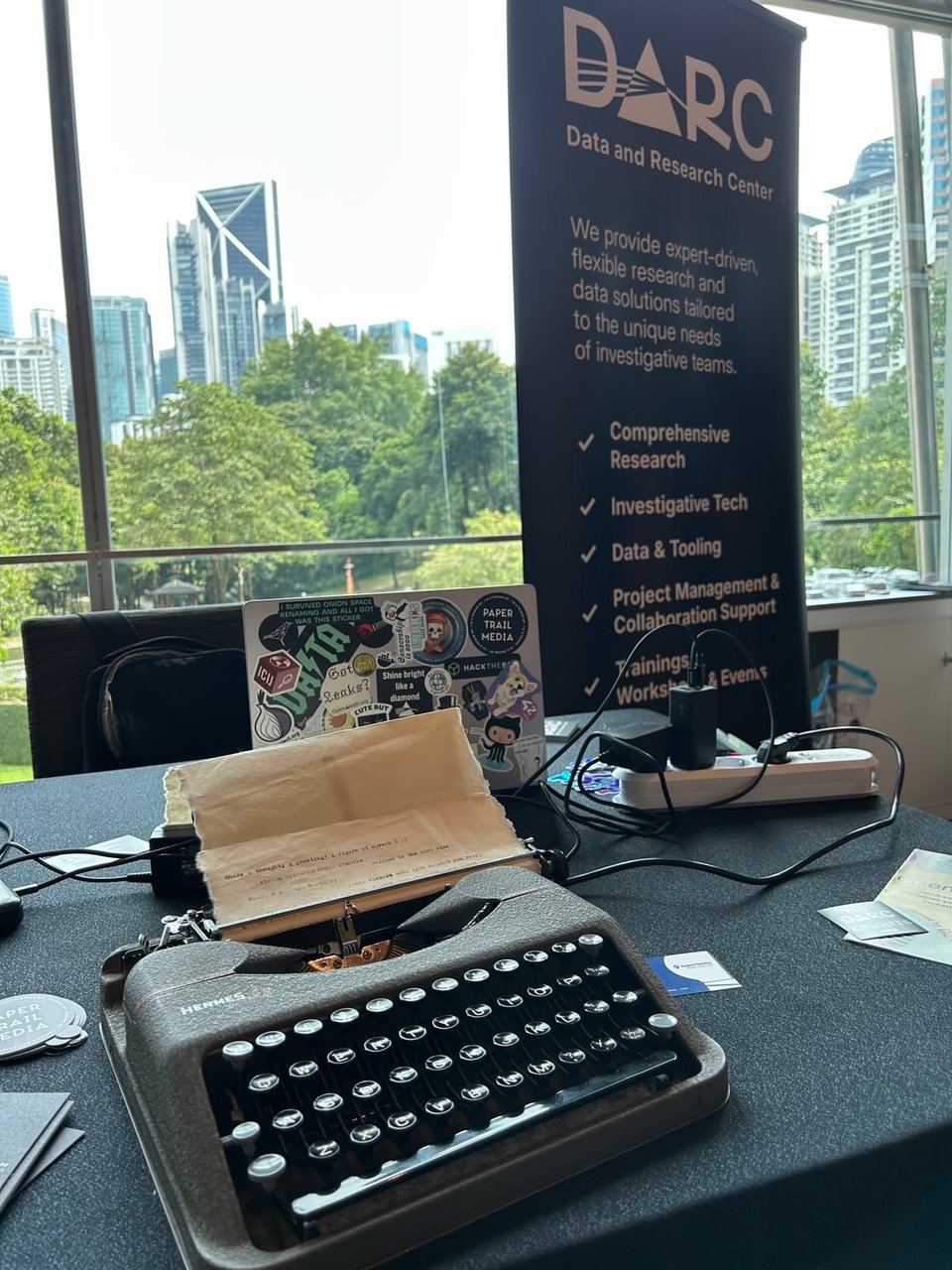
- In November, we headed to GIJC25 in Malaysia to hand out stickers and promote DARC at a (very long) table with our friends at FlokiNET. We ran masterclasses on using OSINT for investigations and joined our genius colleagues on panels about offshore company data, open source research, and investigating cryptoasset crimes. Our friend William from ImportGenius even lent us his typewriter to put on said (very long) table, which was the perfect gimmick to trick people into talking data and research with us.
- In December, Jan joined a two-day workshop at Stanford’s Big Local News that brought together researchers, practitioners, and data experts to talk about agentic AI in journalism. Alongside talks on how AI is shaping local and investigative reporting, the group took part in a hands-on hackathon, trying to get LLMs to understand the FollowTheMoney schema, and openly discussed the opportunities and risks of AI agents. It was a short but worthwhile trip, made even better when Jan spotted a huge fire truck with a separately steered rear axle, which thrilled his inner child.
Join Us on darc.social
We’re still working to create a place where investigators can geek out over the stuff they love most: OSINT research, building open source tools, and making data make sense. It’s a place to share tips, ask questions about your OpenAleph setup, and swap stories about how you cracked everyday investigative problems.
Come hang with us at darc.social.
📖 Content We're Loving
- Karina's been on a True Crime kick, and just finished In the Dark's latest season Blood Relatives. She's now fully convinced the 1985 investigation into the White House Farm murders would have gone very differently had she been on the case.
- Alex is reading Cyberlibertarianism by David Golumbia, which explores the political ideas behind the digital rights and free and open source movements, a timely lens for clarifying the values behind the software we build.
- Jan learned a lot about power dynamics in the North-East of Germany by reading Holger Roonemaa's new newsletter "The Baltic Flank."
- And Simon, well Simon's been busy reading another sunset project's source code: the Memorious crawler framework.
