
The OctoPost: "One of the Chunkiest Known Species"
Cephalopod News
When I see a headline like Scientists Discover The Fattest Ancient Squid Fossil Ever Found, I have to wonder if somebody’s research is being taken wildly out of context.
In this case, it is not.
The authors of the study, published in Papers in Paleontology, describe the fossil as “a thick and peculiar belemnite…one of the chunkiest known species…a portly survivor of a lineage otherwise lost in the depths of geological time.”
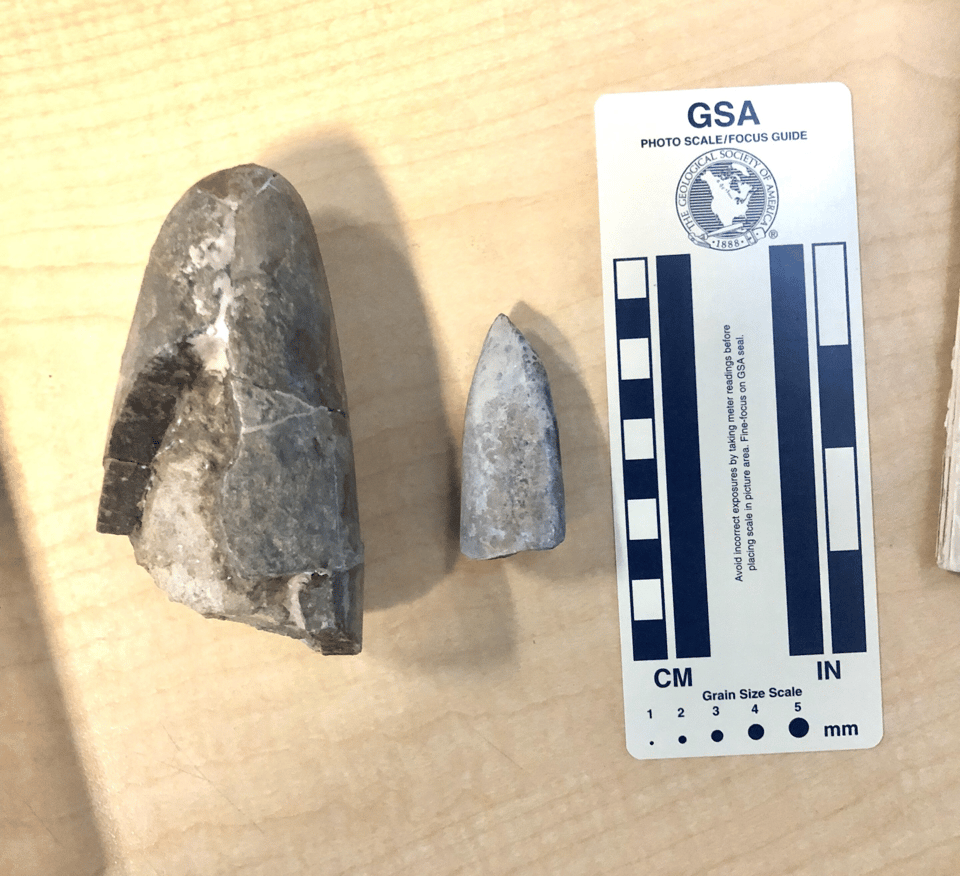
Belemnites—the first cephalopods to look like modern squid, though they are not true squid—left behind abundant bullet-shaped fossils. A typical belemnite is shown below in the middle; the new species, Wyoteuthis linsterorum, is on the left.
I’ll be drawing this portly creature as soon as I get a chance.
Meanwhile, true modern squid have been the focus of recent research on senses. We land-dwelling vertebrates make a big deal about vision and how similar cephalopod eyes are to our own. But if we were fish, a different sensory similarity might catch our attention: the lateral line. This sense, unknown on land, is a core part of the piscine experience. Sensory cells along the sides of the body perceive motion in the surrounding water. Fish use this information to navigate, hunt, and school.
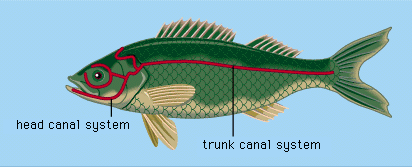
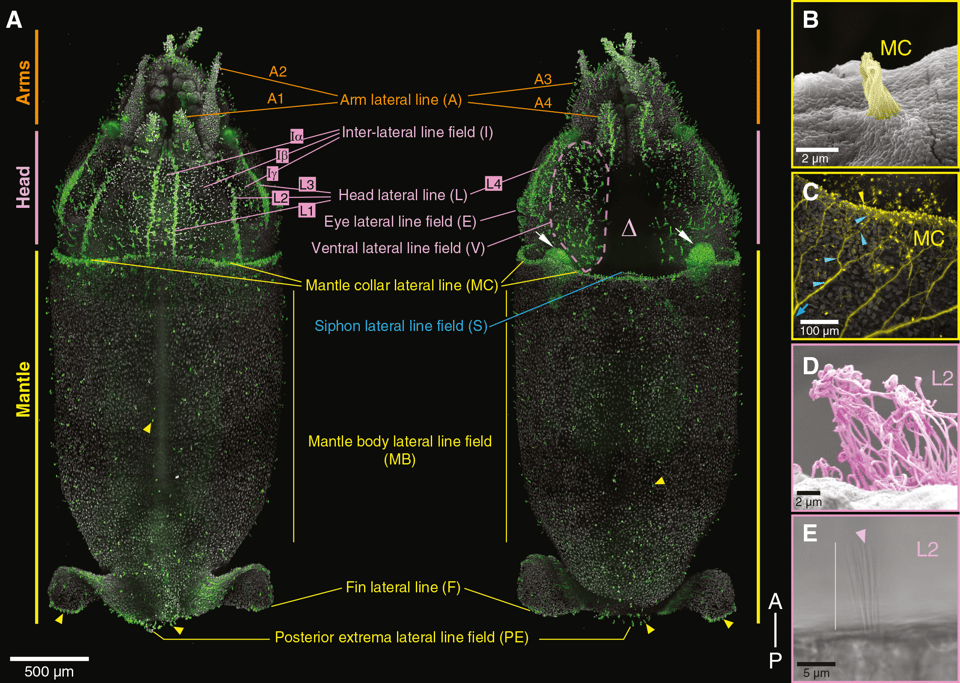
Scientists knew that squid had a similar sense, but its detailed anatomy has only just been elucidated by a new study (hat tip to Max for sending the link). Instead of a line-shaped structure, the authors explain, “the whole squid’s surface is elaborately ornamented” with bits of lateral line—the glowing green dots in the image below.
What does this mean for their perception of the world? Hopefully future research will tell us!
My News
Last month I was incredibly fortunate to participate in two octopus outreach events at the Okinawa Institute of Science and Technology, coordinated by researcher Ryosuke Kimbara—one in a public library, and one in an OIST auditorium. I dressed up as a mimic octopus and spoke to audiences alongside sleep scientist Tomoyuki Mano, with the help of amazing translator Mari Takenouchi. Working with this group really leveled up my science communication!
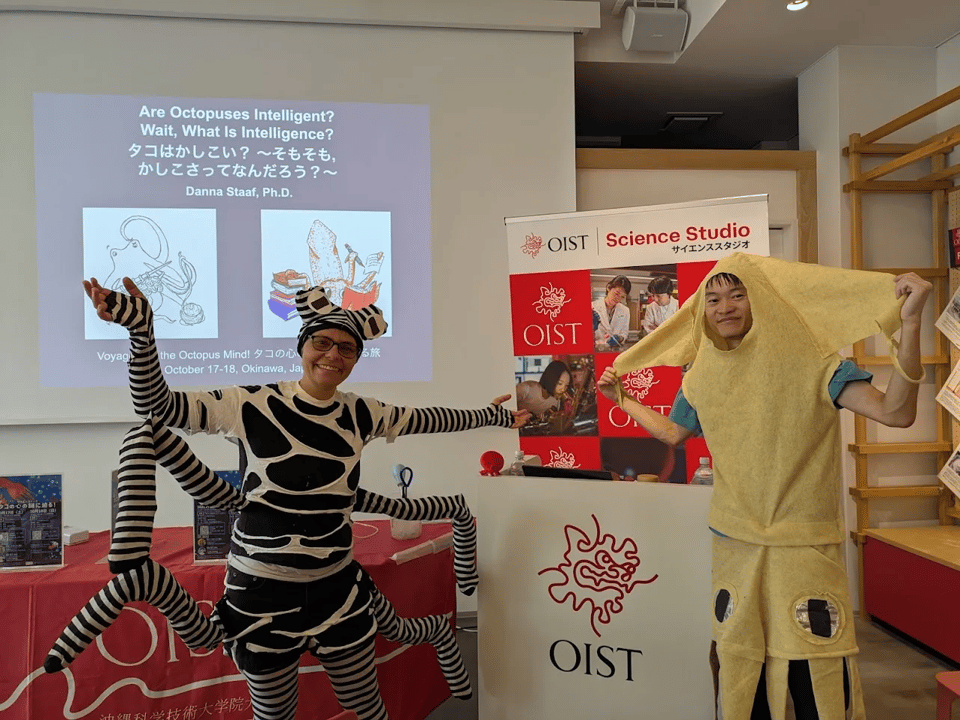
Ryosuke was not only willing to wear my spare squid costume, but brought his copy of the Japanese Squid Empire so I could hold it for the first time. (Ask me sometime about my years-long unsuccessful saga to acquire a copy…) Later an audience member asked me to sign her Russian translation, so I got to hold that too! DELIGHT!
Speaking of holding signed books in your hands, you can order any of mine from marvelous local bookstore Hicklebee’s. Simply specify in the order notes that you’d like it autographed, with a name for the dedication if you want.
Funny Pages
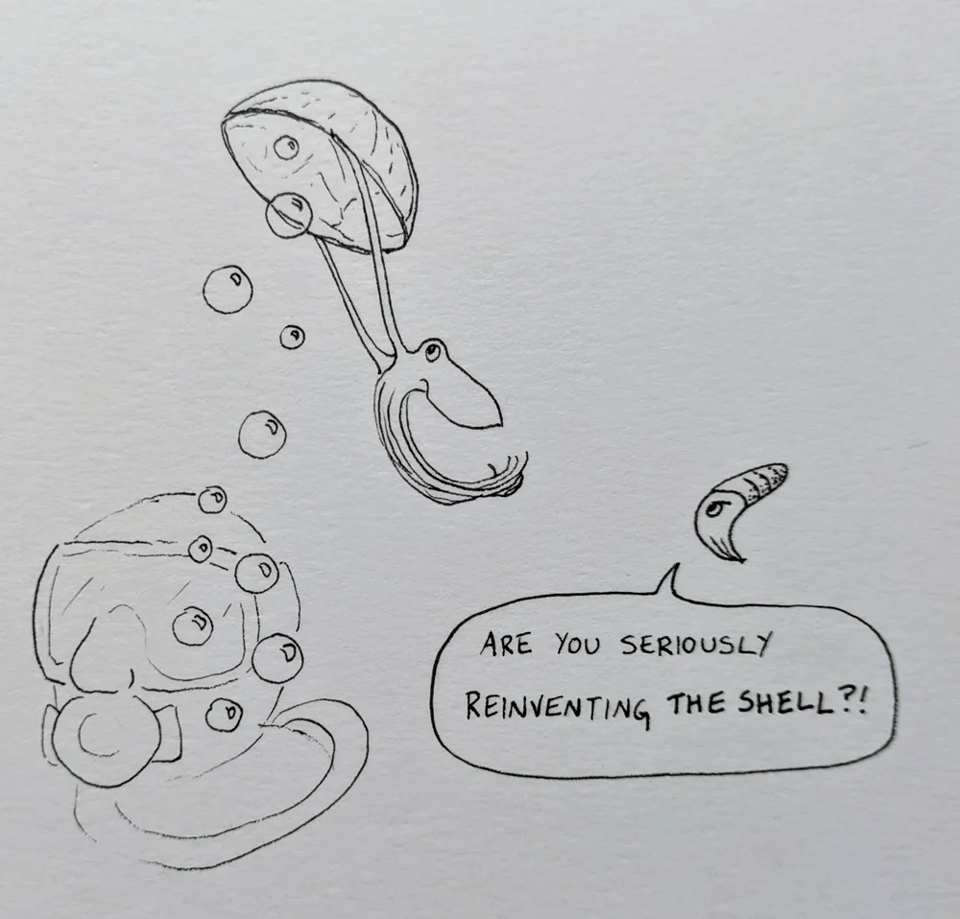
Readers of my last newsletter may recall Eoceras, the newly described oldest cephalopod fossil. Throughout October, I doodled it to the tune of a few Inktober prompts. “Contraption” might be my favorite:
Add a comment: