dAIly — AI Digest, Jun 27, 2026
📌 Top Stories — Today's Biggest Moves (skim)
The day's highest-signal stories, ranked by builder-relevance — each linked to its primary source.



⚡ The Pulse — If You Only Read One Thing90 sec read
🎯 Today's Game-Changer
OpenAI has previewed GPT-5.6 Sol, a next-generation model architecture optimized for high-stakes coding, scientific reasoning, and cybersecurity tasks. By integrating a more robust safety stack directly into the model's core training objective, Sol represents a shift toward "secure-by-default" frontier models, signaling that the industry is moving past general-purpose chat toward specialized, high-reliability agentic execution.
📍 In a Nutshell
- NVIDIA released
AI-Q Blueprints to standardize production-ready agentic deployments on OCI. source
- NVIDIA introduced
- Spectral Labs launched
SpectralQuant, a calibration-aware quantization method for Qwen3.5 0.8B that recovers 96.5% of BF16 performance. source
- Orthrus is preparing to release
- AWS detailed
Cara’s insurance brokerage AI, showcasing a successful pattern for domain-specific enterprise agentic workflows. source
- AWS launched
- HarmVideoBench
was introduced as a new benchmark for harmful video understanding in MLLMs. source
- Sebastian Raschka
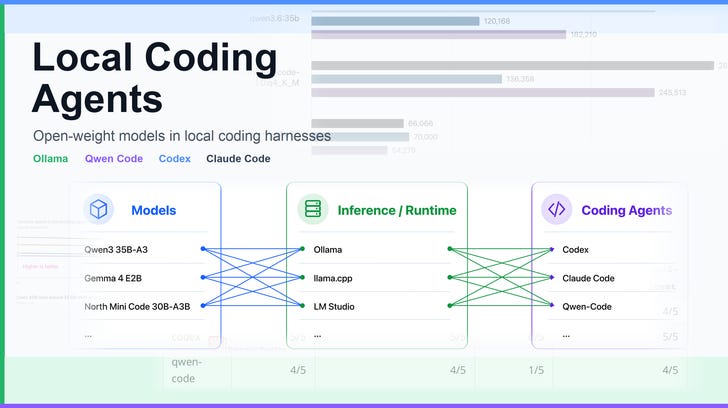
analyzed local coding agents, arguing for open-weight models as a viable alternative to proprietary coding subscriptions. source
🚀 Opportunity of the Day2 min read
Visual Token Pruning Engine (VTPE)
- The gap: MLLMs are currently bottlenecked by the massive computational overhead of processing redundant visual tokens, as highlighted in the recent
- Why now: The release of the TOPS (Token Optimal Preservation Sets) framework provides a first-principles mathematical approach to pruning, making it newly tractable to reduce inference costs by 30-50% without significant accuracy degradation.
- Build as: A middleware library (Python/C++) that sits between the vision encoder and the LLM backbone, providing a drop-in "pruning layer" for popular MLLM architectures.
- Wedge & moat: The wedge is high-latency, cost-sensitive MLLM applications (e.g., real-time video analysis, mobile vision agents); the moat is the proprietary pruning heuristics and calibration datasets that optimize for specific model families.
- Already heating up: The TOPS paper has gained immediate traction in research circles for its efficiency gains (speculative — no commercial product validation yet).
- Closest existing solution: StreamingLLM⚠ focuses on KV-cache management, but there is no dedicated, high-performance library for dynamic visual token pruning during inference.
- First step this week: Implement a prototype pruning wrapper for a LLaVA-style model using the TOPS algorithm and benchmark latency vs. accuracy on a standard dataset like MME.
📊 Stack Signals — Pick Your Tools3 min read
Benchmarks & Evals
- No notable leaderboard moves on LMSYS or SWE-bench in the last 48 hours; focus remains on the integration of new safety-focused benchmarks like
Repo & Model Velocity
Funding & Launches — with Thesis
🔬 Deep Reads — For When You Have Time (skip if rushed)
📖 The One Deep Read
Bridging Talk and Thought: Understanding Dialogue Dynamics Across Collaborative Problem-Solving Contexts by Zhengyuan Liu and Stella Xin Yin. This paper provides a critical framework for analyzing how human-AI teams actually function during collaborative tasks, moving beyond simple chat metrics to evaluate "thought-process" alignment. It is essential reading for anyone building multi-agent systems that require high-fidelity coordination.
Read it for: The conceptual framework for measuring collaborative efficiency in human-AI agentic loops.
📑 Supporting Research
Stay focused on the infrastructure layer; the model-tier is commoditizing faster than the agentic-workflow layer.