
Just What Was a Revolution Anyway?
1776, 1789, and Dan Edelstein's "The Revolution to Come"
The American Revolution, as a revolution, is a funny thing. For more than two centuries, it’s had to get along under the shadow of its rather louder and more controversial younger sibling, the French Revolution. Ah, the French Revolution: now there was a real revolution! The comparison, whether implicit or explicit, has always been rich with political as well as psychoanalytical potential.
Since the 1790s, some Americans have chosen to take pride in the supposedly more pragmatic, sensible, unshowy (and allegedly less violent) nature of their own revolution. But it has still been tempting to point out that it really was “radical” too—just, you know, in its own way. Other approaches emphasise the American Revolution’s global influence, in what can sometimes feel like a measuring-contest predicated on comparison with France.1
In recent years, it seems to me, a couple of American historians of France have been honing a new line of attack: in France, they say, the revolution was so revolutionary that it revolutionised the very concept of revolution.
The events of 1789, as Dan Edelstein writes in his recent book, “marked the first time that revolutionary actors described themselves and their actions as ‘revolutionary.’”2 Until then (so the idea goes), revolutions had only ever been identified restrospectively, as completed transformations, not as ongoing processes that could be shaped from within. What’s more, for Edelstein, this new conception of revolution as open-ended process endowed it with certain inherently dangerous features. Crucially, battles to define the revolution while it was still taking place were the foundation of a new kind of revolutionary violence: not against the revolution’s avowed enemies, but against rival revolutionaries with different visions of where it should all end up.
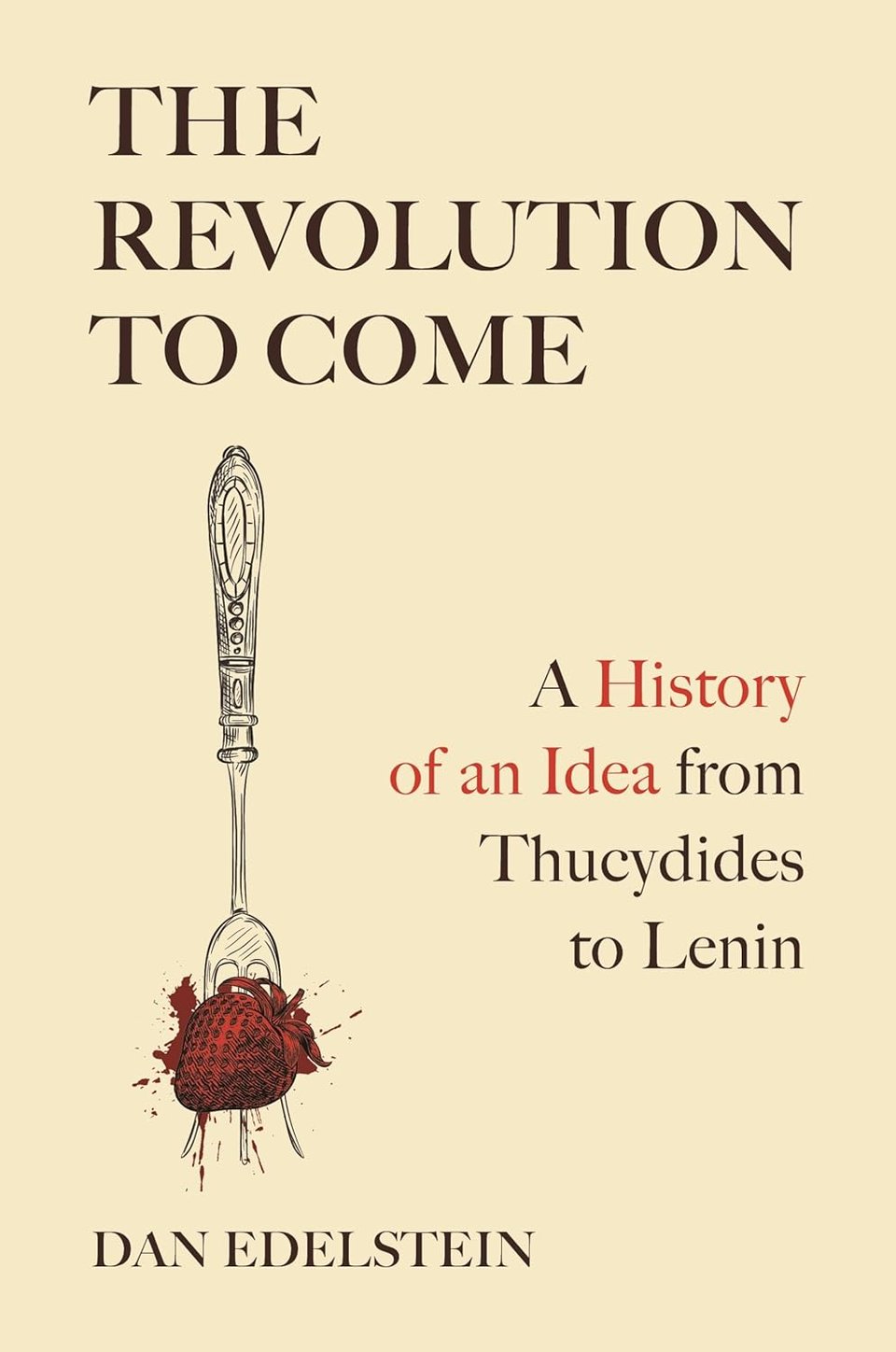
For Edelstein, in this sense, the French Revolution had more in common with the great revolutions of the twentieth century—in Russia, China, and Iran, say—than with its elder sibling across the Atlantic. Violence and terror, perpetrated against fellow revolutionaries, were baked into this modern form of revolution in a way that they were not in the American example. Edelstein isn’t the first to place the American Revolution at the end of a distinct, classical revolutionary tradition.3 But his book is the first time I’ve seen someone link this conceptual transformation to a structural claim about the inevitable internecine bloodletting of modern revolutions.
Now, farbeit from me to defend the honour of the American Revolution, or to enter into any sort of measuring-contest. But as a starting-point to digesting this claim, I’d want to think about the struggles that did indeed take place over the future of the American Revolution, while it was still going on. You don’t have to go as late as Shay’s Rebellion in 1787 to find revolutionaries shooting one another in the new United States: try the Fort Wilson incident in 1779. Patriots, like the French Revolutionaries, divided over visions of what it was all for—and they were not always reticent to use the machinery of the state to enforce their ideas against rivals.
Exactly what counts as a modern revolution is a kind of semantic argument that has, nonetheless, a lot to tell us about how people in the past imagined possibilities for social and political change.4 Edelstein’s book offers huge advances in that argument, in ways I can’t begin to discuss here. His conclusions about revolution are convincingly (if predictably) deflationary. As for people in the present, perhaps the most important question that remains is just what alternative do we have?
Gordon Wood, The Radicalism of the American Revolution (Knopf 1991). For global repercussions, there are different flavours: contrast David Armitage, The Declaration of Independence: A Global History (Harvard, 2007) with Matthew Lockwood, To Begin the World Over Again: How the American Revolution Devastated the Globe (Yale, 2019), or the somewhat more modest claims in Richard Bell, The American Revolution and the Fate of the World (Riverhead, 2025). ↩
Dan Edelstein, The Revolution to Come: A History of An Idea from Thucydides to Lenin (Princeton, 2025); and see Keith Michael Baker, “Revolutionizing Revolution,” in Baker & Edelstein, eds., Scripting Revolution: A Historical Approach to the Comparative Study of Revolutions (Stanford, 2015). ↩
Gordon Wood, The Creation of the American Republic, 1776-1787 (North Carolina, 1969); J.G.A. Pocock, The Machiavellian Moment: Florentine Political Thought and the Atlantic Republican Tradition (Princeton, 1975). ↩
Eighteenth-century British Americans would, of course, have agreed with Steve Pincus: “the first modern revolution” took place in 1688. ↩