
Edward Winslow and the Puritan Atlantic
If the American Revolution was a transoceanic struggle that implicated Englishmen and colonists alike, then so was the English Revolution of more than a century earlier.
Last summer, someone from the Droitwich Spa Civic Society wrote to ask me if I’d come and give a talk there. But not just any talk. He wanted, specifically, a talk on Droitwich native son Edward Winslow, a voyager on the Mayflower and several-times governor of the seventeenth-century Plymouth colony. I eventually agreed, in part because it gave me an occasion to finally read a book that had lain unread on my shelf for several years, John Donoghue’s Fire Under the Ashes: An Atlantic History of the English Revolution (Chicago, 2013). My script for the talk is reproduced below, cribbed largely from Donoghue, and from Len Travers’ ODNB entry for Winslow.
In 1605, soon after Edward Winslow’s ninth birthday, Catholic radicals opposed to further curbs on their religious freedom came close to blowing up the House of Lords and murdering the king. Two years later, riots over the enclosure of common land shook the midlands, not far from where Winslow was at school in Worcester. Religion was a factor in those riots, too, with some landowning families targeted for their connections with Catholics and gunpowder plotters.
Winslow, in other words, grew up amidst the turbulence of two enormous and thoroughly intertwined transformations: one, the gradual emergence of capitalist property relations in the English countryside, and the other, the reconstruction of English religious life in the wake of the Reformation.
One of the things Winslow’s life helps to illuminate is the fact that neither of these two stories can be told properly on a canvas limited to England or the British Isles. Instead, the horizons within which these great struggles played out encompassed the entire North Atlantic world, from the forests of the American interior to the islands of the Caribbean, from the coats of west Africa to the port cities of the Low Countries, and from Droitwich in the Worcestershire countryside to Plymouth Rock in the New World.
Edward Winslow’s voyage into this wide world began with an apprenticeship in London, where he learned to operate one of the early modern world’s most vital new technologies—the printing press. By 1618, he was in the Dutch city of Leiden, where he fell in with a group of Protestant extremists, marrying one of them—Elizabeth Barker—and helping to operate the press on which their radical theology was printed.
In 1620, when the group set sail across the ocean on the Mayflower, Edward and Elizabeth were with them. So was his brother Gilbert; their brother John following behind on a later ship, the Fortune. When Elizabeth died just at the end of their voyage, the new widower married a new widow, Susannah White. Theirs was the first marriage to take place in the new colony of Plymouth. Susannah’s son, Peregrine—now Edward’s stepson—was the first child of the Pilgrims to be born in the New World.
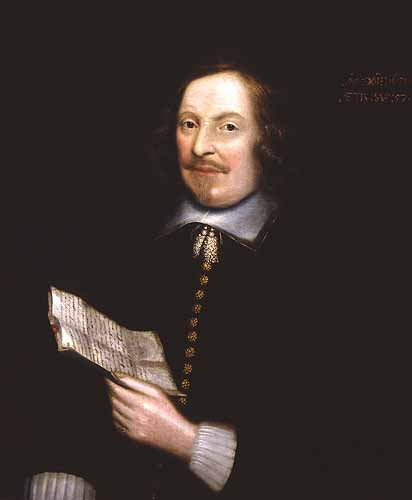
The story I’m going to tell focuses on Edward Winslow’s public life. It will follow him back to England in the 1640s, into the chaotic drama of the English Revolution, and out again on the other side, en route to Hispaniola and Jamaica in the year 1655. But it’s worth noting that for Winslow, the idea of a loving family life was also important to his public standing and persona—maybe also to his sense of self. When, as a gentleman in London, he later came to have his portrait painted, he chose to portray himself not with his hand upon a bible or a globe, but holding a letter from Susannah, signed “your loving wife.”
*
In 1620, the Plymouth colony was tiny, precarious, and frighteningly isolated. What kept it going was the frequent traffic of vessels from England, and relationships the Pilgrims soon established with their indigenous neighbours. Twenty years later, Plymouth remained a small community, numbering only a few thousand people—yet it was no longer isolated in the same way. By the mid-1630s, it belonged to an archipelago of English settlements that dotted the coasts and rivers of the area. To the north, the much larger and faster-growing colony of Massachusetts Bay, centred on Boston. To the south and west, new settlements that would later become Rhode Island and Connecticut. As the landscape of English settlement changed, of course, so too did relationships with the area’s indigenous inhabitants.
Edward Winslow had a key role in the life of Plymouth colony during this time—he was, effectively, its chief ambassador. As a young man, early in the colony’s life, Winslow won the crucial friendship of Massasoit, principal chief of the Wampanoag people who dominated southeastern New England. Without Wampanoag generosity and protection, Plymouth could not have survived the freezing winters or the first few starving years of settlement. In a 1624 book, Good News from New England, Winslow told the story of attending Massasoit during a grave illness and helping nurse the chief back to health with cordials from England—and that most effective of cure-alls, chicken soup.
After 1630, a new diplomatic challenge faced the Plymouth colonists: the recently arrived Puritans of Massachusetts Bay. Through the decade, the Bay Colony grew at the pace of two-thousand migrants every year. It was soon significantly larger and more prosperous than Plymouth. Here again, Winslow displayed his talent for strategic friendship. By mid-decade, he was in close correspondence with the Bay Colony leader, John Winthrop. The two men’s alliance, for better or worse, would end up shaping the rest of Winslow’s life. It also shaped the history of New England itself.
Massachusetts’ rapid population growth, alongside its strict theocratic governance, was a recipe for the kind of instability that had not troubled early Plymouth. The problem was double-edged. On the one hand, growth created conflict with indigenous locals, as settlers cut into the forest and got into arguments over land and livestock. On the other, more new colonists meant more chance of dissent against Winthrop’s rule, and a harder job maintaining the tight-knit religious uniformity practiced in Plymouth. In the mid-1630s, these two problems erupted into simultaneous crises: the Pequot War, which saw the first sustained, armed conflict with New England’s Indians; and the Antinomian Crisis, which saw break-away factions challenge not just the colony’s spiritual and political leadership, but also its theological principles.
Bay Colony dissidents including Roger Williams, Anne Hutchinson, and Samuel Gorton tended to share two positions: colonists should be more free to practice Protestant Christianity as they saw fit, according to their own inner light; and they needed to respect the rights of the country’s indigenous people, taking land only through proper purchases and agreements, not by conquest. Exiled from Massachusetts, they began to establish new settlements on these principles, including Roger Williams’ Rhode Island. By 1643, then, the diplomatic landscape of New England had become considerably more complex.
In that year, Edward Winslow of Plymouth and John Winthrop of Massachusetts transformed their personal friendship into a formal alliance. Along with settlers at Saybrook on the Connecticut River, they formed the United Colonies of New England. The alliance had two main goals: one, to prosecute ongoing war against the region’s native people, especially the Narragansetts who had joined forces with Winthrop’s enemies; and two, to oppose the emergence of new, dissident colonies, like Samuel Gorton’s settlement of Shawomet.
That summer of 1643, armed men from Massachusetts—with tacit support from Winslow and the Plymouth colony—marched into Shawomet, arresting Gorton and some of his followers. Brought back to Boston in chains, the dissident leader was sentenced to captivity and hard labour. Meanwhile, Anne Hutchinson had already fled south from Rhode Island into Dutch New Amsterdam. Only Williams was safe, having already sailed to England to secure a charter for his colony. The next year, having embarrassed Boston authorities into agreeing his release, Samuel Gorton followed Williams’ footsteps and set sail for the mother country. It was there that the next phase of the conflict would be played out.
When John Winthrop cast around for his own man to send to England, there was one obvious candidate—a master diplomat and close ally who had already taken two trips back to England, and whose publications glorifying the holy experiment in the New World would stand him in good stead as a local expert. Winthrop needed someone with unmatched Puritan credentials who could be relied upon to counteract the arguments of wily dissidents like Williams and Gorton—he had one in Edward Winslow. Now nearing his fiftieth birthday, having served three terms as governor of Plymouth Colony, Winslow accepted the commission. Taking leave of his loving wife Susannah, without knowing that it would be for the last time, Winslow sailed for England and the political battle of his life.
*
The last time Edward Winslow was in England, it had been 1635. Charles I was ruling England and Scotland without the aid of a parliament, and his new archbishop, William Laud, had recently embarked on a programme of church reform that deeply offended English Puritans. Winslow himself was briefly imprisoned, presumably for speaking out against the Laudian reforms, and had to petition the privy council for release. Now, just over ten years later, Winslow was stepping off a ship into a very different world. Over the next three years, from 1646 to 1649, he would witness the apogee of the English Revolution.
In 1645, the Parliament’s New Model Army had decisively defeated Charles’ forces at the Battle of Naseby in Northamptonshire. The following year, they captured the royalist stronghold of Oxford, and the king was placed under house arrest. Yet of course, the political future of the kingdom was hardly settled. Conflict with the Scots, and new royalist uprisings, threatened the stability of Parliamentary rule during this period. But even more important, especially in London, was the power of the army itself—and of the ordinary, working people who were represented in its ranks. When Winslow arrived in the capital 1646, he was entering a crucible of radical possibility.
London was not, in general, a comfortable place for anyone tasked with defending the established order. Egalitarian thinkers like John Lilburne and Richard Overton, soon to be labelled Levellers by their opponents, made use of the city’s presses to proclaim the equal “birthright” of freedom that belonged to every Englishman. They challenged not only the authority of the king, but of the Parliament that had now sat for six years—and which, with its restricted franchise, hardly represented all Englishmen in any case. Levellers called for frequent elections under universal manhood suffrage, and the abolition of the House of Lords. They also sought religious freedom for dissenting Protestants, and an end to any efforts to enforce a uniform religious doctrine.
Samuel Gorton’s criticism of the rigid, theocratic regime in New England thus fell on receptive ears. His tract, published in 1646, condemned “the combat of the United Colonies” against both “Natives” and English “subjects” in America. Moreover, it accused Winthrop and his allies of wielding power in their own right, not under the jurisdiction of the English state. Gorton asked Parliament, and in particular its Committee on Foreign Plantations, to reassert their rule in the New World by granting a charter to his own colony at Shawomet and repudiating Massachusetts’ claim to it.
Winslow’s response to Gorton was titled Hypocrisy Unmasked. In it, he accused Gorton of being a “notorious disturber of the peace and quiet of the several governments wherein he lived.” Worse, Winslow wrote, Gorton had engaged in a “desperate conspiracy” against the United Colonies, alongside “ambitious and treacherous Indians”—in other words, his Narraganset allies. Winslow quoted in full several letters written by Gorton and his friends back in New England, intending to demonstrate how radical and dangerous his ideas were. But in doing so he propagated Gorton’s ideas to a new, English audience. Winslow complained that Gorton’s enmity encompassed not just the Massachusetts leadership, but also “magistracy itself, and all civil power.” Such expansive notions of liberty hardly struck all readers as the nonsense Winslow evidently thought they were.
This public exchange of views was, of course, only one part of the political struggle. Both men’s tracts were dedicated to the Earl of Warwick, chair of the Committee on Foreign Plantations that would decide the future of Shawomet. It may well be that the Earl was influenced mostly by more mundane political realities. His task, after all, was to ensure full Parliamentary control of England’s empire, and its profitable expansion at the cost of England’s enemies.
At the same time, Warwick was likely influenced by an ally on the committee—Henry Vane, a former governor of Massachusetts who had been an admirer of the dissenting preacher Anne Hutchinson. Vane had returned to England after losing an election to John Winthrop and had since taken a leading role in England’s revolution. If his politics remained hard-headed and fully committed to English empire, Vane’s religious views tended to the same kind of anti-authoritarianism as Gorton, Hutchinson, and Williams.
Whatever considerations most influenced the committee, Winslow’s lobbying on behalf of Massachusetts was ultimately unsuccessful. Just as Roger Williams had won his charter for Providence Plantation a few years earlier, Gorton returned to America with Parliament’s blessing for Shawomet—an implicit rebuke to the Bay Colony and Winthrop’s overreach. Gorton promptly renamed his settlement after the committee chairman who had sided with him—it still exists today as the city of Warwick, Rhode Island.
*
Perhaps it was the shame of this political defeat that prevented Winslow from quickly departing London and returning to New England. Perhaps it was the ongoing print debate in which he was embroiled. An attack on him titled New England’s Jonas Cast Up at London came out in 1647, authored by a major in the New Model Army whose brother had been on the anti-Winthrop side in Massachusetts. Winslow had responded in a pamphlet he called New England’s Salamander, subtitled, “a satisfactory answer to many aspersions cast upon New England.”
But it may also be that, in his time in London, Winslow came to enjoy close proximity to government and power. Whatever the reason, and however much he missed his wife and family, he remained in London for most of the rest of his life.
As it turned out, 1647 was the high point of the revolutionary Leveller movement, the year the New Model Army’s soldiers debated English liberty at St Mary’s Church, Putney, and promulgated their radical constitution, the Agreement of the People. It was the new MP for Droitwich, Colonel Thomas Rainsborough, who gave that movement its clearest and most lasting statement, at Putney, when he said:
“Really I think that the poorest he that is in England hath a life to live, as the greatest he; and therefore truly, sir, I think it clear, that every man that is to live under a government ought first by his own consent to put himself under that government; and I do think that the poorest man in England is not at all bound in a strict sense to that Government that he hath not had a voice to put Himself under.”
Rainsborough’s vision was one of complete political and spiritual equality, at least among Englishmen. But as the high tide of egalitarian ideas receded, and the army turned to suppressing royalist revolts in the provinces, English politics became again a more hospitable place for men like Edward Winslow—men who valued authority and order, so long as it was exercised by godly Protestants.
In January 1649, when Charles I was finally executed and England was proclaimed a republican commonwealth, it was not so much a victory for the Leveller radicals as it was for the army leadership that orchestrated the affair—including the “purge” of Parliament the month before, when MPs expected to oppose the king’s capital trial were ejected. Oliver Cromwell, who had once resisted his army’s republican impulses, now willingly signed Charles I’s death-warrant.
That year, Gerard Winstanley and a ragged band who called themselves True Levellers—also known as the Diggers—were forcibly ejected from their communal farm on St George’s Hill just outside London. Edward Winslow, sensing the shifting winds of power, republished his tract, Hypocrisie Unmasked, under a new title: The Danger of Tolerating Levellers in a Civil State. John Winthrop’s authoritarian Puritanism in 1630s Massachusetts now became a model for the commonwealth of England.
In these years, Winslow involved himself closely in the emerging imperial strategy of the revolutionary state, still ruled by the Rump Parliament first elected in 1640. With his intimate knowledge of the New World and its indigenous peoples, he was a sought-after man amongst the various new corporations and committees that were busily imagining the future godly empire across the Atlantic. It was in this period, most likely around 1651, that Winslow had his portrait painted with the letter from his wife Susannah, emphasising his continued intimacy with the colonial project in Plymouth.
For Winslow and men like him, the turbulent spirit of the Levellers—the disorderly freedom and disdain for authority that had emerged in England in the last years of the Civil War—was an immense threat to the real project that lay at hand. That project was nothing less than the spiritual reformation of the world, the extirpation of the Catholic enemy, and the wholesale conversion of humanity to true religion. To achieve that aim, authority was an essential tool. Men who would not subordinate themselves to godly leaders were no better than Catholics and savages—worse, indeed, because they hypocritically claimed to be the true interpreters of Protestant religion.
His experience in the New England of the 1630s had done much to shape that perspective. There, from his vantage in Plymouth, he had seen how giving space to theological dissent could lead directly to the breakdown of fragile social and political bonds. Charismatic thinkers like Anne Hutchinson and Samuel Gorton, preaching the doctrine of personal freedom in biblical interpretation and in civil life, had undermined the unity and thus the strength of Massachusetts, emboldening indigenous resistance and fragmenting the force of Christianity across New England.
Winslow may have failed in his immediate mission—to prevent Gorton attaining a charter for his Shawomet colony—but as conditions changed in England itself, he came to believe that victory in the larger struggle was within his grasp. Just as Winthrop had driven the dissenters out of Massachusetts, so the Puritan elite and its merchant allies had forced Levellers to the margins of England’s political life by the end of the 1640s. And as they consolidated power at home, these same men turned their eyes westward, towards Ireland and the New World. The stage was set for what would be the final act of Winslow’s transatlantic career.
*
The first great military target of the new Puritan English republic was, of course, Ireland. There, Catholic and royalist forces had been fighting for nearly a decade against an array of disunited Protestant armies. With England itself pacified by 1649, however, Cromwell was able to turn his full attention—and the full force of the army he had helped to build—towards the bloody suppression of Ireland’s Catholic majority and their Protestant royalist allies.
Cromwell’s campaign, carried on after 1650 by his son-in-law Henry Ireton, did more than just put down the rebellion. It reordered Irish society by granting land and power to a new aristocracy of Protestant settlers. It was, in other words, a programme of social and religious reformation carried forward at the point of the sword—a preface to the righteous global conquest that Cromwell and his friends foresaw.
As the republic began to rebuild the strength that had been sapped during the Civil War, and as its navy once again grew capable of fighting for control of the Atlantic, even Protestant rivals found themselves on the receiving end of English aggression and ambition. The First Anglo-Dutch War, fought at sea between 1652 and 1654, was one of the first fruits of the renewed attention men like Edward Winslow were bestowing upon England’s oceanic empire. The brief struggle reasserted English naval power, signalling the republic’s intention to enforce its control over commerce with the colonies in the New World—commerce now governed by the Navigation Act of 1651.
Meanwhile, Cromwell himself had increasingly become the lynchpin of the entire republican state—and by the end of 1653, he had run out of patience with the only other political force left to challenge his vision and strategy. With no general election held since 1640, the Rump Parliament had little public legitimacy left anyway. So when Cromwell shut it down, and had himself inaugurated Lord Protector, there were few to mourn its passing.
For Winslow, in any case, the dissolution of Parliament was a moment to savour: its leading voice had been one of his last remaining political enemies, Sir Henry Vane, the former Massachusetts Governor who had taken Samuel Gorton’s side against him in the Committee of Foreign Plantations. With Vane gone and Cromwell in full control, Winslow was closer to the centre of English power than ever before. He would not let his moment slip away.
The richest and apparently most vulnerable target in the New World was not, after all, the Dutch. It was the Kingdom of Spain, the Catholic empire that dominated South America and the two largest islands in the Caribbean. Spanish convoys shipped back so much gold and silver from its New World mines that inflation ran rampant in Spain itself. What was more, English propaganda derived from the critical reports of Spanish humanists like Bartolomé de las Casas had long held that Spanish colonists treated the indigenous Americans with horrifying, inhuman barbarity. This black legend helped Englishmen—and Dutchmen too—to justify their own, allegedly less brutal empires.
What could be more obvious than to take England’s victorious army, and its newly reinvigorated navy, and to use it to strike a decisive blow against the corrupt, Catholic, Spanish empire in the Americas? No project could be better designed to bring both great wealth and spiritual glory on those who accomplished it. And who better to act as the lead civilian advisor to the English fleet—the man who would, perhaps, become the governor of conquered Spanish lands—than the New England veteran, unimpeachable Puritan, and expert diplomat, Edward Winslow?
So, in any case, thought Lord Protector Cromwell. In late 1654, Winslow set sail with the English fleet. His salary, £1,000 a year, was a projection of the windfall that Cromwell expected God to grant from his adventure.
Winslow set sail, we can only assume, full of the same high hopes as his master in London. In Barbados, the fleet added thousands of new recruits to the somewhat scanty muster it had brought from England. Men brought out to the Caribbean as indentured servants or as convict transportees joined up not out of any sense of godly mission, but because they hoped to plunder Spanish treasure like so many English pirates had before. So they were sorely disappointed when, as soon as the now-strengthened fleet set sail towards its target, Hispaniola, Winslow told them that there was to be no plunder. He wanted the colony’s estates left intact, so as to be passed onto their new English owners with the minimum of start-up costs. Winslow, after all, was no pirate—he thought his men should fight for God and Cromwell, not for money.
As things turned out, Cromwell and Winslow’s plans did not find favour with divine providence. When it reached the Spanish colony of Hispaniola, the unhealthy and demoralised army of Englishmen was swiftly repulsed by the Catholic defenders, forced to flee ignominiously back to the fleet. Those who did not die of Spanish musketry or yellow fever mostly ended up on the nearby and undefended island of Jamaica—something of a booby prize, which would in time become the jewel in England’s Caribbean empire.
Winslow, though, was not among them. His fate, at the age of fifty-nine, was burial at sea, one of the many victims of the Caribbean’s notorious disease environment. The yellow fever that probably killed him was borne to his veins by a single mosquito; but before that, it had been carried from Africa across the vast Atlantic in the bloodstream of a man, woman, or child held in slavery. By 1655, England’s colonies had only just begun to institutionalise the racial slavery regime. A century later, there were more than 100,000 enslaved people in Jamaica alone.
Winslow’s death was, in the end, a remarkably typical one for the English New World colonists of the mid-seventeenth century. For every man who crossed the Atlantic and lived to three-score and ten, there were many more who perished young. Had he stayed with Susannah in New England, where temperatures were low enough to ward off tropical diseases, he would most likely have lived long enough to see the restoration of King Charles II in 1660. Perhaps he was better off in the Caribbean after all.
*
A century later, English colonists in North America were still struggling with many of the same problems and dilemmas that Edward Winslow had encountered in his lifetime. Britain’s empire during the eighteenth century, under the new Hanoverian dynasty of George I, II, and III, proudly imagined itself as a unique force for moral progress in the world—maritime, commercial, Protestant, and free. Yet of course, that empire intensified the land-stealing and slave-holding practices that its early precursors began.
Revolutionaries like John Adams, the future second president of the United States, liked to look back on Puritan New England as a time of spiritual virtue, and of de facto independence from the English state. Protestant dissenters back in England, those who were excluded by the doctrines of the established Church of England, were among the most vociferous supporters of the colonists during the 1760s and 1770s. Some of them, like the historian Catherine Macaulay, looked back on the English Civil War and the short-lived republic as a beacon for eighteenth-century aspiration.
Just as in the 1640s, moreover, the revolution that formed the United States was full of its own internal contradictions and riven with internecine struggle. Many who took up arms in pursuit of liberty found themselves at odds with their fellow revolutionaries—and often along similar lines. There were some who sought to turn the whole world upside down, establishing new ways of living more fairly and equally, without a caste of rulers or a doctrine to be enforced by the state. Then there were others who saw in the revolution mainly a chance to change one set of rulers for another, to win for themselves the spoils of empire and slavery.
It was men of one stripe, men like Cromwell and like Edward Winslow, like John Adams or George Washington, who built new armies and new governments, and who established forms of power that the world had never seen before. But it was men like Samuel Gorton, women like Anne Hutchinson who perceived a greater freedom possible for humankind—and whose desire for that greater freedom, shared and struggled for century after century, helped shape in crucial ways the states and empires created by the men of power.
Just as Edward Winslow crossed and recrossed the Atlantic in the 1600s, men like Thomas Paine became participants in a transoceanic age of revolutions in the eighteenth century. The revolution in America inspired new waves of egalitarian and democratic protest that lay the foundations for the struggles of the nineteenth-century Chartists and workers’ movements, and beyond. It is their legacy, as well as and alongside legacies of war, conquest, and empire, that shapes our world today.