
Transmission 10 | 06.19.26
Long-gaming, high definition solstice light and expansive listening.

Friends,
Summer solstice is nearly upon us and I couldn't let it pass without sending a transmission. I salute you all, we appear to have made it. Ladies and Gentlemen, we are nearly floating in summer space.
As we approach this longest day of the year, I'm thinking a lot about light and the qualities of it. Usually sometime in early February, I begin checking my sunlight app to see how many minutes of daylight we’re gaining per day. These are desperate times. The instruments reveal incremental gains, even if they are yet to be perceivable. The real magic happens when I begin to notice—later in the month—that the days are in fact lighter and longer. Even though it’s good science and I’ve lived through some version of all this many, many times before, the realization remains wild. It’s not just theory, there it is. Meraviglia!
By the time we get here, with summer solstice so close, the light itself begins to feel different through the day. It's the light shifting, not the hour. More than in previous years, I'm noticing it. There is less of that winter light, of course, but it also feels thin and more compressed. This light we've moved into now and how it drapes over our long days, this is a broader kind of light, full fidelity, and I can't wait to wrap myself in it.
Time Stretching
Over the course of the long stretch of short days between solstices, I rediscovered these slowed down and stretched-out versions of pieces of music I already loved. There are a number of them available on YouTube. The idea almost seems too simple to be anything more than novelty: a music file is slowed down drastically, so that the experience of it stretches and hyper-extends. It's slow-motion sound. How that transforms the recording can be quite remarkable, though.
A couple of my favourites are a 6-hour version of Brian Eno's Music for Airports and a whopping 8.75-hour version of the first movement of William Basinski's The Disintegration Loops. I've listened to the original recordings of these works countless times and what brings me back time and time again to both is the sheer spaciousness of the music.
These works offer parallel listening modes for me. For Eno and Music for Airports, the intended primary mode for the music was passive. The music can operate like a mist in the space it's playing in. We can fluctuate between hearing and listening. It's atmospheric and—naturally—ambient. It's drifting all around us but we are not quite in it.
A second mode of listening draws me in. It's the same recording, but I'm down at the particle level — the tonal changes, timbre, reverberation. When it's really on, I feel as though I'm inside the music. Both recordings are spacious in their original forms—each runs about an hour. But when slowed-down, the sense of space is exploded. The music shifts from a comfortable room to a palace, or an expansive grand temple for contemplative wandering. Giving time and even partial attention at this scale feels radical in this moment in history.
Long-Gaming
I'm a long-gamer. I identified this years ago when it became clear to me that, at the pace I work (I usually describe it as glacial), the only game I can get in on is the long one. Since I realized this, I've been on the constant lookout for artists engaged in long, creative lives.1 This ongoing investigation is both for inspiration and just to get a peek at what it might look like.
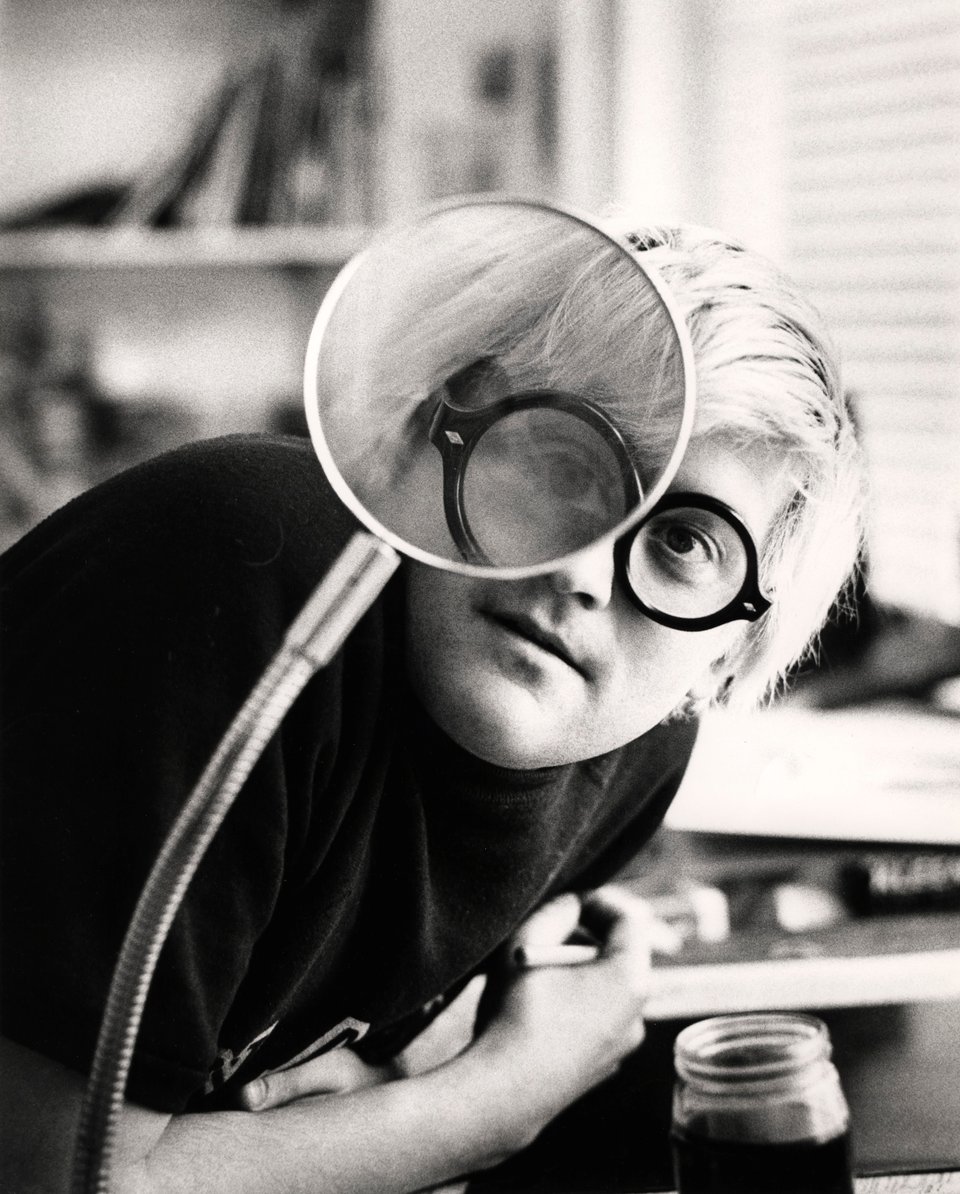
"I mean, my argument has always been that in traditional perspective infinity is a long way away and you can never meet up with it. Whereas if you reverse perspective, infinity is everywhere and you are part of it. There’s a vast difference in the two viewpoints, a totally different way of looking at the world. You haven’t just reversed a little game, you’ve reversed a whole attitude toward life and physical reality."
—David Hockney
David Hockney left us last week. I'll miss knowing he walks among us but my immediate reaction was just: what a run. Thankfully for us, he was incredibly well documented so there are countless riches without even trying. Here's one of him flipping through one of his sketchbooks. No commentary, no music. Just his hands, his sketchbook, an ashtray and a partial pack of cigarettes. There are many Hockney books, but if you haven't read it, I recommend True to Life: Twenty-Five Years of Conversations with David Hockney by Lawrence Weschler. It's filled with all kinds of great material and observations (Hockney's observations of course but Weschler is masterful in his ability to engage beautiful minds with his beautiful mind.2)
Just one highlight of many:
"One morning I rose to find another of Hockney’s occasional faxes dangling out from my machine. He’d photocopied two printed texts onto a page. The first, in boldface, read:
Thou shalt not make unto thee any graven image, or any likeness of any thing that is in Heaven above, or that is in the earth beneath, or that is in the water underneath the earth;
and the second:
Islam tells us that on the unappealable Day of Judgment, all who have perpetrated images of living things will reawaken with their works, and will be offered to blow life into them, and they will fail, and they and their works will be cast into the fires of punishment.
Beneath these unsettling edicts, Hockney had scrawled:
I will try to send some better news later."
"I live in the present. I have no future. It is a very strange time because it is enlarged... Every hour, every morning, every afternoon there are spaces in the world—meraviglia." — Isabella Ducrot
Isabella Ducrot, now in her mid-nineties, still walks among us. I've watched this video a few times because she's a delightful bundle of creative talent and energy. Recently, I played and replayed the section where she says this bit (above) because she's so open, reporting from a frontier I hope to someday explore, but then she drops this word, almost like a throwaway as she's pressing on. I had no idea what she was saying, then I figured it out. Meraviglia — an Italian word covering the area of wonder, astonishment, amazement or surprise. Still feeling and being fuelled by this kind of wonder late in the game must be at least part of what the long game is about.
Yancey Strickler wrote a little piece called How to Long Game a while back and it stuck with me. It's just reemerged and it's resonating once again. It's not about longevity per se, it's about mindset and strategy and it's worth a read. I've been following Strickler's efforts for some time and I'm a genuine admirer of his work and what he chooses to lock in on. Way back, Kickstarter, the long and still running Creative Independent, and more recently Metalabel, Dark Forest Operating System (DFOS) and Artist Corporations.
All of these operate in service of one problem—how to get creative people more power—each coming at it from a different angle. I'm an early and optimistic adopter of DFOS and it's been inspirational to watch A-Corps gaining ground over the last year or so. I can't do any of these projects justice here, but if the broad space piques your interest here I'd highly recommend digging into the Strickler-verse if you haven't already.
Deep Listening
A good part of our life is plugged into our family and friends in Victoria, so when new and good things are happening there, the magnetic pull becomes greater. Burrow is one of those things. Burrow is a new creation by Colin de la Plante (aka the Mole) and Anja Simona. As all the subterranean language wrapped around these good people suggests (mole, burrow, DigDug), the habitat is low profile but as an organism it appears to be reaching for the light: curious listening and reading, unique programming and community. Is it a bookstore? An interplanetary communication centre?3 I don't know, but Burrow is warm and welcoming, with a killer sound system that lifts records up where they belong.
There are a couple of back-to-back nights I'll be hitting this weekend that promise to be outstanding. Tonight (Friday, June 19th), Oakland DJ Breath of Fresh Dave is presenting a listening session comprising of two records: Michael O'Shea's self-titled 1982 record (delightfully new to me and I'm into it) and the first pressing of Loveless by My Bloody Valentine.
The latter record first flipped my wig back in 1991 when it was released (and I was blessed to see them play it the following year). I can't tell you how many times I listened to this record, in how many different places and with how many great people over the years but I can tell you I'm hella giddy to hear Breath of Fresh Dave drop the needle on it with this particular sound system.
There's more. Tomorrow night, Victoria/Earth DJ Tyger Dhula (Cobblestone Jazz, Modern Deep Left Quartet) will be guiding adventurers on a Dig Dug session offering one of many possible routes through the world of American music great, Les McCann. The exciting thing about this one, given Dhula's expansive collection of McCann, is the not knowing of the route or any of the ports of call ahead of time. From the session description:
“Any time sharing Dhula's passion for Les is like peering into Borges' Aleph. Anyone who listens in with Tyger, really listens, can peek at a point in space that contains all other points, a glimpse of everything in the universe from every angle simultaneously, without distortion, overlapping, or confusion.”
Sold! Set the controls for the heart of McCann. Burrow deets here (IG) and tix here.
Bit Slinging
A few quick bits from our studios: Tristesse, our pal Kevin Paetkau, a group of other artists, and I will have work in a group show opening at The J Project (Gallery in the alley btwn 5th & 6th 1/2 blk east of Quebec St) June 26, 2026. Next Friday night. Watch the socials updates.
I'm in a new Duct Tape Magazine (Number 7: iPhone Wabi-sabi) — the issue is available for purchase now; the launch takes place Aug 15.
It looks like 100 Amigos is back this year and lands in August. Tristesse will have a piece in it again. More deets to come.
That’s it until next time.
✌️✨D
See some related long-game artists back in Transmission 5 ↩
As he did with another favourite of mine, his book on Robert Irwin, Seeing is Forgetting the Name of the Thing One Sees ↩
Have you seen this amazing short film about John Shepherd? ↩
Add a comment: