
Zuck in the dock
Mark Zuckerberg testified a few days ago that his services aren’t addictive. This was part of the ongoing trial against Facebook/Meta and Google/YouTube. (Snapchat and TikTok were also named in the case but then settled out of court.) At issue is social media’s predation on kids: the Big Tech companies want to sign them up as young as possible and establish habits of usage – even to the point of addiction – in order to lock them in.
So far, so familiar. Tobacco companies pioneered this approach last century, after which it was adopted by vaping company Juul with its candy-colored products. I covered this in Juul and the corruption of design thinking. (For “the rest of the story” with Juul, I’ve posted it on Media Diet.)
And that’s just the beginning. For almost four years I’ve been adding to a thread called Kids and addictive tech on our members-only Creative Good Forum. (Join us to get access – and support my research.)
The point is, this is nothing new. Zuck is following a well-trodden path that, let’s face it, is common sense for any addiction merchant with no ethics: it’s easier to establish kids’ addiction when they’re young and vulnerable.
On February 18, it was Zuck’s turn to testify in a Los Angeles courtroom. The plaintiff’s attorney brought up internal Meta documents showing Zuck’s explicit direction to focus on kids. As one leaked email stated, “Mark has decided that the top priority for the company in H1 2017 is teens.” From Wired:
While Zuckerberg previously claimed that the Meta team does not receive directives to increase the time users spend on their platforms, Lanier produced a 2015 goal-setting email from Zuckerberg that listed this as the first item.
But this was hardly the only deceit exhibited by Zuck. He also had to defend against the (correct) accusation that under his leadership, Facebook and Instagram were designed for addiction. From the Wired article, here’s what Zuck said:
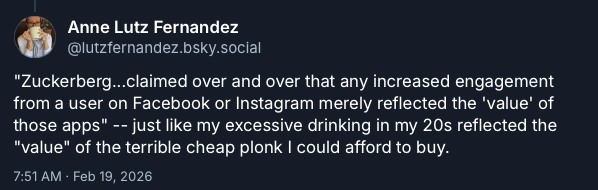
“I wanted people to have a good experience with it,” he said of the company’s platforms. Then, a moment later: “People shift their time naturally according to what they find valuable.”
So you see, Facebook and Instagram aren’t addictive – even though there are multiple document leaks showing that this was an explicit strategy, demanded by Zuck, while whistleblowers were hunted down. Instead, Zuck says, users appreciate his platforms because they’re valuable. It’s like the intrinsic value of a slot machine, or a cigarette, or a crack pipe. Addicts the world over are so thankful for the value they experience every day. As a Bluesky post put it:
On this point, Zuck was consistent with his lieutenant Adam Mosseri, CEO of Instagram. Mosseri gave testimony at the social media trial a few days before Zuck. From the NYT (Feb. 11, 2026):
[Mosseri said that] people could be addicted to social media in the same way that they could be addicted to a good television show, but that did not mean they were “clinically addicted,” which was more serious.
Here the excuse is that Instagram isn’t clinically addictive – whatever that means. My best guess is that the lawyers advising Zuck and Mosseri found a phrase that, while not accurate, or ethical, or right in any human sense, would at least shield them long enough to survive the trial, after which they can get back to addicting kids to their services.
Should we trust Mosseri and Zuck? I’ll point out again what I did in The upside of child sacrifice. A report from Fairplay from last September, subtitled “How Instagram is Failing to Protect Minors,” opens with a foreword written by two parents whose teenagers committed suicide after sustained exposure to harmful content on Instagram. They write (emphasis mine):
Meta’s new safety measures are woefully ineffective. . . . Time and time again, Meta has proven they simply cannot be trusted. . . .
We implore everyone reading this: Help us make sure that not one more child is lost to Meta’s greed, and not one more parent has to live with a grief like ours.
The answer is no, we can’t trust Mark Zuckerberg or Adam Mosseri.
Get off of Facebook and Instagram, and if you can, get your kids off those services, too.
Updates to last week’s column
Last week I wrote It’s time to get rid of networked cameras (Feb 19, 2026). On our Forum, Creative Good members and I have posted several followups, as the story has continued to develop. Here are a few:
Amazon Ring could be planning to expand Search Party feature beyond dogs, reports Engadget (Feb 19), confirming my (and other tech critics’) warnings about Ring.
The Amazon ad seems to have triggered a long-overdue spotlight on surveillance, writes Glenn Greenwald (Feb 13), echoing the point of my column.
Definitely Only for Dogs, a parody video by a competitor to Amazon Ring (warning: YouTube video – watch in Duck Duck Go browser to strip out Google surveillance).
Good Reports: Home security cameras is our members-only thread listing several Amazon Ring alternatives, allowing for local surveillance without giving access to Big Tech. (Join us for access.)
And finally, Remove Your Ring Camera with a Claw Hammer, which gives explicit and helpful instructions about how to handle your Big Tech surveillance gear.
I hope this has helped. My goal is to raise awareness about Big Tech’s harms, while pointing to positive alternatives – so that we can live in healthy communities with the benefits of ethical technology.
If this resonates with you, please support my work by joining the Creative Good community. You are on a free subscription and I hope you’ll consider pitching in.
Until next time,
-mark
Mark Hurst, founder, Creative Good
Email: mark@creativegood.com
Podcast/radio show: techtonic.fm
Follow me on Bluesky or Mastodon