
AI and the illegal war
“No stupid rules of engagement.” That was Pete Hegseth, the American war secretary, boasting during a press conference about the approach with which he and the current occupant of the White House started a new war.
No stupid Congressional approval, no stupid legality or constitutional basis, and no stupid rules of engagement.
The press conference came two days after a missile fired by US-Israeli forces slammed into a girls’ elementary school in southern Iran, while class was in session, killing nearly 200 girls and teachers. (See NYT coverage. There are also reports of a double-tap.)
Just that much, just those three paragraphs above, should be enough for me to stop writing, and for all of us to turn off our screens and reflect for awhile. “No stupid rules of engagement.” The sheer murderous arrogance of it all.
Still, while my writing will not touch the enormity of what occurred, I will say more.
In particular I want to point out what the Washington Post wrote (March 4, 2026) about the war so far:
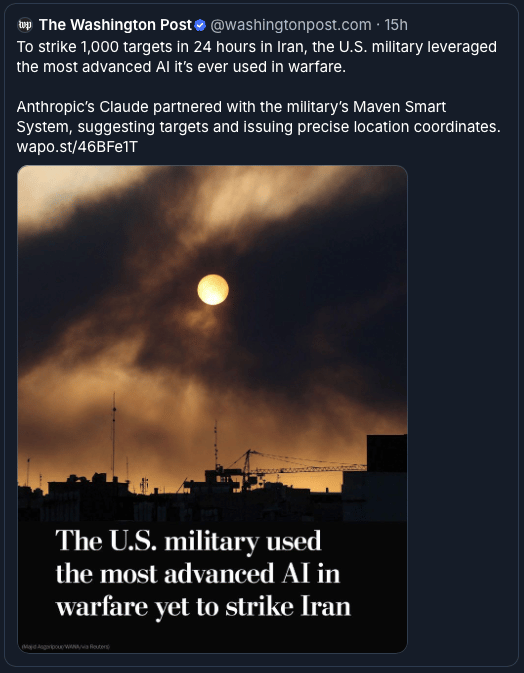
The headline of the article: “Anthropic’s AI tool Claude central to U.S. campaign in Iran.” The subhed follows as such –
Advanced AI technology is identifying targets in Iran and quickly prioritizing them, supporting the massive military operations carried out by U.S. and Israeli forces.
Expressed as redaction poetry, combining the WaPo and NYT articles might go something like this:
Anthropic’s Claude
the most advanced AI
quickly prioritizing targets
issuing precise location coordinates
supporting massive military operations
killed at least 175 people, many of them students attending class.
But the WaPo article praising Claude doesn’t make this connection. It doesn’t mention that the precise location coordinates led to the bombing of the elementary school and, in Tehran, the killing of two high school students whose school was also hit by precise, AI-guided bombs.
The story also doesn’t mention that Claude, the military’s “advanced AI” from Anthropic, was funded in large part by Amazon, whose founder Jeff Bezos owns the Washington Post.
Nor does it mention that Bezos laid off over 300 Washington Post employees last month, citing the need to find a sustainable business model.
A certain diabolical logic begins to emerge here: a Big Tech oligarch (like all the others) has bet his company, and the entire economy, on a deeply flawed technology popularly known as “AI.” The easiest way to prop up AI’s revenue numbers is to sell it to the US military. (To sweeten the sale, one must first bankroll a propaganda film about the current occupant’s wife.) Then, when the current occupant begins an illegal war with the help of the oligarch’s AI, the oligarch’s newspaper is full of praise for the AI and the military that uses it.
All of this provides benefits: the AI is presented as a viable, even inevitable, technology; the current occupant is pleased; and the post-layoff newspaper shows its value as a propaganda source.
There’s just one downside to this entire effort: the AI-powered military surveillance state is not democratic, just, or sustainable in any way. Outside of the benefits to the current occupant of the White House, the Silicon Valley oligarchs, and the vassals who cater to them, the effects of the AI blob are bound to fall most heavily on the most vulnerable, at first. At some point those effects will fall (perhaps literally) on you.
I will give credit to the Washington Post’s Shira Ovide for this story (gift link, Feb 23, 2026) about AI’s effects on the economy. Emphasis mine:
Massive investment in AI contributed “basically zero” to U.S. economic growth last year, Goldman Sachs has calculated.
. . . Prominent economists, including from Morgan Stanley and JPMorgan Chase, calculate that the AI buildup was directly responsible not for 92 percent or 39 percent of gains to the U.S. economy in 2025, but as little as zero.
Here we see the difference between propaganda and reality. The oligarchs, through their vassals, spread the fantasy that their AI is a kind of fairy-dust that, when sprinkled at the cost of a trillion dollars or so, magically brings about growth. The reality, confirmed by the banks themselves, is that AI hasn’t created any significant economic gains – even as it strains the power grid, drains the water, pollutes the air, and raises utility prices.
Undeterred by this news, the oligarchs are now floating the hype that their AI, used in the illegal war, is “precise” and can “prioritize targets.” I invite them to look at the photos of the elementary school and the students’ coffins. Look at the child sacrifice, then tell me again about “precision.”
Where does that leave the rest of us? AI continues to spread, as the oligarchs have – as I said – bet the entire economy on Big Tech-owned large language models that, by their very architecture, are inherently and irreparably error-prone. We are all at risk, and it’s getting worse.
Ross Barkan concludes his essay Why Fiction? (Feb 27, 2026) with a warning about what’s at stake. Emphasis mine:
Much is on the line for the AI oligarchs. If enough of us do not take to their creations and make them economically viable, they will be out many billions, maybe begging for federal bailouts. They’ll battle to avoid that outcome as much as they possibly can. This next decade will be pivotal, for both the anti-humanists asserting their market position and the humanists trying to lay claim to what is sacred . . .
The next decade is pivotal, but so is the next year. So is the next month.
I intend to keep raising the alarm about what the oligarchs are doing, while encouraging communities and alternatives that are creating good in the world.
If this resonates with you, join Creative Good, our community where we’re resisting Big Tech and exploring better, healthier paths.
Until next time,
-mark
Mark Hurst, founder, Creative Good
Email: mark@creativegood.com
Podcast/radio show: techtonic.fm
Follow me on Bluesky or Mastodon