
Dear Friends,
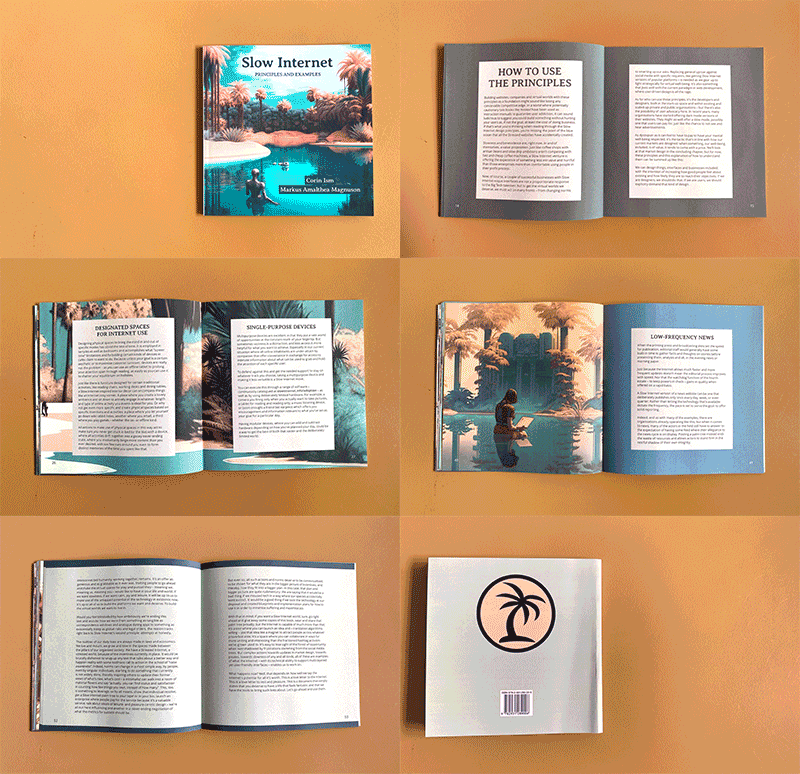
Welcome to the first newsletter from the desk of Ism. Today, the focus will be on the first public-facing release from the Future of Governance Agency: Slow Internet.
Governance – the architecture of power – has long been something deeply associated with territory. Governing has been what you do in relation to physical states and physically bound companies. This is no longer a sufficient outlook to understand influence. The average time people who are connected to the Internet spend in virtual worlds is already seven hours (four if you’re in Japan, nine if you’re in South Africa[1]). If you’re following tech launches, from AR to agentic AI, you know that the current-day level of immersion in virtual terrains is only the beginning. No matter how you slice our online worlds – as surveillance machines, the infrastructure for our relationship, the high- and low-ways of propaganda, or as the core of global intelligence – the Internet today is a space where our wars are fought and minds are shaped. With the last third of humanity predicted to come online in the next decades[2], the digital worlds are rapidly becoming our only worlds. This being the case, governance – both in and of – our virtual landscapes are rapidly gaining relevance.
Many of the texts and projects FOGA has developed and now has slotted for publication address different aspects of this largely underreported shift. This first release spotlights the aesthetics of our online lives – how it feels to be on the Internet today – and most importantly, how we can act to make sure it feels much better tomorrow.

Out of all the possible metrics for what constitutes a good society, how it feels to live inside of it is a crucial one. This notion is pronounced in the well-being economy movement, but perhaps even more so inside all of us who’ve lived to experience GDP increasing while feelings of disempowerment and disillusionment remain or rise. In few domains has that paradox – between plentiful priced value and declining well-being – been as stark as in the performance-anxiety-encrusted doomscrolling that signifies the Stressed Internet of today. And so, it’s high time to articulate its antithesis. To suggest how we can build online life instead. It is this Slow Internet attempts to do.
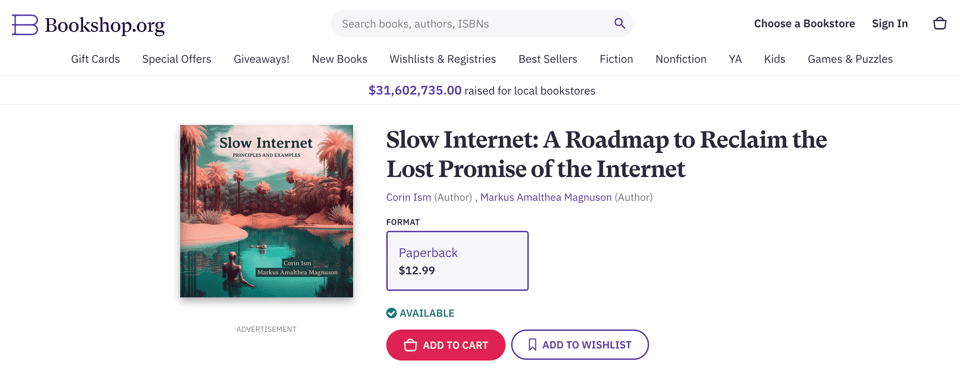
In the Slow Internet book – designed to be brief enough for people whose attention spans have been shattered by hellsites – three design principles, a philosophy, a vibe and plenty of concrete examples are presented. They add up to a way to reconsider our relationship with tech in general and develop Slow Internet sites, services and realities in particular. You can buy the book, co-authored by me and altruistic hacker Markus Amalthea Magnuson, on our HTML-only website slowinternet.info – a technical choice we’ve made to highlight how the slow movement’s emphasis on intentionality is merged with the promise of early ’90s web, whose slogan read “let’s share what we know”. We know this: we deserve to feel good, and by now, we have the tech, data and lived experience to achieve that in our online lives.
Along with the book, we’re also releasing a palm tree badge. Posting it, or its emoji ditto 🌴, is a way to swiftly communicate your desire to opt out of Stressed Internet conventions. Be it by no longer updating your socials according to incumbent high-frequency expectations, or by committing to legislation and norms promoting AI to be made safer before it’s made stronger. The guiding principles laid out in Slow Internet all emphasise intention. Particularly, that the right pace to achieve a certain goal – like well-being and a post-scarcity world – is superior to a pace that’s high for the sake of itself, or for racing competition. The palm tree is a way to show that your actions reflect, not ludditism, but that very allegiance to intentionality.

On a personal note, many of you know I opted out of a lot some six years ago. I did it to enable a kind of focus I couldn’t achieve while entrenched in virtual or physical social life. Subsequently, I, through FOGA as well as independently, have a number of releases in the pipeline now. Many of which are about the heaviest subjects conceivable. Starting this launch season off with design principles for online life might seem surprisingly trivial to some. But technologies have been rearticulating power dynamics at a very rapid pace this decade, and I operate with the conviction that it is the job of the intellectual to help people understand what to demand. To investigate fields and not just report the findings, but turn them into demands that are both relatable and potent. Demands people can make to create subversive motion. Slowness, intentionality, well-being are themes in that lane, they relate to the here and now of modern existence, but cut to the core of the incentive design at play on global markets. Slow Internet as such is an experiment. We’ll see what traction it can render. If it’s abysmal, well, then luckily, the pipeline consists of several other tactics to achieve the same objectives. But for now, if you like this project, or the post-scarcity goals that are the backdrop, do help platform this initiative. From podcasts and op-eds to editorials, talks at conferences and hackathons, we’re geared up to take on all relevant requests and collaborations.
For now, that’s the state of affairs,
/Ism
[1] https://datareportal.com/reports/digital-2024-global-overview-report
[2] https://datareportal.com/reports/digital-2024-deep-dive-the-state-of-internet-adoption

You just read issue #1 of Corin Ism. You can also browse the full archives of this newsletter.