
The Three Doctors
“I am he as you are he as you are me and we are all together.”
When I was a lad, and the universe less than half its present size, we all saw The Three Doctors as Doctor Who’s tenth anniversary story, and saw no reason to quibble the details. But then along came a revisionist school, one to which I admit I contributed, that pointed out that The Three Doctors was transmitted closer to the series’ ninth birthday than its tenth, and when that was countered by people pointing out that it was, at least, the first story of “Season Ten” responding by pointing out that, actually, in the winter of 1972/3 fandom had not yet decided into what "seasons” Doctor Who should be divided.1
It’s also true that Doctor Who’s early 1970s producer Barry Letts often talked of his desire to have a “gimmick” opener for each of his seasons in charge, and he included having Hartnell and Troughton appear in The Three Doctors in that retrospective list. This fact was wheeled out to suggest that this was, in fact, the true reason behind The Three Doctors, rather than any anniversary shenanigans.
But unfortunately for the likes of me, while the famous Radio Times Tenth Anniversary Special was indeed a year in the future when The Three Doctors was shown (and indeed does not break Doctor Who into “seasons” yet) the issue of Radio Times proper covering the transmission of The Three Doctors does make a great deal out of 1973, the year about to start, being that in which Doctor Who turned ten.
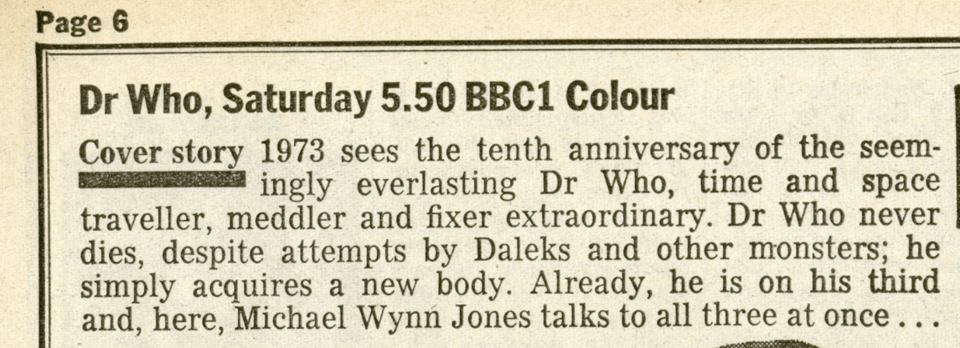
I mention this not to embarrass others, or indeed even myself. But as an example of how sometimes revising the revisionists is necessary. Not to put things back where they were, but to take account of what they (we) got wrong and what wasn’t (or couldn’t be) known. As well as admit to that which it was sometimes just too tempting to not try to tackle, prod at or knock off its perch.
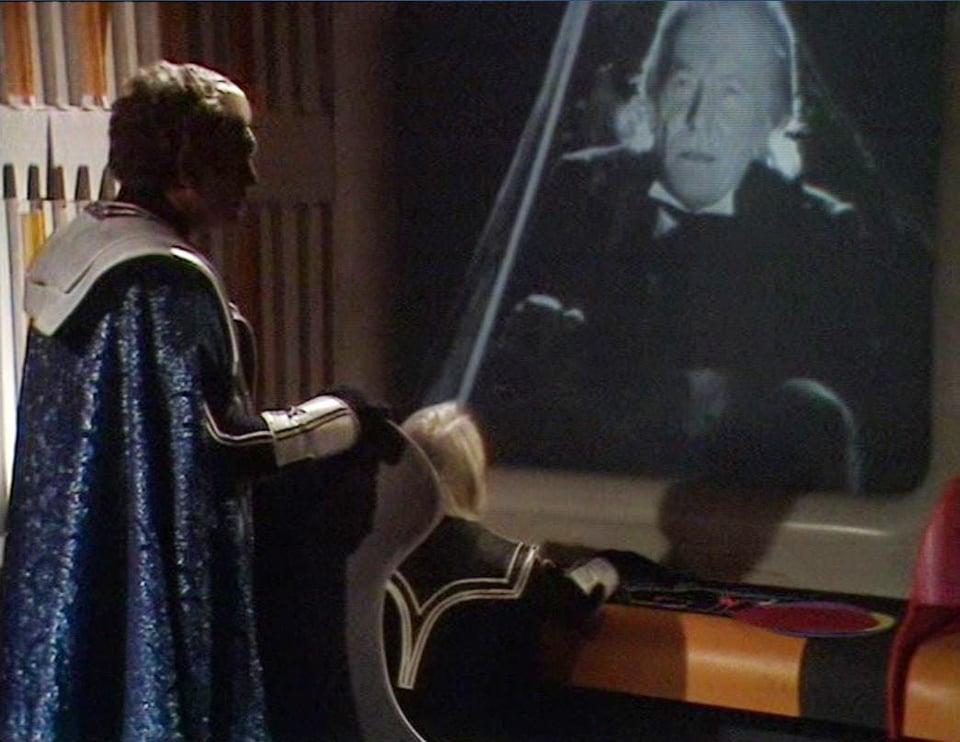
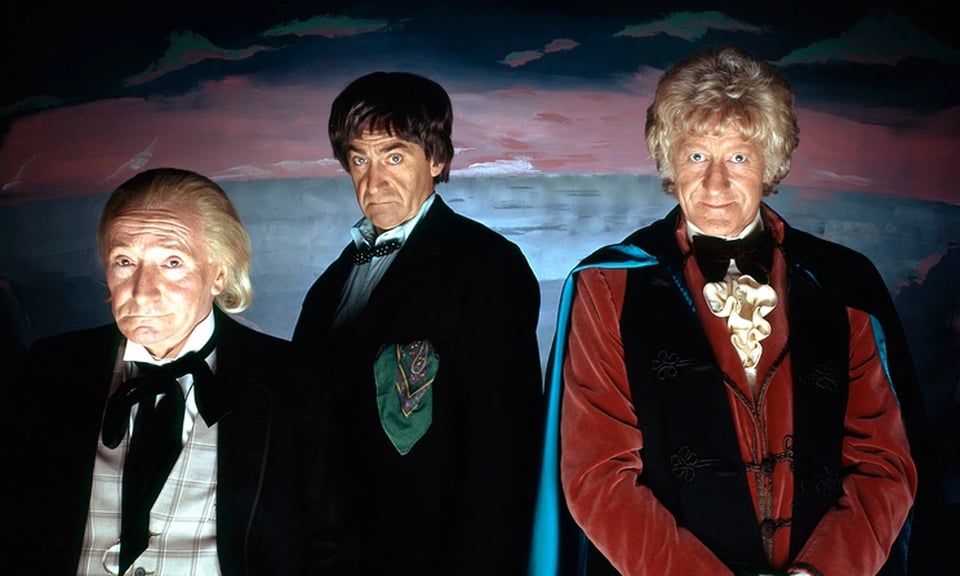
Because The Three Doctors was on a pretty high perch thanks to that whole anniversary business, and the presence of the then-two previous Doctors, alongside the current one. It’s also, and this was less understood then, a key point in Doctor Who’s early 1970s renewal after its near death experience of 1969. On transmission, the first episode was one of the handful of episodes after Christmas 1965 to be seen by more than 9m people, and the second only the fifth since that time to be seen by more than 10m. The final episode drew 11.9m viewers. Only the second to top 11m since autumn 1965, and the first to even come close to 12m since March that same year. For two of the three Doctors here present, it’s the most watched episode of Doctor Who in which they appear in new material.2 Only Hartnell’s original Doctor can claim to have appeared before a bigger audience in the part.
Of course, his Doctor’s role in this story is little more than a cameo, only in that final episode does he appear in more than one scene, and Hartnell was never in the studio with his other selves. The often told story is of Letts calling Hartnell by phone to confirm his willingness to appear in principle, only for the production office to be rung back later by his wife, who had been out when they called, with her explaining that Hartnell’s ultimately terminal arteriosclerosis was at a more advanced stage than he understood, and there was no way he could ever act again.
Determined to present three Doctors onscreen for their anniversary bash, Letts and his script editor Terrance Dicks re-conceived their story. At this point it was not yet scripted and only at a ‘bouncing storylines back and forth with script writers Bob Baker and Dave Martin’ stage. On 13 April 1972 Dicks wrote to ‘the Bristol boys’ (as the production office termed them based on their shared city of residence) explaining that it had been agreed with Hartnell and his family that he would be available for a single day’s filming at Ealing studios, where he would deliver lines to camera. It was stressed that his appearance should be thought of in terms of shots, rather than minutes.
In the end, Dicks would slightly reduce even this material when creating the rehearsal draft in November that year, and Hartnell was not able to record everything that was scripted. Nevertheless, he was able to make a final appearance in the series that he had launched and done so much to make immortal, and it’s notable that Dicks amended the final lines of Hartnell’s role in the story, Doctor Who and indeed his acting career; writing the wistful “I shudder to think what you’ll do without me” to go in place of the comically grumpy “But while I am here, the first thing you did wrong was to…” They seem like deliberate, conscious last words.3
Heather Hartnell later said that she thought the pride he felt in having accomplished this, of being photographed at the press call with Troughton and Pertwee4 and appearing on the cover of Radio Times again, gave him a renewed energy that literally extended his life, and certainly the period of it for which he was able to remain active. For that alone, The Three Doctors is owed high honours by anyone who cares about Doctor Who.
It is also debatable whether or not the delightful Pertwee / Troughton double act that developed in rehearsals for The Three Doctors could have happened had they taken place with an ill Hartnell on hand. Not least because initially those rehearsals were extraordinarily bad-tempered. The two men had radically different working methods. Troughton, both hugely confident and constantly overworked, always delivered an approximation of his scripted lines, in a manner that was widely regarded as improvisationally authentic by many, including Letts. Pertwee, far less sure of himself as an actor, preferred for the entire cast, including him, to be “letter perfect” by midway through rehearsals.5 These contrasting methods and the disputes they caused were not helped by Troughton’s periodic treading on or omission of cue lines6 which Pertwee regraded as unprofessional.
This was a view that, when Pertwee expressed it, angered Troughton, who pointed out that he had been playing leads on television for twenty five years, not three. (He also, Letts later said, found it difficult to grasp emotionally if not rationally that Doctor Who was now Pertwee’s turf, and that he was a guest on his show, even if it did not feel like it.) This argument was had multiple times, and in later life Letts suggested that he did briefly think the situation so bad that they might have to cancel the show.
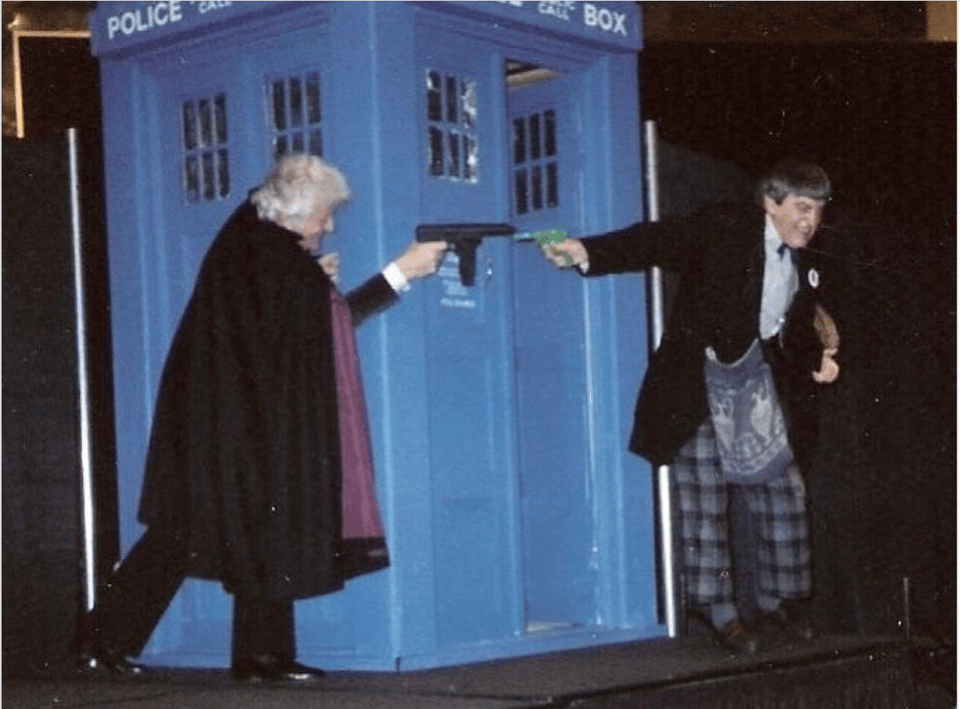
Eventually cooler heads prevailed, and Troughton adapted a little to Pertwee’s way of working, while Pertwee tried to rule the roost less obviously than he had been doing. The two also bonded a little over their mutual wartime Navy service, and in later years they became friendly, continuing this serial’s double act at conventions, albeit mostly in the United States, where both of them could be guaranteed a handsome fee at a time when most UK conventions were volunteer run and offered at best expenses.7
That November rewrite of Dicks’ was in part necessary to remove Jamie Mccrimmond8 from the script. Frazer Hines had indicated a willingness to return in order to appear alongside Troughton, but in the end it clashed with his commitments to Emmerdale Farm. Troughton’s own return had been easier to arrange but not that easy, even before his clashes with Pertwee. With two families totalling six children to support, Troughton would work any hour or job God or Equity sent, so was obviously willing to return to a part he knew how to play.9 But that constant busyness meant he was unavailable in what should logically have been the active production period for a story due to start transmitting in Week 52 of 1972. As a consequence, the story was shot from 6 to 28 November, leaving exactly four weeks before the first episode was to go out.
That haste, unseemly for early 1970s drama, although common even half a decade earlier, has been blamed for The Three Doctors being a somewhat shoddy production. But newsflash: I don’t think it’s a shoddy production at all. It is quite a light-hearted story, absent much of the grime and grit fandom (largely fallaciously) associated with the Pertwee era. I suspect that this and both fandom and the production itself being the wrong age when the story went into circulation following its repeat on BBC 2 as part of The Five Faces of Dr Who (1981) are responsible for the years when it was considered a disappointment.
The production did not feel dated or old-fashioned to me when I saw it in 1990, where it was the late night Sunday climax to the BSB Doctor Who weekend, which we shall sadly be leaving behind after this edition of Psychic Paper. I think it’s really only lacking in comparison to the functionally infinite visual budget of Dicks’ superb and much reprinted 1975 novelisation. The film work is good. The UNIT lab set good enough for much of it to hang around for a couple of years or so. The new TARDIS set is a return to the glories of the early 1960s, with the addition of colour. Omega’s castle and the Time Lords’ control room are both imaginative and odd. They aren’t expensive, but both seem much bigger than they are, a good measure of smart design in the era of VT television. This is especially true of the former, crammed into the confines of TC6.10 The latter contains the particular joy of the Time Lords pieces of circular paper which, combined with the size and the design of the TARDIS console room imply the roundels are for all the paperwork Doctor Who can never be bothered to do.
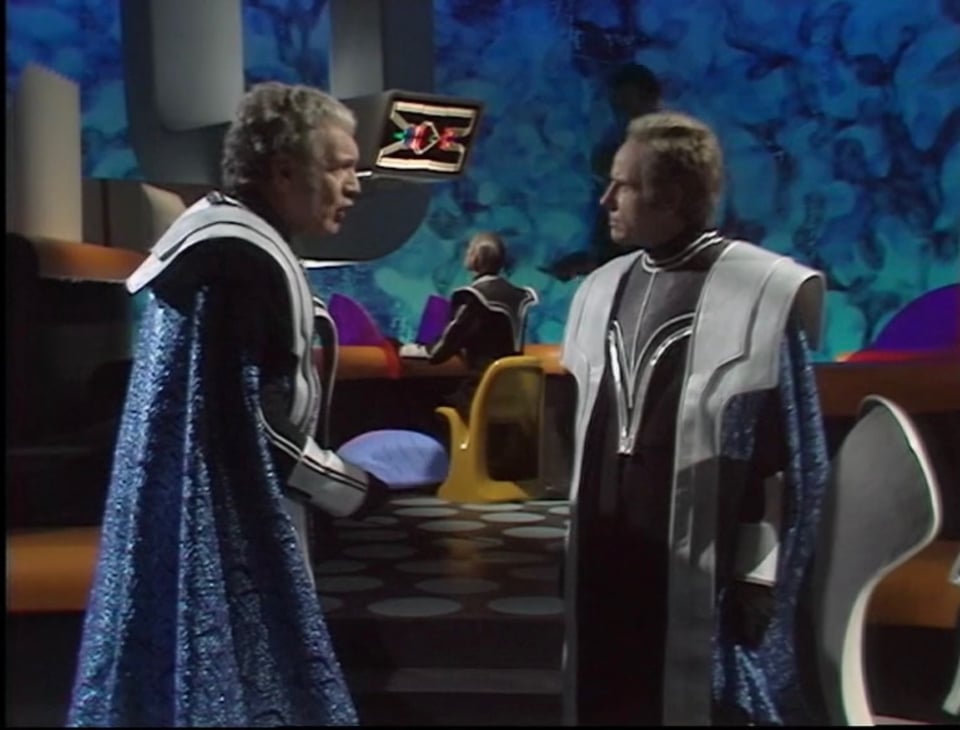
The Three Doctors wears its influences on its sleeve, next to its heart. Baker and Martin readily acknowledged the debts owed to The Wizard of Oz (Victor Flemying, 1939) in terms of its structure, and it is surely the Cambridge English scholar Dicks who shaped Omega, the Time Lord villain responsible for a threat so large as to necessitate three Doctors to fight it, as a kind of Miltonic Lucifer. Is it Dicks too, schooled (literally) in mid century literary theory who applied the term, “the dark side of my mind” to the champion that Omega sends to fight Pertwee’s Doctor at the cliffhanger to Part Three?
The term has easy echoes of the Jungian shadow self. The unconscious part of the personality that does not conform to a self-created ideal. In Omega’s case, its feral violence does not fit with his idea of himself as not vengeance-obsessed and destructive, but grievously wronged and demanding a fair hearing. Given the story’s attempts to parallel Omega and the Doctor, it’s very easy to see Troughton’s version, the most tricksterish Doctor even now, as outwith Pertwee’s incarnation’s self-image as a dignified man of action. The trickster being an archetype frequently associated with the shadow by jungians. Even that quarrel between Troughton and Pertwee over methods to achieve the same ends suggests that perhaps the actors who played Doctor Who were not as integrated as a union as the character they jointly portrayed.
But there is another kind of unconsciousness that we should perhaps take into account when it comes to this serial. By the time The Three Doctors was made Letts had been practising Buddhism for a long time; he read widely around the subject and it had a profound influence on his creativity. That the Letts’ co-scripted Planet of the Spiders overtly contains many Buddhist elements (and indeed characters who practice it) has meant that there’s been less consideration of his influence on other stories.11
We’ve already talked about how 1972 was the year in which Doctor Who began consciously to invoke its own past. The year in which it became a series that returned to old and once discarded elements such as the Daleks and the Ice Warriors who had not appeared for five and three years respectively. This is something which is a quantifiably different creative process to returning to something from a few months before and then doing so again until prevented (as had happened with the Daleks in the first place) or until the whole thing runs out of steam (as had happened with the Cybermen).
Letts would inevitably have been aware of the eighth level of consciousness in Buddhism ādānavijñāna, which is often called “the storehouse consciousness” in English. A communal and eternal level of perception, this eighth consciousness is said to store the impressions (vāsanāḥ) of previous experiences, which form the seeds (bīja) of future karma in this life and in the next after rebirth. (Or indeed regeneration.)
Is it coincidence that it is under Letts that Doctor Who begins to draw on its own common treasury quite so much and in a way that has perpetuated, in a relapsing remitting sense at least, to this day? Who knows. But, deliberate or otherwise, The Three Doctors, the culmination of that year of renewal, is now a fantastically influential piece of Doctor Who. Quoted, copied, paraphrased and parodied up the The Reality War (2025) literally the most recent episode of Doctor Who made and transmitted at the moment I’m writing this.
The Three Doctors, something which in many ways was a culmination of Doctor Who, and had circumstances not intervened would have been more so, is now a foundational text. A touchstone. It has entered ādānavijñāna. More than half a century on this story remains, appropriately enough, a kind of bliss.
Which at least has the advantage of being true. ↩
The most watched episode on which either has a credit is The Day of the Doctor (2013) ↩
This amendment is so late it’s in the Camera Script, rather than the Rehearsal Script; given Hartnell’s shooting day for the serial was 6 November 1972, before any other recording for the story, it’s conceivable this line was changed on the day and then this change incorporated into the shooting script which would have been prepared slightly later. It’s notable in this context that Dicks deputised as producer on 6 November, standing in for Letts who had work commitments elsewhere and he could conceivably have made the change there and then. ↩
The only time the three actors were ever in the same place at the same time in their lives. ↩
There are, for the record, known instances of Pertwee failing to observe his own professed standards; he used to tell an anecdote about Letts expressing a strong view that Pertwee was not prepared enough for some stories late in his third production block as the Doctor, leading to him reverting to mean, explaining to the cast during rehearsals for The Time Monster; “Barry took me to one side and gave me a bollocking.” ↩
One of these happens on camera towards the end of Part One, and you can see the reasons for Pertwee’s annoyance. ↩
It seems churlish to wonder if they were ever as close as Pertwee would recall after Troughton’s death, but then the specifics of their arguments of 1972 were not made public by Letts and Dicks until this century, and even then both recorded their thoughts in interviews expected to be utilised only after their own decease. ↩
There are multiple variant spellings of the character’s surname in scripts and other documentation over the years, and I’ve decided I like this one. ↩
Troughton had also worked with The Three Doctors assigned director Lennie Mayne on the Doomwatch episode In The Dark (15 February 1971) in which he gave a dual performance a two brothers, one terminally ill and the other vying for his business interests. Given that Jon Pertwee and Katy Manning rated Mayne, a foul-mouthed diminutive Australian and former dancer, this suggests an ingenious calculation in director selection on Letts part. ↩
Which was not quite 650 square feet. ↩
It remains one of the major-minor sadnesses of Doctor Who history that the notes he made on Kinda in his capacity as Executive Producer do not survive in the serial’s production folder. ↩
