
Return to Devil’s Planet
The Daleks’ Master Plan (1965/6) was made at a strange time for Doctor Who. Originating producer Verity Lambert had departed a few months before, and her successor John Wiles, a writer who apparently did not want to be a producer, was extremely resentful of the twelve part Dalek story that she had commissioned on her way out the door. Most people would, under such circumstances, probably be grateful. Three months of the successful programme which you, a novice, were taking over, being set up for you in advance by the very people who had made it such a success. Wiles, though, later claimed he’d “washed his hands” of the story which he thought “got in the way” of what he wanted Doctor Who to be.
Upgrade nowWhat exactly he wanted Doctor Who to be is not very clear, even now. Who he wanted Doctor Who to be is only a little clearer. In that he quickly decided he wanted Doctor Who to be “not William Hartnell”. Very early on in his ultimately brief tenure, Wiles had withdrawn the previous production office’s offer to extend the contract of companion Maureen O’Brien (Vicki) for another few months, leaving her to return from holiday for the third production block only to discover she had four weeks work booked, not four months. He seems to have done this, and there’s no other way to put it, in a fit of pique following her criticising the scripts for the final story of the second block (Galaxy 4) during rehearsals. (She famously told Wiles’ friend and Story Editor Donald Tosh that “It’s not fucking Shakespeare” when he criticised her for changing “the text”. She later said she had no recall of this incident but disarmingly admitted it’s the kind of thing she did and that “I haven’t changed”.)
O’Brien’s removal upset Hartnell, who relied on her help and friendship, and he questioned the decision. In what seems now like a shockingly insensitive bit of brinkmanship, Wiles responded by denying Hartnell’s request for time out of rehearsals for an episode of The Myth Makers in order to attend the funeral of an Aunt who, according to Hartnell’s granddaughter Jessica, had been at least as responsible for raising him as his mother had been. Hartnell, it seems, never forgave Wiles and the working relationship between the two men effectively ceased to exist. Eventually Wiles would try and remove Hartnell but resign instead after higher management refused his request, later saying he was well on his way to a breakdown.
Decades later, Doctor Who’s then third regular actor, Peter Purves, would be unsparing in his criticism of Wiles, calling him “incompetent” and “dishonest” and insisting that the real reason Wiles quit was because he would otherwise have been sacked. During shooting of the early parts of Master Plan Purves had feared for his own job too. Having seen Maureen O’Brien being unceremoniously dumped off contract so quickly, he was currently making the third episode of a twelve part story that had been plotted on the assumption she was going to be in it1 he eyed suspiciously actor Nicholas Courtney’s turn in the serial, and it’s undeniable that Space Security Agent Bret Vyon, the 007 of outer space, has more than a little in common with Steven Taylor, Pilot of the Future. He could easily have slotted into stories conceived for him in exactly the same way hurriedly drafted Trojan handmaiden Katarina (Adrienne Hill) couldn’t replace O’Brien’s ‘orphan from space’ for more than a few weeks.2
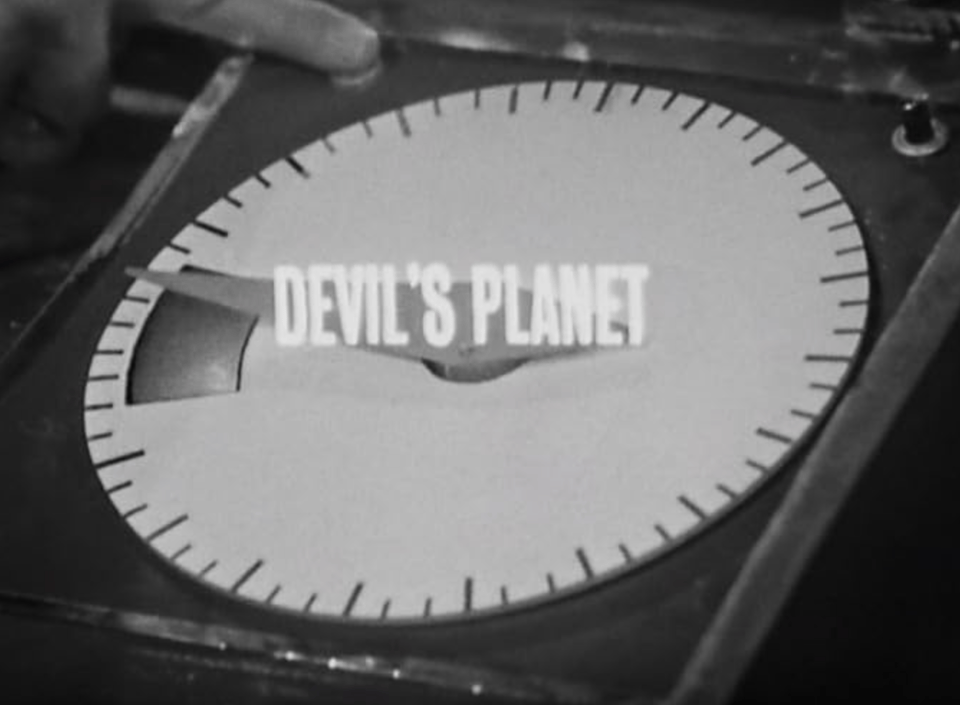
That’s all loose background for Devil’s Planet, the second of the two recently returned episodes of The Daleks’ Master Plan, which I fully expect anyone interested enough in Doctor Who to be subscribing to a newsletter to have watched several times in the last few weeks. (Although if you haven’t, I ain’t judging.) Master Plan was directed by Douglas Camfield, who has been considered by some to have effectively produced and directed the serial in the absence of Wiles' being actively involved. Certainly Camfield was more popular with his actors than their boss, and he’s still recalled fondly by essentially everyone who worked with him. This perhaps accounts for the strength of the performances in this episode in particular, even - actually especially - from Hartnell and Purves, who were under such unfair pressure from above.
William Hartnell’s periodic difficulty with his lines is somewhat legendary amongst seasoned watchers of old money Doctor Who. The stuff of convention anecdote as well as poring over video tapes. But here’s a secret truth (and it is a truth). In Doctor Who, Hartnell’s successor Patrick Troughton blows his lines at least as often as Hartnell does. But the younger actor (almost) always brazens through. Whereas Hartnell, as much as I love him, sometimes visibly gets The Fear. He never quite drops character, but there are moments where you can see in his eyes that something has gone horribly wrong.
But not here. In Master Plan in general and in Devil’s Planet in particular, he ploughs on in a manner closer to that which Troughton would later employ and even as the script, grammar and basic sense go to the wall. The result is a vigorous performance by a man who is sometimes just talking abject nonsense. Okay, some of that nonsense is scripted. Some of it not. But almost all of it glorious. None, though, is more glorious than his objection to having to being “stranded on this pimple of a planet, whilst you footle with that fuse box.”
That pimple is the titular Devil’s Planet. A human penal colony in the year 4,000 that visually suggests the first Doctor Who serial’s Stone Age setting, and here as then possession of a knife is key. But on Desperus, as it’s emblematically named by writer Terry Nation, a knife, seemingly the only knife on the planet, also works as a parallel for the serial’s ultimate McGuffin of the Time Destructor. Both are weapons the holding of which imbues supreme power. It’s a figurative point made explicit when we see a literal point embedded in a conference table, like-but-unlike the Daleks’ own, and immediately after the villainous Kirksen fails to steal a knife in exactly the same way the Doctor succeeded in stealing the Time Destructor in the episode before this.
Looked at in terms of mere plot, Devil’s Planet is a bit of wheel-spinning, if we’re honest. We get from A to B by a circumlocutory route with a brief stop off along the way. As a bit of world building, though, it’s very effective. The penal planet of a dystopian future that we must nevertheless try and save was something Nation would return to later in his career, and Blake’s 7 would also deploy a term first used in his work here, and by the Daleks: “pursuit ships”. Devil’s Planet is also, let’s be honest, really, really good 1960s TV.
Like The Nightmare Begins it’s an episode for which an off-air soundtrack existed, but for which there are no known tele-snaps.3 So until it bounced back into all our lives, we had very little idea what it looked like, despite the existence of a few clips from both it and the following episode, and the episode before it having turned up back in 2004. There’s so much about Devil’s Planet as television that isn’t apparent from that audio or those clips. Sure they gave us an appreciation of the chunky sound design of this episode. But even performances aren’t all there when you’re listening to an audio of a visual production. I wrote about Nicholas Courtney a bit in my response to The Nightmare Begins. Here we get a great close up of Courtney as he says “Troy?” and then decides it’s probably best not to ask, which feels like a rehearsal for his later role in Doctor Who history.
We could get a sense of Adrienne Hill’s oddly trippy out of this world line deliveries from the audio. But her look - black lacquered hair and smoky eyes - is fabulous, like someone measured out the exact mid-point between ‘swinging London’ and the RSC in Roman mode. We can also see now we can, er, see her, that Hill knows exactly what she’s doing in this part. She doesn’t get more to do, exactly, than in the preceding two episodes, but we get to see her deliver, I think. I love her, and the next time DWM does a poll I’m voting for her as my favourite companion. Because someone has to.
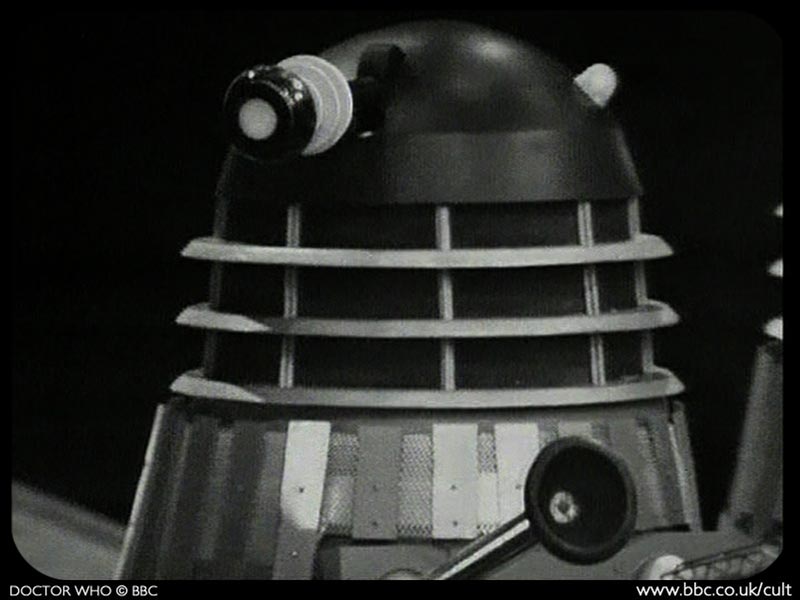
Even the Dalek Supreme gets to do a bit of acting here. It’s clear in vision in a way that it isn’t on audio that it decides Zephon should be executed after he insults it, not because it believes anything Chen says to persuade him of Zephon’s perfidiousness.
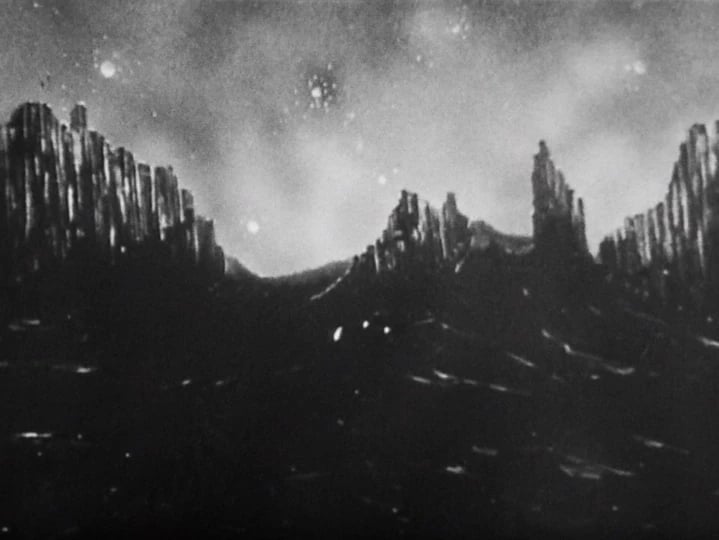
Camfield was a director actors liked, but he also had a strong visual sense, and over and again in this, brilliant Camfield-isms abound. The genuinely beautiful matte shot that’s the only proper look we get at Desperus, craggy mountains visible in half night as torches carried by desperate men bob in the foreground. A genuinely awesome shot of Mavic Chen’s Spar (“space car”) in flight that literally made me gasp when I saw it. There’s superb use of one of BBC drama’s few background on-set screens to give the impression of the Spar in-flight from the inside. We also get another shot of a flashing lightbulb or two. (I told you he liked those a couple of weeks back, right?) Best of all that huge column thing from all the Mission to the Unknown publicity makes a wholly unexpected (at least to me) appearance. Yay.
But while Camfield deserves oodles of credit for this episode, we shouldn’t run away from sharing it with others behind the scenes. Some books on Doctor Who suggest that Camfield even wrote some sections of this story, and above and beyond what rewriting an invested director might do. This stems, in part, from claims by Donald Tosh that Nation disappeared to America in a taxi after having delivered only a handful of pages to cover his six episodes of this twelve part serial. This claim is false, as is made entirely clear by the copies of Nation’s drafts of the episodes uncovered in recent decades. We should always have been more suspicious of this as a fandom than we were. Not least because The Nightmare Begins has the same basic structure as almost all Doctor Who part ones written by Nation from 1964 to 1979. One moment in that episode, which has always been attributed to Camfield’s skill, the Dalek looming over Kert Gantry as it exterminates him, is specifically asked for in Nation’s draft.
Devil’s Planet too has a structure that is pure Nation. We can see that from his draft, which has exactly the same scenes and in exactly the same order as the episode playing in front of me. What the episode lacks is almost all of Nation’s dialogue, although a couple of scenes with The Daleks escape substantial rewriting from (presumably) Tosh. The revised dialogue isn’t better or worse. It’s just different, and it feels like Tosh putting his own stamp on the story because he could. He had an excuse too; Nation’s version of this episode features Vicki. He knew that she would have departed before this, but it was easier to use her as a placeholder, and he did so knowing he’d be rewritten. Although I doubt that he realised everybody else would be.
On original transmission Devil’s Planet was the last episode of Doctor Who to be seen by more than 10m people until a Christmas 1971 repeat compilation of The Daemons. That’s another story with a distinctly diabolic hue. Which just goes to show that what they say is true. The devil really does have the best tunes. Or at least the ones the most people want to listen to.
Listen to? We’re beyond that now. How much better that we can, and for the first time since 27th November 1965, actually watch it.
Literally, Terry Nation’s outline for The Daleks’ Master Plan exists and it features Vicki right up to the final episode, which at this point is called The Mutation of Time. ↩
And, it seems now, she was never intended to. ↩
Photographs of programmes taken off screen during a programme’s airing by a company owned by a man called John Cura. But then you know that. ↩
