
On the Trail of a Time Lord
I was struck by many things watching the new 4k master of the 1996 Doctor Who TVM at the BFI this weekend. One is that, in exactly the same way as the Blu-ray of Spearhead from Space made the Third Doctor’s jacket noticeably midnight blue rather than black, the Eighth Doctor’s coat was now visibly green in a way that it had never been before. Except in publicity photographs. Also, that the Seventh Doctor’s trousers had a clear pattern I’d never quite been able to ascertain before. Some of these observations were’t about clothes. Honestly. A friend who is a huge fan of this story noted that the internal geography of the TARDIS console room was clear to him, having seen it on a big screen, in a way it just never had been on any of the umpty ten previous occasions he’d watched it. Such are the pleasures of a 4K scan from camera negatives.
Something I’d never really noticed before was that, in Grace’s house as part of what’s probably the first scene McGann shot as Doctor Who, his lips visibly say “I have twelve lives” even as his ADRd voice says he has “thirteen”. Now, I’ve known this was the case for a long time, and I’ve never been much of a one for revisiting a story I prefer to refer to as Grace: 19991 for fun, but I’d never really SEEN that ADRd moment before. Only been aware that it was there. If you see the distinction being made.
The idea of a Time Lord being limited to twelve regenerations, and thus thirteen lives, originated in Robert Holmes’ script for The Deadly Assassin (1977), one of the two earlier stories from which, in plot and story terms the TVM borrows from most heavily. (The other has already been mentioned in this newsletter today.) But it’s easy to see where confusion over this can set in. “Regeneration” is sometimes treated as a synonym with “incarnation”, the more usual Doctor Who argot for one of the Doctor’s faces / actors, when it isn’t. Because, at least we assume, a Time Lord is born (or loomed) and thus their second incarnation is their first regeneration. Hence why the fifth Doctor describes himself as the “fourth!” regeneration in The Five Doctors, leading the first Doctor to reply “Goodness me! So there are five of me now!”
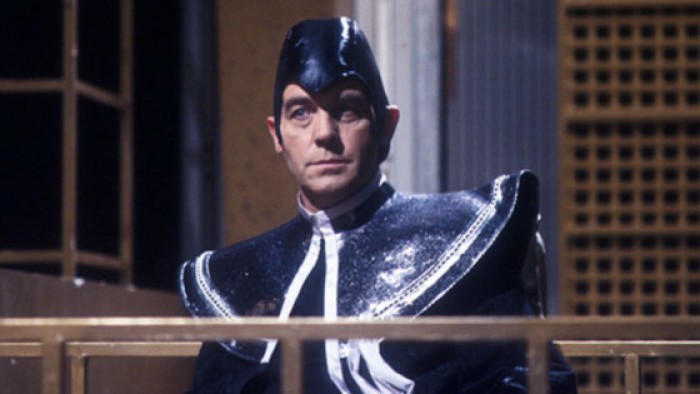
Upgrade nowIt’s a confusion that, oddly, Holmes himself was later guilty of, and it’s something that feeds into the wider confusion and complications of the villain of the last story he ever wrote for Doctor Who - The Valeyard.
In the summer of 1985 Doctor Who’s then Script Editor Eric Saward had held a meeting with the writers for the 1986 series at BBC Threshold House. At that time, those writers were intended to be Robert Holmes and Philip Martin, who would ultimately write five and four episodes of that series respectively, and David Halliwell2 and Jack Trevor Story.3 These latter two writers’ stories would be abandoned as plans for the series were revised, and were replaced by four episodes by married writing team Pip and Jane Baker.
Halliwell’s notes from the meeting – dated Tuesday 9 July 1985, over a year before the conclusion to The Trial of a Time Lord series was shot – record the intention that: “Valeyard actually Dr in future regenerated form. Corrupt.” This intention is exactly represented in the first draft of Part Thirteen, the penultimate episode of the serial, as written by Holmes. When the Master reveals the Valeyard’s secret identity to the courtroom from the Matrix screen he does so by addressing the Doctor thus:
MASTER
Your twelfth and final incarnation… and may I say you do not improve with age.
Even more interesting is that this is not what is said onscreen in the episode as recorded, or indeed much like it, except superficially. There, Anthony Ainley delivers the following -
There is some evil in all of us, Doctor, even you. The Valeyard is an amalgamation of the darker sides of your nature, somewhere between your twelfth and final incarnations… heh, and I may say you do not improve with age.
This is, of course, not simply an example of an actor going off-piste and completely revising the definition of the serial’s ultimate villain on the fly; it’s an approximation of what is actually in the shooting script for the scene, which is -
MASTER
“There is some evil in all of us, Doctor, even you. The Valeyard is an amalgamation of the dark side of your nature, somewhere between your twelfth and final incarnation… and I may say you do not improve with age.”
There is also a fourth, or more likely a second, version. In Pip and Jane Baker’s novelisation of the last two episodes of The Trial of a Time Lord, published as The Ultimate Foe in April 1988 renders is differently again.
“The Valeyard, Doctor, is your penultimate reincarnation… Somewhere between your twelfth and thirteenth regeneration… and I may I say, you do not improve with age..!”
This, though, is unlikely to be a revision by the Bakers themselves. Pip and Jane were called in at short notice to write Part 14 of The Trial of a Time Lord, the final episode of the story, after Robert Holmes died having completed a version of Part 13 only. They then novelised both their own episode and Holmes’. While the first half of their book contains huge amounts of dialogue not included in the transmitted Part 13, all of it is present in at least one extant previous draft of that episode, whether Holmes’ own or that as revised by Saward following his death and none of it is their own invention.4
The changes in the dialogue across these four versions of the line are not editorially incidental. The Valeyard’s nature changes from the straightforward (he is a future, indeed the final incarnation of the Doctor) to the inchoate (he is an indeterminate figure between the penultimate and final Doctors, but also somehow the Doctor’s penultimate incarnation) to the vaguely psychological (he is in some sense the Doctor’s dark side, while also being from his own future, perhaps as a sort of warning).
Across these revisions, there is a process of muddying the nature of the Master’s revelation but it is not clear exactly when, or why, or by whom these changes were made. Shortly after the completion of Part Thirteen, which he rewrote heavily from Robert Holmes’ first draft, Saward left Doctor Who, citing a combination of exhaustion and disagreements with the series’ producer John Nathan-Turner about the script for Part 14, which he was writing following Holmes’ death. Saward’s script for Part 14 was then abandoned at his own insistence, and it was only at this point that the Bakers were hired as replacement writers.
On his 2008 solo DVD commentary on Part 13, Saward is hazy about the details of the Valeyard’s nature, and possibly unaware that the wording of the Master’s revelation changed at least once after he left the Doctor Who production office for the last time. Writing in Doctor Who Magazine in the nineteen nineties , John Nathan-Turner seemed to take at least some responsibility for this change, saying:
“I did not wish to “waste” a regenerative form on the Valeyard, so I’d always requested that the Valeyard be considered the black side of the Doctor’s character, somewhere between the last two regenerative forms. That way future producers still had Doctors Twelve and Thirteen at their disposal.” 5
Taken with Saward’s hazy recollection, Nathan-Turner’s “always” creates an indeterminacy over the exact timing of these changes, which the dates on the surviving draft scripts don’t help to clear up.
These revisions do though, represent a definite, gradual process of watering down the original intention for the story. This was, as Holmes’ draft attests, simply that the Valeyard was a future incarnation of the Doctor, and that his motivation for his actions in the story would be to continue living by paradoxically stealing the lives of his earlier incarnation. It is also inarguably the case that Saward’s version of Part 14 (which also survives, again by chance) presents the character exactly as originally conceived. The Valeyard is written simply as a future incarnation of the Doctor. It is stated that if the Doctor is killed, the Valeyard, as a future incarnation of the same Time Lord, will cease to exist. In their final confrontation the Doctor ask the Valeyard “How did I ever develop into such a pathetic individual?”
This is not the case in the Bakers’ Part 14, which makes some attempt to square the circle of the transmitted version of Part 13’s description of the Valeyard. The Master explains his desire to defeat the Valeyard by telling the Doctor that his morality gives the Master an advantage in their frequent battles, whereas the Valeyard (“A distillation of all that is evil in you, untainted by virtue, a composite of every dark thought…”) is a different proposition. This builds on the Master’s comment in Part 13 that he is “not prepared to countenance a rival” (the Valeyard), but is very much more in keeping with the “dark side” description of the Valeyard’s character than the “future.. corrupt” one. The occasion in the transmitted Part 13 where the Master says the Doctor and the Valeyard are “one and the same person” is, tellingly, an untouched line of dialogue that has survived from Holmes’ initial draft.
The Bakers have the Valeyard himself articulate his desire “to be free” of the Doctor, whose very existence, never mind his “constant crusading.. restrains me”. He also chides himself for giving in to Doctorish “urges” such as quoting from human literature. These lines together suggests the Valeyard is a kind of Jungian Shadow self, who is not fully real or fully actualised while the Doctor himself exists. In the transmitted Part 14 Glitz refers to the Valeyard as the Doctor’s “other persona”, which is not out of keeping with Jung and the idea of the Valeyard as the Doctor’s shadow self. Some script-editing to Part 13 also helps shore up this interpretation. In all scripts for Part 13 the Doctor tells Glitz, “I want you to meet my other self,” as they travel to see the Valeyard. Onscreen this has become “I want you to meet my darker side” “Other self” is a term used by the Doctor and others in both The Three Doctors (1972-73) and The Five Doctors (1983) to describe past and future incarnations of the same Time Lord, the amendment seems crucial and specific.
The Bakers make further detailed reference to this redrawing of the character in their novelisation. Chapter 11 has the Doctor thinking:
“Now he had to face the fact that the cold, calculating prosecutor was the personification of every deplorable act he had ever committed; every adverse deed he had ever contemplated. The malice he had learnt to govern had burst from its cage and been reincarnated into this monster known as the Valeyard.”
Together these things make the Bakers’ Valeyard’s motivation for stealing the Doctor’s lives a rather different matter to his simply being “Just a pathetic old man” who has acted solely to “extend you own miserable life”, which is what the Doctor berates the Valeyard for being at the conclusion of Saward’s version of Part 14.
In many ways, the distinctions make the Valeyard a significantly different character in terms of motivation, action and execution. It is to Michael Jayston’s infinite credit that his performance in the two episodes that were shot smooths over such radically different conceptions of the part he has been asked to play. It would perhaps have been better for all concerned had the “future” aspect of the Valeyard’s origin been disposed of during script editing, making him unambiguously a kind of Mr Hyde to the Doctor’s Jekyll, an id to the Doctor’s superego.
Intriguingly, a line cut from Holmes’s draft has the Doctor refer to himself and the Valeyard as “Id and Super-Id”. This is a strange conflation of Jung and Freud that perhaps reflects direction or feedback from the Doctor Who production office, tying in with Nathan-Turner’s comment that he had ‘always’ wanted the Valeyard to be something more abstract than a later incarnation of the Doctor. But we can never know.
This is how convoluted and contradictory the very idea of the Valeyard had become by the time The Trial of a Time Lord was transmitted. As Philip Martin noted in a Doctor Who Magazine interview shortly after that transmission, “..when we reached the final episode I couldn’t follow it! And I had been there at the beginning!”6
I hope no one feels the same about this post.
Hat tip to my old pal Lee Thacker for coming up with that when the universe was less than half its present size. You can follow him on social media here. He’s right about Biggles - Adventures in Time too. ↩
1936-2006. Multi-award winning absurdist playwright, best known for Little Malcolm and His Struggle Against the Eunuchs (1965, adapted to film 1974), starring Halliwell’s RADA flatmate and future Doctor Who John Hurt. ↩
1917-1991. Novelist whose most famous work The Trouble With Harry (1949) was adapted to film by Alfred Hitchcock. ↩
The book also presents its scenes in the order they are in Holmes’ first draft, rather than the order they are in in the shooting script. All of this strongly suggests that the novelisation’s first half if based on a draft of the script between Holmes’ first (which exists and has survived by chance) and the shooting draft (which is filed at the BBC). In 1987 (DWM 137) Pip Baker recalled producer Nathan-Turner sending an taxi to their home with a copy of Part 13 on the back seat, so that they could begin work on Part 14 as soon as possible. I conjecture that this physical interim script remained at the Bakers’ home, or at least in their permanent possession, and was used along with their own draft of Part 14 to write the book. ↩
“This must be the place I waited years to leave..” DWM 245 (1996) ↩
Writing Who - DWM 125 ↩
