
“Don't tread on an ant, he's done nothing to you.”
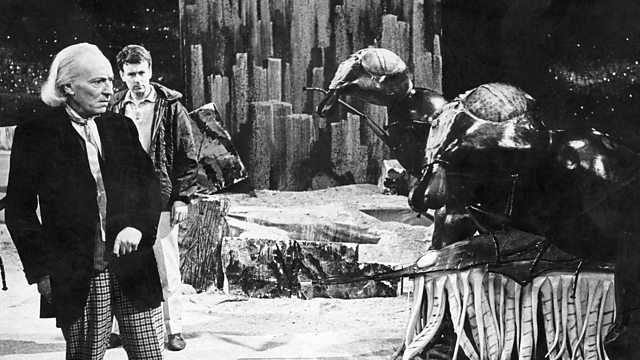
The Web Planet, transmitted in six episodes in spring 1965, remains one of the most highly rated Doctor Who stories ever. That’s not, by the way, in terms of how fans feel about it now, nearly sixty years on. No. In fact, this piece is in part prompted by readers of Doctor Who Magazine decreeing it their least favourite story starring William Hartnell as of March 2023.1 In terms of the number of people who have actually seen it however? Well, of the fifteen or so Doctor Who episodes watched by more than 13m people on first transmission, from November 1963 until the very day you are reading this, two of them are from this story. Of the ten twentieth century episodes to feature in the weekly top ten of watched television, three are from this story. In 1965 the UK contained 54,229,565 people. Which means the 13.5m who tuned into the first episode of The Web Planet were almost exactly a quarter of the population.
Subscribe nowThe Web Planet was big, and the serial’s monsters and guest characters were pushed in contemporary merchandise - on badges, and as slides in a toy projector but not, sadly, ever as dolls. They also appeared in the Doctor Who comic strip in TV Comic and in stories in the first ever Doctor Who Annual. They were even on the cover of Radio Times. The most significant item of merchandise, however, was the novelisation of the serial. Doctor Who And The Zarbi, written by Bill Strutton, the story’s screenwriter. This was only the third Doctor Who novelisation, and the first not written by David Whitaker, Doctor Who’s original story editor and someone who had played a huge role in the series’ development.
That makes it big not only in terms of its total audience on transmission, but also in terms of the series’ merchandising and publishing spin offs. Strutton’s book was hardly ever out of print between its 1973 paperback reissue2, and the end of the twentieth century. There are two (relatively) recent twenty-first century editions too, a first edition hardback replica, and a new version of the paperback. There’s even a splendid audiobook read by William Russell. It’s a vast ambient six hour extravaganza, recorded in 2005 but available new as a download as I type. Doctor Who And The Zarbi is a book with a very long shelf life, both literally and figuratively.
Writing Doctor Who And The Zarbi, then, and the TV serial on which it’s based, is an achievement. But one with a downside. Despite a long and seemingly successful career as a writer in several media, most of Strutton’s wikipedia entry concerns the story, rather than him, and The Web Planet dominated his obituary in the UK Daily Telegraph. Although it is possible that, without his six hugely successful episodes of Doctor Who, he’d not have received newspaper obituaries at all. He’s one of those writers for whom their contribution to Doctor Who is their only real posterity.
Bill Strutton was in his eighties when he died. He lived into the “archive research” era of Doctor Who fandom and was interviewed by Doctor Who Magazine. So we also know more about him than basic biographical facts, which is not the case for all Doctor Who writers from the series’ earliest years. We know he was an Australian, and an ANZAC during World War II. We know he was captured by the German Army during the Nazi paratroop invasion of Crete and spent the rest of the conflict in prisoner of war camps, where he developed an interest in writing, creating the camp prisoners’ newspaper in order to stave off boredom. We also know that an image from his childhood in Southern Australia, of two large bull ants fighting near his parents’ home, inspired the creation of the Zarbi, a race of gigantic alien ants.3
The Web Planet has provoked remarkably little critical commentary, even as it has slid down the chart of fan appreciation. Reviews? Yes. But actual critical discussion? Much less so. Maybe that’s because of how odd the story is. How difficult to parse. It is, after all, the story of a war between giant ants, the aforementioned Zarbi, and giant butterflies, the Menoptra; what’s at stake is the occupation and reconquest of a luna like planet called Vortis, the Menoptra’s former home. As the story opens it has been overrun by Zarbi, which the Menoptra had long considered to be domesticated work animals, with limited self-awareness. Later we discover that the Zarbi are no longer in control of themselves, they’re animated by a malicious alien force, which calls itself the Animus.
For one Doctor Who fan, Russell T Davies, our once and future show runner, The Web Planet was exactly the sort of story that twenty first century Doctor Who could not afford to do. Although he meant that in terms of its drama, rather than its effects. A piece of pure outer space fantasy, a story with no human or human seeming characters bar the regular cast, was not something he felt a casual audience would invest in in the mid noughties. (Although he obviously retains an affection for the story, sneaking mentions of the Venom Grubs named in its novelisation into his own scripts.)
For another fan, Twelfth Doctor Peter Capaldi, “The Web Planet represents Doctor Who at its most Festival of Britain… with strange kind of actors doing strange kind of movement and mime. The incredible ambition of trying to render a complete world on a budget… immensely successful.”4 He noted on another occasion that “The Web Planet lived powerfully and expansively in my head for decades… until the DVDs came along and spoiled the party… But those old shows were only made to be watched once, on a flickering monochrome telly that smelled of valves and furniture polish. In that context, they succeeded immeasurably. They were triumphs of imagination… I’m glad to say that the Menoptra eventually flitted back into my dreams, where they belong.”5
But is The Web Planet really pure fantasy? Does it mean anything? What’s it about? Other than 150 minutes? Well, the creature that is causing all the fuss on Vortis lives in a web called the Carsenome (spelt like that in the novelisation). That’s a homophone for “Carcinoma”, as in cancer. On Vortis, this world of literal giant butterflies and ants, are we to take the Carsenome as a metaphorical cancer? A cancerous growth roughly the size of an insect or lepidoptera? Is the story that The Web Planet tells essentially about overcoming disease? Are the battling insects like antibodies in the body of Vortis? Is that how we should see it?
Earlier I mentioned that Strutton did a lot of other work, which is mostly ignored by Doctor Who fans, the only people interested in him. It doesn’t have to be like that though. In Strutton’s case, not all that other work is totally lost to history, some of it is even available to buy. He wrote for Crown Court (Intent to Kill, which is out on DVD) and The Avengers (Lost, but since remade.) He also wrote several novels other than Doctor Who And The Zarbi, and the advantage books have long had over other media is that they’ve tended to remain accessible, in a way that much television and film haven’t. In the worst case scenario, the UK has several copyright libraries that will let you read virtually any book ever published in the country while you’re on site.
Can we make more of The Web Planet by trying to contextualise it in a broader canon of Bill Strutton’s work? Does that suggest other readings? His 1957 novel The Secret Invaders, which is about the preparation for the Allied invasion of Normandy during World War II, concerns an advance Commando party. Their activities, believe it or not, closely resemble those of the advance party of Menoptra who arrive on Vortis ahead of their own invasion of their occupied homeland. So perhaps The Web Planet is a WW2 occupation story in disguise, like The Dalek Invasion of Earth more obviously is?
Here’s an alternative; other work by Strutton demonstrates what might be termed a “robust anti-communism” and his rejected, much later Doctor Who pitch, The Mega6 has elements of cold war thriller to it. Given the way the Animus controls the Zarbi, who are explicitly former working animals, maybe the story is essentially anti-communist. Maybe that’s it.
Here’s another; in Jungian theory, the Animus is the unconscious masculine side of a woman, and the character itself is voiced by a woman in the television production. Is it that the story is not anti-communist, but anti-feminist? Is The Web Planet, one of the big successes of Verity Lambert’s Doctor Who, a story about how women shouldn’t be in charge? Hmmm. Well, probably not. “Animus” has alternative, pre-Jungian meanings, including referring to mental powers, which is exactly what the Animus of Vortis demonstrates.
Maybe none of these quickly extemporised theories is valid, and it’s a mistake to assume that this is Doctor Who’s version of The Insect Play.7 Despite that pretty in-depth interview, Strutton never tried to impart any additional meaning to his story, in the way way that other Hartnell era writers as distinct as Glyn Jones, John Lucarotti or Terry Nation did. But then television is a collaborative medium. In the case of The Web Planet, we know that some of the story’s secondary characters, the Optera, were added by director Richard Martin8 who felt the scripts were too short.
Or maybe it is just a glorious flight of fantasy inspired by a childhood image, one that found its way through the miracle of television into the eyes of a quarter of the UK’s population and which, somehow, continues to find new audiences even today.
Even if, at the moment, they don’t seem to think all that much of it. “Zaaaaarbii!”
Upgrade now
1
This is more than a little harsh. But I would probably have said that about whatever story ended up on the bottom of the heap.
2
The first edition as part of the beloved Target range.
3
Interviewed by Gary Hopkins, Doctor Who Magazine #158
4
www.youtube.com/watch?v=arZrvU7rApU
5
Interviewed by Benjamin Cook, Doctor Who Magazine #468
6
Later adapted, and splendidly, for Big Finish by Simon Guerrier, and available to download here.
7
More properly Ze života hmyzu (literally Pictures from the Insects' Life) a Czech play by the Brothers Capek (1921), much discussed as a political allegory, especially in the inter-war years.
8
Although Strutton credited / blamed Dennis Spooner, Martin is firm they were his own contribution. It is possible, perhaps likely, Spooner and Martin worked together in creating these sequences.
