
Dear friends,
This week's letter is not the one I had planned to send. It starts from a hunch about goodness and travels through a newspaper op-ed of mine that ran yesterday, to a Motörhead song, with Jung holding the pieces together in the middle. I make no apology for the detours, only a promise that they connect.
I don't have data to back this claim, but I'd bet that most humans, regardless of background, ancestry, geography, or any other marker, wake up every day wanting to be "good" people, as we understand that term. But our understanding of what is "good" isn't necessarily ours alone. Some of it, as far as anthropologists can tell, belongs to nearly everyone. Combing through more than 600 written accounts of 60 societies, one team found seven kinds of cooperative behavior that were counted as good in every society where they turned up: helping your family, helping your group, returning favors, being brave, deferring to superiors, dividing disputed resources fairly, and respecting others' property (Curry et al., 2019).
The "goodness" for which we strive gets shaped by social and environmental influences, our experiences, and countless other forces. What some count as goodness – income or healthcare for all, housing guarantees – others might see as harmful. Moral psychologists have mapped part of that divide: in one set of studies, liberals put the most moral weight on care and fairness, while conservatives spread theirs more evenly, adding loyalty, respect for authority, and purity to their mix (Graham et al., 2009).
At the same time, it is not only our idea of what is "good" that we share but also our location on the "goodness" surface. Whereas I'd like to think that I've spent more time on the higher elevations of that surface than the lower, I know without doubt there have been moments, some passing and some that linger still, when, from the vantage point of people around me, I was sliding down hills and leaving my footprints all through the valleys.
I mean the surface about as literally as a geographer can mean an imaginary one. Geographers map all sorts of things as surfaces, from rainfall to rents, by letting height stand for the value at each spot. On this one, the terrain is shared, elevation is how good we look from where others stand, and none of us gets to survey our own position from above.
The terrain may be imaginary, but laboratory and field experiments on cooperation suggest that it shapes how we treat one another: knowing other participants' past behavior, even when they are strangers, makes people more likely to cooperate (Ostrom, 2010, p. 661). As for our own position, we seem to be worse surveyors of it than of other people's: in a series of studies, people tended to overrate how generously they themselves would act, while their predictions about other people came closer to the mark (Epley & Dunning, 2000).
Playing the part
If our elevation is a matter of how we look to others, then striving to be "good" is almost always acting. It's playing a role that we think others want us to play, regardless of whether the people we're encountering share our ideas and expectations on these matters. I am hardly the first to see it that way. The sociologist Erving Goffman built a whole account of everyday life on that idea, casting each of us as a performer managing the impression we make on an audience. He also observed that our performances tend to put a society's "officially accredited values" on fuller display than our behavior as a whole does (Goffman, 1959, p. 35).
I'm not an actor and have no talent for it, so I cannot speak to the verity of my conjecture for a professional; but, in my experience as a layperson muddling through reality playing the roles I feel are mine to play for reasons other than strictly my own, spending too much time in character erodes actual identity and authenticity. We become our roles; at least until we don't.
Another sociologist, Arlie Hochschild, can speak for one kind of professional: people paid to perform feelings. Studying flight attendants, among them trainees whom Delta Air Lines taught to smile, she concluded that what she called emotional labor – managing one's feelings for a wage – can leave workers "estranged or alienated from an aspect of self" (Hochschild, 1983, p. 7), and that those who merge too completely with the job risk burning out (p. 187).
Jung built one of his best-known concepts on much the same conjecture. He called the role we play for others the persona, borrowing the word for the mask once worn by actors, and he insisted that the mask is far less personal than it feels. The persona, he wrote, is "only a mask of the collective psyche, a mask that feigns individuality, making others and oneself believe that one is individual, whereas one is simply acting a role through which the collective psyche speaks" (Jung, 1966a, para. 245).
Regular readers know that I have been calling consciousness a commons: the layer beneath our private thoughts that none of us owns and all of us draw on, which Jung called the collective unconscious. On Jung's account, the persona is cut from shared cloth as well, which squares with where this letter started: our understanding of what is "good" is not necessarily ours alone. Right after the passage quoted above, he calls the persona "a compromise between individual and society as to what a [person] should appear to be," and adds that in making it "others often have a greater share than [they]" (Jung, 1966a, para. 246). In other words, the "good" person each of us tries to play is a role written in large part by other people, which is arguably why the goodness surface is shared terrain rather than a private ladder.
Stranded on a local peak
Written rules can outlive their fit in much the same way roles do. In yesterday's Buffalo News, I wrote about how Buffalo voters approved a charter amendment that requires the Common Council to convene a charter revision commission at least once every ten years, rather than waiting for a crisis to force one. Five years earlier, in 2021, my colleague Jason Knight and I had written in the Buffalo News, naming just such a crisis and saying that the City needed a commission selected in a public process to lead an open, democratic charter rewrite. The basis of our argument then, and of mine now, is that the rules on the books had fallen out of step with the place and time for which they were written. They were mismatched. The charter went more than a quarter century without a full review, and in that time conditions shifted drastically, while the rules stayed largely the same. The rules fit the place; until they didn't.
Mismatch is a term from evolutionary biology, a field that has claimed a good share of my attention, from multilevel selection (the idea that natural selection works on groups as well as on individuals; Wilson et al., 2008) to the shape of what biologists call fitness landscapes. Simply put, an evolutionary mismatch arises when a trait that was selected for in one environment persists into another, where it no longer serves and may even do harm. A familiar example is our appetite for fat and sugar – a taste that plausibly served ancestors who rarely found enough of either, and that works against us in a world with a drive-through on every other corner. Psychologists have applied the idea to the mind, arguing that evolved patterns of thought and feeling, the taste for sweetness among them, can misfire in just this way: the rule stays the same, the setting changes, and a tendency that once helped can start to hurt (Li et al., 2018).
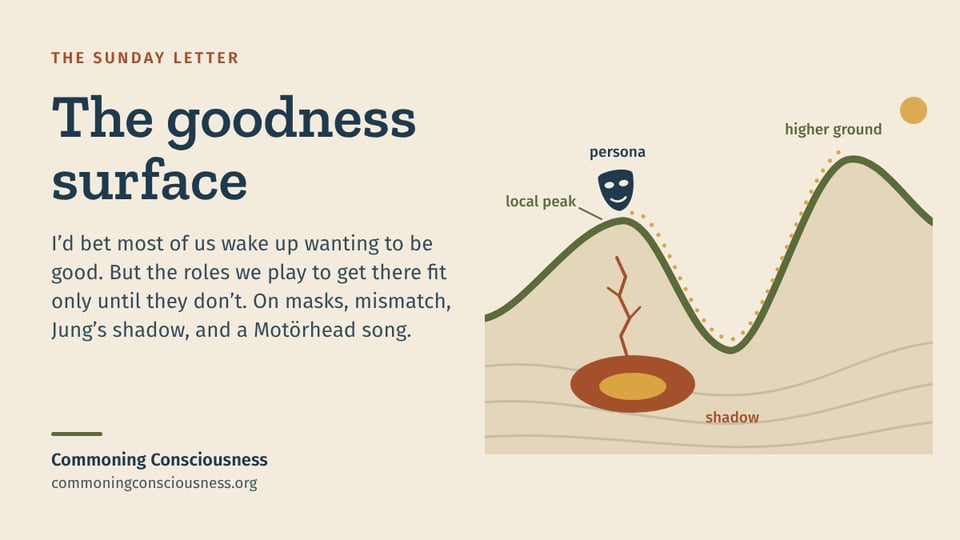
Fitness landscapes are where the picture from the top of this letter comes back. The geneticist Sewall Wright (1932) introduced the idea, picturing evolution as movement across a landscape of peaks and valleys. Imagine every possible way of being, for a species or for an institution, laid out across rugged terrain, with the height of the ground standing for how well each way of being suits its environment. Change tends to come in small steps, and small steps tend to go uphill. The catch, as the political scientist Ian Lustick has explained, is that small steps uphill lead to the nearest peak, which is not necessarily the highest one, and that the terrain itself can shift when circumstances change (Lustick, 2011, pp. 6–7).
Thus a rule or a role can end up stranded on such a local peak. The peak stays higher than the ground right around it, so every step away registers as a loss, even as it sinks and better ones rise out of reach. As Lustick puts it, "Institutions do change, but they change slower than life changes" (Lustick, 2011, p. 3). Left to itself, he argues, an institution stuck on a local peak tends to stay there until "some extraordinary event" moves it (Lustick, 2011, p. 7). In a city, that event is often a crisis.
That, in short, is the case for reviewing a city charter on a schedule. Elinor Ostrom, who shared the 2009 Nobel Prize in economics for her studies of how communities govern common resources, found that long-enduring commons tend to share a short list of design principles. Two of them, as she listed them in 2010, are rules "congruent with local social and environmental conditions" and arrangements in which "most individuals affected by a resource regime are authorized to participate in making and modifying its rules" (Ostrom, 2010, p. 653). After all, a city charter is a set of rules its residents hold in common. Calling a commission at least once a decade writes the first of those principles into the calendar, so that a city can ask whether its rules still fit before the ground gives way beneath them. The second, who gets to do the modifying, is a question no calendar can settle, and it is why our 2021 call for a commission selected in a public process still matters.
Under the surface
One role-rule that has regulated most of my life is the aforementioned striving to be a "good" person. Not an authentic person. A "good" one, with all the social weight the term carries. But even as an aspiring "good" person, I can name more times I've indulged in cruelty than I'd care to admit; and there are likely even more times than I can ever admit, given that we are capable of committing cruelties without being aware of it.
When I started my journey into Jung several years ago, one of my first and hardest lessons was that I am, definitively, not a "good" person – at least not all of the time. Everything that I repress and remove from my subset of available actions and behaviors when I'm playing social roles never leaves. It just constellates in my shadow, until the pressure becomes too intense and the magma erupts as lava onto the "goodness" surface, where others see me from their positions far higher than my own.
The shadow, for readers new to the term, is Jung's name for the parts of ourselves we would rather not see, and so tend to push out of view. In Aion, a book he published in 1951, he observed that the dark characteristics making up the shadow "have an emotional nature, a kind of autonomy," and that emotion "is not an activity of the individual but something that happens to [one]" (Jung, 1968, para. 15).
Jung did not treat the discovery of one's shadow as a catastrophe. Rather, he saw the shadow as part of what gives a person substance: "How can I be substantial without casting a shadow? I must have a dark side too if I am to be whole; and by becoming conscious of my shadow I remember once more that I am a human being like any other" (Jung, 1966b, para. 134). Elsewhere he put the lesson more bluntly, in a sentence that reads almost like a reply to my opening hunch: "Unfortunately there can be no doubt that man is, on the whole, less good than he imagines himself or wants to be" (Jung, 1969, para. 131).
Lemmy's puzzle
Oddly enough, that lesson of Jung's helped me reconcile a song passage that had puzzled me for more than 20 years. This section began as an entry in my journal two Novembers ago. In the song "One More F**king Time," from Motörhead's 2000 album We Are Motörhead, the band's late singer and bassist, Lemmy Kilmister, sings:
And if I would have been a bad man
You would have seen the good in me
...
But since I am a good man
The same was all the same
I'm not sure how others interpret those words, and I don't even know how, or whether, Lemmy meant them to be understood. And if the message is clear to readers and I sound dim for saying it's confusing, please excuse and indulge me. See, I couldn't figure out why the listener Lemmy is addressing would have seen his good side if he were a bad man. That is, being a good man seems to be what keeps his audience from seeing the good in him.
I should say, other lyrics in the same song seem to hint at Lemmy's meaning in plain sight. Again, if I have come at the message more than two decades late, please forgive me. As a consumer of these lyrics, I'm taking license to interpret them in this way. To me, Lemmy was saying that uncharacteristic prosocial acts by people with antisocial reputations – a bad man's good deeds – tend to be more readily noticed and remembered.
To put it in terms that planning scholar Kevin Lynch uses with respect to city design (I used to teach his brief but powerful The Image of the City in my 400-level Cities and Urban Design course and highly recommend it), such acts are more legible and imageable. Lynch called a city legible when its parts are easy to recognize and to organize into a coherent pattern, and imageable when it is likely to evoke a strong, vivid image in anyone who sees it (Lynch, 1960, pp. 2–3, 9).
An act that might be seen in everyday light as ordinary if an ordinary person did it (donating to a charity or volunteering at a shelter) becomes more legible as a "good" thing to do when an antisocial person does it, because it is in line with social norms and far afield from what such a person might do. As such, that contrast also produces imageability, making the act stand out in memory, while an ordinary person's "good" acts might fade quickly. Something close to this has shown up in lab studies of how we remember other people: once we have formed an impression of someone, we tend to recall the things they do that clash with it better than the things that fit it (Hastie & Kumar, 1979).
Lynch (1960) had a word for features that work that way: landmarks, the things we orient by because they stand out so sharply against their background (pp. 48, 78–79). The contrast runs in the other direction, too. For someone cast in the role of "good man," good deeds are the background – the flat and featureless plain of what everyone expects – and a single cruelty breaks through it like lava, the one feature on that plain anyone remembers.
Experiments on how we judge one another's character have found a similar lopsidedness: an impression built on morally good behavior gave way easily to news of immoral behavior. One explanation is that a person has to be good all of the time to be seen as good, while a few bad acts are enough to be seen as bad (Baumeister et al., 2001, p. 346). That, I suspect, is the trap Lemmy is singing about. The same research is harder on the other half of his complaint: an impression built on bad acts tended to resist news of good ones, so a bad man's good deed may be remembered without changing many minds about him (Baumeister et al., 2001).
Jung's writing on the persona suggests something worse about that trap: in the "good man" role, a lapse not only stands out more but also becomes more likely. Right after recalling the Scottish evangelist Henry Drummond's lament that bad temper is "the vice of the virtuous," Jung adds a sentence of his own: "Whoever builds up too good a persona for himself naturally has to pay for it with irritability" (Jung, 1966a, para. 306).
In the song, Lemmy says he's a good man. Yet he's aware of his own potential to be cruel or antisocial, or to do or say things that harm others. To those others, he'll always be a "bad" man. When we live our lives playing roles, the mask is going to slip. Those slips redefine us in the eyes of anyone who knows us only by our roles. In a classic experiment, people who knew a student only from a taped job interview, in which he had been told to come across as ideally suited for the post, took his answers as a truer glimpse of him if he broke with that part than if he stayed in character (Jones et al., 1961). The answer is authenticity. As Lemmy repeats several times in the chorus of the song quoted above:
Both your eyes wide open
You see the shape I'm in
...
So go on and find me guilty
Just one more f**king time
In my reading, Lemmy is addressing an audience who saw behind the mask they knew. Beneath it is a flawed person striving to be good, and he's done hiding those flaws. He met his shadow, and it taught him that the rules he was living by were mismatched to his present circumstances. So he let them go.
The long way to higher ground
All of which brings us back to the terrain we started on. If being "good" is a role, then it behaves a lot like a rule on a fitness landscape. We learned it somewhere, it worked there, and it carried us up to a peak of sorts, a spot where the people around us could see us as good. I made a similar point last week, in the language of adaptation: "We identify adaptive strategies for profitably navigating different socioecological contexts, and we often build our personas around these successful strategies." From the top of a local peak, every step away looks like a step down, and that is what makes the role so hard to leave even after it has stopped fitting. People are not institutions, of course, and the comparison is a decidedly imperfect one. Still, Lustick's description of rugged terrain fits a person surprisingly well: "many better ways of being are not 'accessible' without going 'downhill,' or becoming less 'fit' in the process of becoming more fit" (Lustick, 2011, p. 7).
Authenticity, in those terms, starts with the walk downhill. That is a different trip from the sliding I described at the start: a slide happens to us when the mask slips, and a walk is a descent we choose. Taking that walk means letting people watch us climb down off the peak they had us standing on, and accepting the verdict of anyone who preferred the role to the person. Lemmy even offers, in the same chorus, to "plead no contest," which in court means accepting the penalty without mounting a defense. That seems close to what meeting the shadow asks of us: not a defense of the mask, and not a show of self-punishment, but a willingness to stand in plain view as we are and take the consequences.
On the far side of the valley, if Jung is right, lies higher ground: a self that no longer has to keep its cruelties in the dark because it has stopped pretending they are not there. Research on authenticity points the same way, if modestly: in two studies of college students, those who felt more authentic across the roles they played reported more self-esteem and less depression and stress (Sheldon et al., 1997). If my reading of Lemmy holds, that ground looks higher from where others stand, too. Once the people who stay with us have seen the whole shape we are in, a slip need no longer redefine us, and the good in us finally has a background to stand out against.
And because the goodness surface is shared, none of this is only personal. What I push into my shadow never leaves, as I said, but it does not stay mine alone. This project calls that export: handing other people what we have not dealt with ourselves. Lava runs downhill, so it reaches whoever happens to be standing below me. Social psychologists have a drier name for one version of that: displaced aggression. When someone we cannot or dare not answer back provokes us, we tend to take it out on a bystander who had nothing to do with the provocation, and a review that pooled the experimental research found the effect robust (Marcus-Newhall et al., 2000).
Jung saw the shared side of this clearly. Owning the shadow only in private, he warned, leaves the job half done: "Privacy prolongs my isolation and the damage is only partially mended. But through confession I throw myself into the arms of humanity again, freed at last from the burden of moral exile" (Jung, 1966b, para. 134). That makes authenticity a form of tending, this project's word for the everyday upkeep that keeps shared ground livable for everyone who stands on it.
Buffalo's voters offered one more idea worth borrowing. They decided not to wait for the next crisis to ask whether their rules still fit. Admittedly, most of us will never seat a commission to review our own roles – the appointment process alone would presumably be awkward – but we can hold a smaller review now and then, on purpose, before the pressure builds and the magma picks the date for us.
People who do step out of a role seem to start that way too, with questions rather than a leap. Helen Rose Fuchs Ebaugh, a sociologist, drew on interviews with 185 people who had left roles central to their lives, among them ex-nuns, ex-doctors, divorced people, and ex-convicts. She found that leaving tended to begin with first doubts and a search for alternatives, before any turning point, and that people carried some of the old role into their new identities (Ebaugh, 1988).
A practice for this week
This week, hold a small charter review of one role. Pick a part you play often – the reliable one, the peacekeeper, the one who never needs anything, or, most to the point, the "good" one – and put it to the questions a review commission would ask. When was this role written, and for what conditions? Do those conditions still hold? Then ask the question a commission might skip: what does this role keep off the table, and where does that go instead? Last, take public comment. Since none of us can survey our own position from above, ask one person you trust what the role looks like from where they stand.
You do not have to retire the role. Some roles still fit, and a few are worth keeping even when they pinch. If yours no longer fits, try a single small step off the peak: say the true thing a little sooner than usual, or let someone see the effort behind the part. If the step feels like a step downhill, that may be the point. Doing it imperfectly is allowed. Charters get amended more than once, and so do we.
With care from the porch,
R
P.S. The op-ed itself goes further than this letter into how the next charter review could be set up, from letting a major change in circumstances call a commission early to letting residents, rather than officials, choose who sits on it: "Buffalo's most important charter amendment is the promise to look again."
References
- Baumeister, R. F., Bratslavsky, E., Finkenauer, C., & Vohs, K. D. (2001). Bad is stronger than good. Review of General Psychology, 5(4), 323–370. https://doi.org/10.1037/1089-2680.5.4.323
- Curry, O. S., Mullins, D. A., & Whitehouse, H. (2019). Is it good to cooperate? Testing the theory of morality-as-cooperation in 60 societies. Current Anthropology, 60(1), 47–69. https://doi.org/10.1086/701478
- Ebaugh, H. R. F. (1988). Becoming an ex: The process of role exit. University of Chicago Press.
- Epley, N., & Dunning, D. (2000). Feeling "holier than thou": Are self-serving assessments produced by errors in self- or social prediction? Journal of Personality and Social Psychology, 79(6), 861–875. https://doi.org/10.1037/0022-3514.79.6.861
- Goffman, E. (1959). The presentation of self in everyday life. Doubleday.
- Graham, J., Haidt, J., & Nosek, B. A. (2009). Liberals and conservatives rely on different sets of moral foundations. Journal of Personality and Social Psychology, 96(5), 1029–1046. https://doi.org/10.1037/a0015141
- Hastie, R., & Kumar, P. A. (1979). Person memory: Personality traits as organizing principles in memory for behaviors. Journal of Personality and Social Psychology, 37(1), 25–38. https://doi.org/10.1037/0022-3514.37.1.25
- Hochschild, A. R. (1983). The managed heart: Commercialization of human feeling. University of California Press.
- Jones, E. E., Davis, K. E., & Gergen, K. J. (1961). Role playing variations and their informational value for person perception. Journal of Abnormal and Social Psychology, 63(2), 302–310.
- Jung, C. G. (1966a). The relations between the ego and the unconscious. In Two essays on analytical psychology (R. F. C. Hull, Trans.; 2nd ed., Collected Works Vol. 7, paras. 245–246, 306). Princeton University Press. (Original work published 1928)
- Jung, C. G. (1966b). Problems of modern psychotherapy. In The practice of psychotherapy: Essays on the psychology of the transference and other subjects (R. F. C. Hull, Trans.; 2nd ed., Collected Works Vol. 16, para. 134). Princeton University Press. (Original work published 1929)
- Jung, C. G. (1968). Aion: Researches into the phenomenology of the self (R. F. C. Hull, Trans.; 2nd ed., Collected Works Vol. 9, Part 2, para. 15). Princeton University Press. (Original work published 1951)
- Jung, C. G. (1969). Psychology and religion. In Psychology and religion: West and East (R. F. C. Hull, Trans.; 2nd ed., Collected Works Vol. 11, para. 131). Princeton University Press. (Original work published 1938)
- Li, N. P., van Vugt, M., & Colarelli, S. M. (2018). The evolutionary mismatch hypothesis: Implications for psychological science. Current Directions in Psychological Science, 27(1), 38–44. https://doi.org/10.1177/0963721417731378
- Lustick, I. S. (2011). Institutional rigidity and evolutionary theory: Trapped on a local maximum. Cliodynamics, 2(2), 3–20. https://escholarship.org/uc/item/43w3q5kp
- Lynch, K. (1960). The image of the city. MIT Press.
- Marcus-Newhall, A., Pedersen, W. C., Carlson, M., & Miller, N. (2000). Displaced aggression is alive and well: A meta-analytic review. Journal of Personality and Social Psychology, 78(4), 670–689. https://doi.org/10.1037/0022-3514.78.4.670
- Motörhead. (2000). One more f**king time [Song]. On We are Motörhead. Steamhammer; CMC International.
- Ostrom, E. (2010). Beyond markets and states: Polycentric governance of complex economic systems. American Economic Review, 100(3), 641–672. https://doi.org/10.1257/aer.100.3.641
- Sheldon, K. M., Ryan, R. M., Rawsthorne, L. J., & Ilardi, B. (1997). Trait self and true self: Cross-role variation in the Big-Five personality traits and its relations with psychological authenticity and subjective well-being. Journal of Personality and Social Psychology, 73(6), 1380–1393. https://doi.org/10.1037/0022-3514.73.6.1380
- Wilson, D. S., Van Vugt, M., & O'Gorman, R. (2008). Multilevel selection theory and major evolutionary transitions: Implications for psychological science. Current Directions in Psychological Science, 17(1), 6–9. https://doi.org/10.1111/j.1467-8721.2008.00538.x
- Wright, S. (1932). The roles of mutation, inbreeding, crossbreeding and selection in evolution. Proceedings of the Sixth International Congress of Genetics, 1, 356–366.
You just read issue #9 of Commoning Consciousness. You can also browse the full archives of this newsletter.


