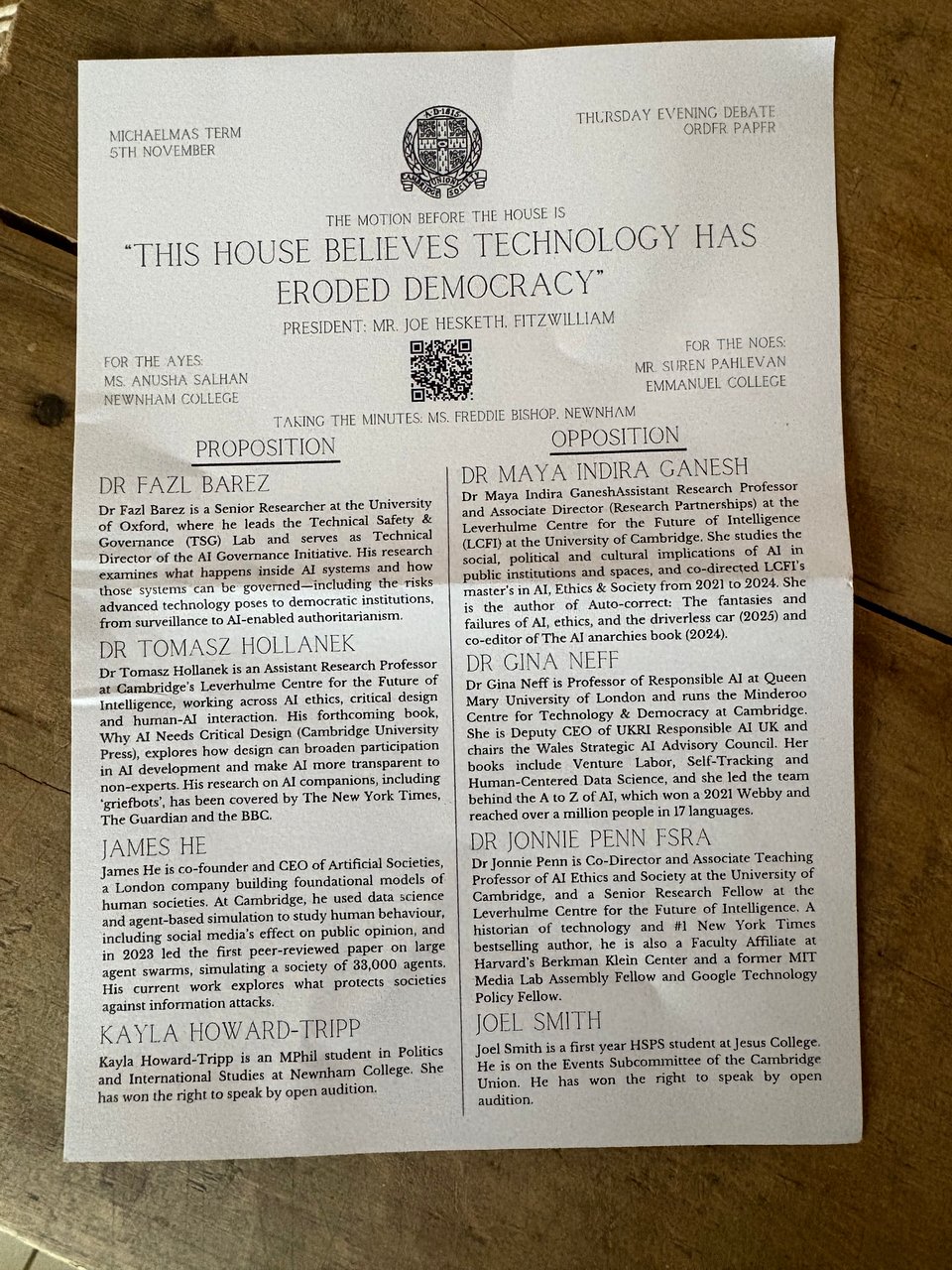
“This house believes technology has eroded democracy”
On November 5 I participated in a Cambridge Union Society debate: This house believes technology has eroded democracy. I was part of a team with Gina Neff, Jonnie Penn, and Joel Smith. Huge thanks to Suren Pahlevan for bringing us together. Here is what I presented. And -WE WON!
Good evening friends, Mr President, and thank you to the Union for their invitation to argue against the proposition that technology has eroded democracy.
I’m going to convince you that if we think of technology as an app or an agent that works outside of the control of people, organisations, and movements, then we are at risk of assuming that democracy is an output rather than a process, a process that people actually have agency in.
As my team-mate Gina Neff has argued, technological determinism centres technology as the protagonist, the evil twin, and the solution to the complexity of social and political life. We have so fully swallowed this idea that we don’t actually stop to look at who benefits from centring technology, and if it is really truly at the centre of social life. And democracy.
For as long as I can remember, every time there is an election in India, almost any news report anywhere in the world will carry the trope that India is the world’s largest democracy. What they’re usually referring to is the scale of this process: the systems, infrastructures, and people, required for 968 million voters to exercise their franchise across the cultural political and economic geographies of the world’s seventh largest country.
While it can be a highly catalytic and emblematic moment in a democracy - and one that is susceptible to manipulation - democracy is not just about voting day and electoral outcomes.
It is the institutions and social contracts that make voting and elections possible. These include freedom of the press, freedom of speech and expression, the right to assembly, transparency and public accountability of institutions, rule of law. These are fundamental to the idea of democracy. When they are talking about the 'world’s largest democracy' there is often a lump in the throat: they are referring to the fragility of these social and political institutions under conditions of authoritarianism. Technology has not eroded these - people have.
In 2024 64 countries went to the polls and there was widespread concern about disinformation campaigns and the manipulation of voting; however, luckily these fears were unfounded barring one or two cases. The Heinrich Boll Foundation in Germany reported that social institutions have positively countered algorithmic disinformation and that the greater threats came from offline socially engineered negative campaigning, exacerbating people's prejudices and beliefs. Technology might have amplified the speed and scale of these messages but did not eventually prevail because of social mobilisation.
Technology in fact enables social mobilisation towards democratic outcomes. In Brazil’s recently concluded and very close and fraught presidential election won by Luis Inacio Lula da Silva technology companies did manipulate public opinion on social media. What I want to draw attention to is how everyday Brazilians rallied offline and online, using platforms to mobilise to get the vote out for Lula’s campaign.
Challenging colonial and authoritarian conditions requires movements and people coming together despite surveillance and there have always been ways to do this even with analog technology. For instance, radio was crucial to shaping Algerian resistance to the French, and the Russian practice of Samizdat, or hand-made copying of print, inspired organising in the USSR. What is the messaging app Signal but a contemporary manifestation of the same desire to use technology to secure human rights to free speech and expression, and assembly, required of democracy. So successful is it in this regard that even the United States' Department of War uses it to discuss its operations.
The former PM Imran Khan is in prison in Pakistan. He worked with his social media team to create an AI generated image of himself delivering a message to his millions of supporters. Carefully handled technology can support democratic values.
But - I get it. We have been lulled into thinking that we’re all data points and completely subject to our phones and algorithmic targeting and enshittified apps. 'They' want you to believe this.
However, evidence keeps showing that this is not true. Democracy is flawed and usually frustrating; but it is a collective deliberation about the future we want. ‘World’s largest democracy’ also refers to the complexity of what comes after the election. Democracy is not just about governing a billion and a half people from the top down. It is - in theory - about enabling a billion and a half people to participate in that governance. Of the people by the people and for the people.
No better example comes from Taiwan and how new philosophies of technology emerged from the 2014 Sunflower movement. The Taiwanese open source platform pol.is totally altered public policy deliberation. By mathematically clustering public opinions, while intentionally eliminating reply buttons, and amplifying bridging statements across differences, the system prevents trolling and structurally rewards consensus. Taiwan successfully used this model to co-author national legislation on the highly divisive issue like regulation of Uber. Again, this only worked because you had a movement that shaped the tool.
Our colleague Ella MacPherson in Sociology has written about how Amnesty International and other human rights groups, and journalists and investigators, have enrolled cadres of everyday people in analysing large amounts of digital data like videos and social media posts, to collate evidence of human rights abuses, and challenges to authoritarian and anti-democratic regimes.
The 2016 Brexit vote and the election of Donald Trump created an anxiety about the manipulation of voting through large scale data surveillance, targeting, and manipulation; and that generated technological solutions like fact checking and the wave of studies about political disinformation and misinformation. While it turns out that while polarisation and manipulation does happen, however, scholars like Alice Marwick and others find that there are only small subsets of people who are actually manipulable, and manipulated. The large scale uniform manipulation of an entire population does not happen. In other words, the idea of us as people who are controlled by and helpless in the face of technology amplifies digital tools and platforms as eroding democracy, and at the same time the solutions to democracy are also within those very tools rather than the technological systems that actually sustain and support democracy. Like, for instance, national public service media, or Wikipedia, or national and open data bases, and not criminalising journalism or dissent - these are essential to democracy and people’s agency. Technology is a network of networks that enables and sustains it. So is society. Democracy cannot survive and thrive without the other. I beg you oppose the proposition that technology erodes democracy.
Thank you.