Synapse - May Edition (test)
Upcoming Events
CNI Summer School
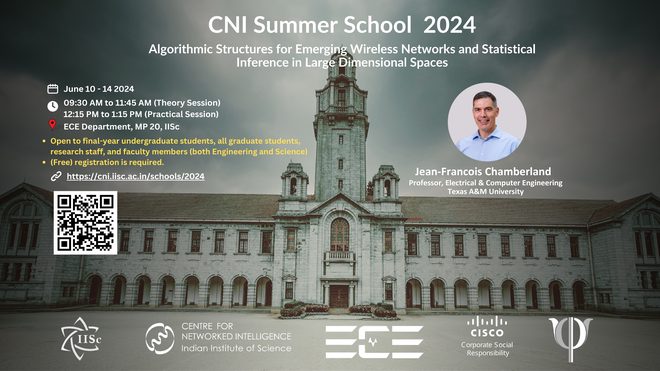
Registrations for the fourth annual CNI Summer School are closing soon on May 15, 2024! Don't miss your chance to join us from June 10 to 14 for a special short course with Prof. Jean-Francois Chamberland from Texas A&M University. This course will explore Algorithmic Structures for Emerging Wireless Networks and Statistical Inference in Large Dimensional Spaces. It's designed for senior undergraduate and young graduate students in engineering (ECE/CS/EE or related fields) and science backgrounds. Register now to secure your spot and take advantage of this valuable learning and networking opportunity! Secure your spot by registering here before May 15, 2024. Don't miss out!
Upcoming Talk
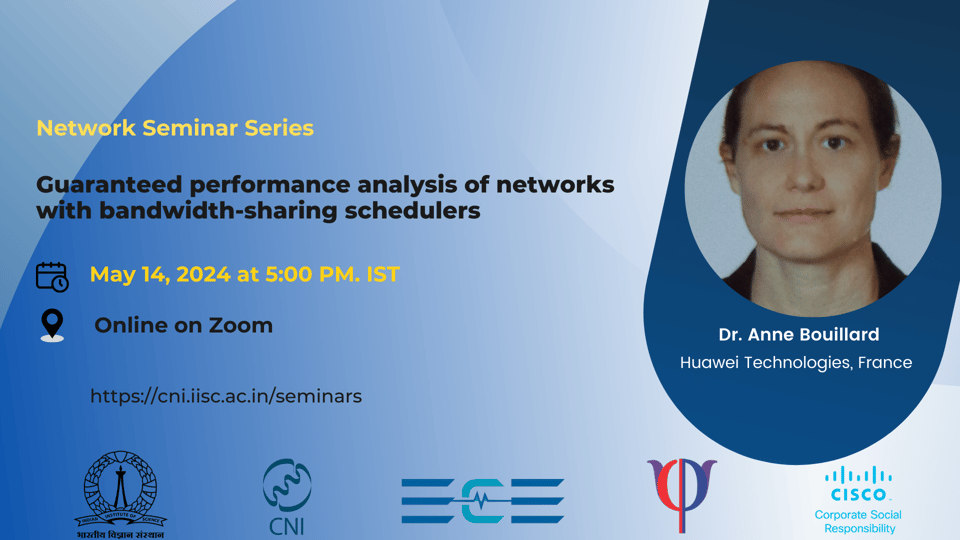
Join us at the upcoming talk on "Guaranteed performance analysis of networks with bandwidth-sharing schedulers" by Dr Anne Bouillard, a researcher at Huawei Technologies in France, on 14/05/2024 at 17:00 hrs IST.
What’s cooking at CNI?
CNI PhD fellow, Moonmoon Mohanty, has co-authored a conference paper titled "Energy-minimizing workload splitting and frequency selection for guaranteed performance over heterogeneous cor” . She will present the same work at the 15th ACM International Conference on Future and Sustainable Energy Systems, which will be held in Singapore from June 4 - 7, 2024.
Heterogeneous computing involves CPU architectures that support more than one core type, and it aims to achieve energy efficiency while meeting the performance guarantees. This aim can be achieved by the operating system or the on-chip driver by exploiting the differential power-performance trade-off that heterogeneous cores offer. In their work, they have characterised the power-performance trade-off for an Intel CPU with heterogeneous cores and provided a mathematical framework to study heterogeneous computing.
In particular, a probabilistic workload split and operating frequency for all active cores that allow workload execution with minimal carbon emissions is provided.
The analytical findings are supported by experimental evaluations for a few representative workloads. As compared to the default Linux frequency governors, their scheme can reduce the energy-delay product by up to 80%.
Past Events
Quickest Fault Detection over Lossy Networks for Industrial Machinery
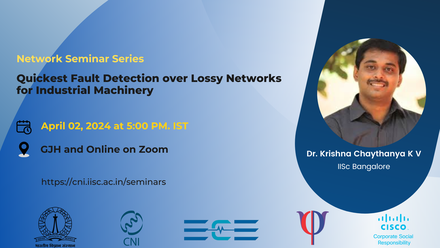
Dr. Krishna Chaythanya KV discussed the challenge of quickly detecting faults in industrial machines using sensor data transmitted over unreliable networks. To address this, we developed a computationally efficient generalized CUSUM algorithm based on the likelihood ratio principle. This method leverages the cyclostationary nature of bearing vibration signals to reliably detect faults, even in low signal-to-noise conditions. Our approach provides practical detection times and minimal false alarms, making it suitable for scenarios involving data loss and queuing delays over wireless networks.
Tight Bounds for General Computation in Noisy Broadcast Networks
Dr. Raghuvansh Saxena discussed simulating protocols over noisy broadcast channels where symbols may be flipped upon reception, aiming to create noise-resilient versions with minimal added rounds. Gallager's 1980s result demonstrated that certain protocols with independent round communications can be made noise-resilient with logarithmic round overhead. The talk explored if this universally applies or if some protocols require more rounds. A simulation scheme with approximately square root logarithmic overhead for any protocol and channel alphabet was presented, along with a discussion of a matching lower bound for specific pointer chasing protocols using polynomial alphabets and n rounds.
Streaming Codes for Three-Node Relay Networks With Burst Erasures
Prof. Mahesh Marina discussed the evolution of mobile networks from closed, vertically integrated systems to more open architectures in the talk. This transformation was reflective of broader trends towards openness in mobile networking. The economic and other drivers behind this shift were highlighted, along with the key enablers that facilitated the transformation. Additionally, research contributions in this area were outlined, including CoreKube, a rearchitected mobile core control plane designed for efficient cloud-native operation and supporting open (multi-vendor) core implementations. Finally, the potential for increased openness and efficiency gains through initiatives like Open RAN was explored, with an emphasis on data-driven operations and the use of AI technologies.
Adaptive Multi-armed Bandit Algorithms for Markovian and i.i.d Rewards
In this talk, Prof. Arghyadip Roy discussed achieving regret guarantees for multi-armed Bandit (MAB) problems with Markovian arm rewards, deviating from the typical i.i.d. reward assumption. A novel algorithm was presented that differentiated between Markovian and i.i.d. reward structures using a total variation distance-based test. This algorithm dynamically switched between standard KL-UCB and a specialized version based on the identified reward structure, resulting in low regrets for both i.i.d. and Markovian settings.
The Capacity of Causal Adversarial Channels
In this talk, Prof. Sidharth Jaggi discussed characterizing the capacity of discrete-time arbitrarily varying channels with discrete inputs, outputs, and states under specific conditions. The discussed conditions include scenarios where the encoder and decoder lack shared randomness, and there are constraints on input and state costs. The achievable strategy involves employing stochastic encoding with list decoding and a disambiguation step to optimize capacity. Conversely, the converse strategy utilizes a two-phase babble-and-push approach, where the adversary randomly selects states initially and then adjusts state inputs to symmetrize the channel. These results generalize previous work on specific channel models to encompass broader discrete alphabets and models.
