|
This month's spotlight features two papers co-authored by CNI fellow Tejashree S. and a paper by former CNI fellow Ankita Koley and Prof. Chandramani Singh in the IEEE Transactions on Networking.
The Triangle Friendship Paradox
Bishakh Bhattacharya, Nitya Gadhiwala, Frank den Hollander, Pradeeptha R Jain, Tejashree Subramanya · Sankhya A
The study explores the friendship paradox for triangles in networks, groups of three mutually connected vertices. Unlike traditional versions of the paradox, the resulting friendship bias is not always positive; the paper shows both graph classes where the paradox holds and examples where it does not. Further, the work also studies triangle friendship bias for classes of sparse and dense random graphs as the number of vertices tends to infinity.
Diagnostic Accuracy of Artificial Intelligence-Enabled Screening for Oral Cancer: A Systematic Review and Meta-analysis
Dahy Sulaiman, Tejashree Subramanya, Anushka Amble, Sumirtha Gandhi, Debnath Pal · BMC Head & Face Medicine
Can AI help detect oral cancer earlier? Reviewing 27 studies, the research finds that AI-enabled screening systems achieve pooled sensitivity and specificity of 91%, highlighting their potential to support early detection and clinical decision-making.
|
|
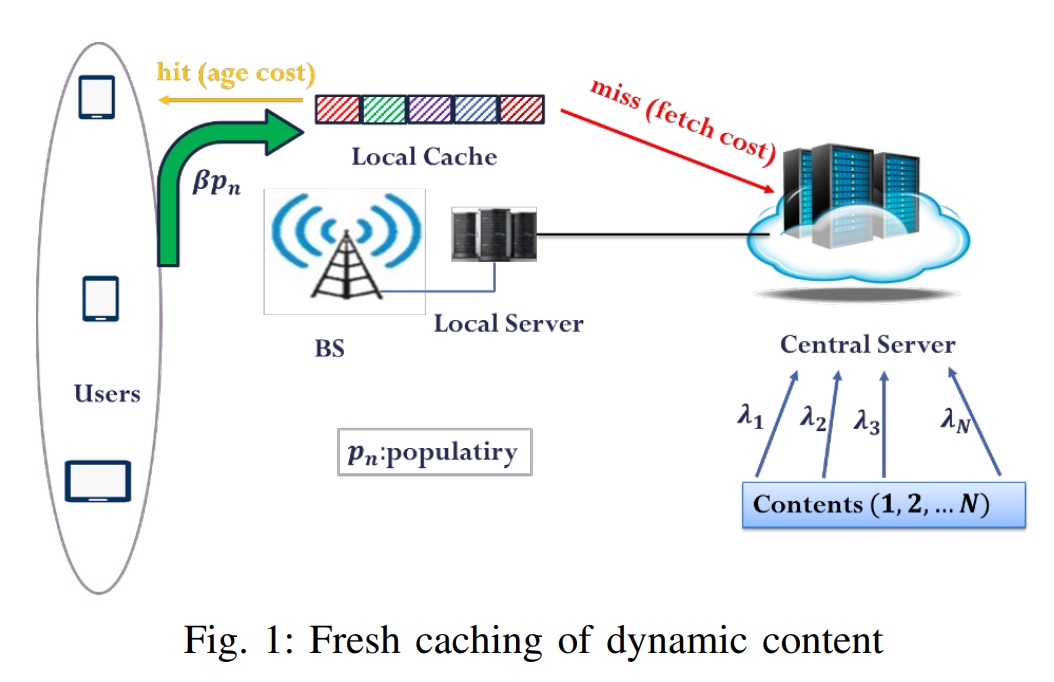
Fresh Caching of Dynamic Contents Using Restless Multi-Armed Bandits Over Wireless Access
Ankita Koley, Chandramani Singh · IEEE Transactions on Networking
The paper addresses the challenge of keeping dynamic content fresh at wireless edge caches, while balancing the costs of fetching, serving, and denying requests. The authors formulate the problem using restless multi-armed bandits and develop a Whittle index-based policy to determine when content should be fetched or served from the cache. Numerical results show that the proposed approach substantially outperforms existing methods and performs close to the optimal policy.
|
| |
|
Highlights from Recent Talks
|
|
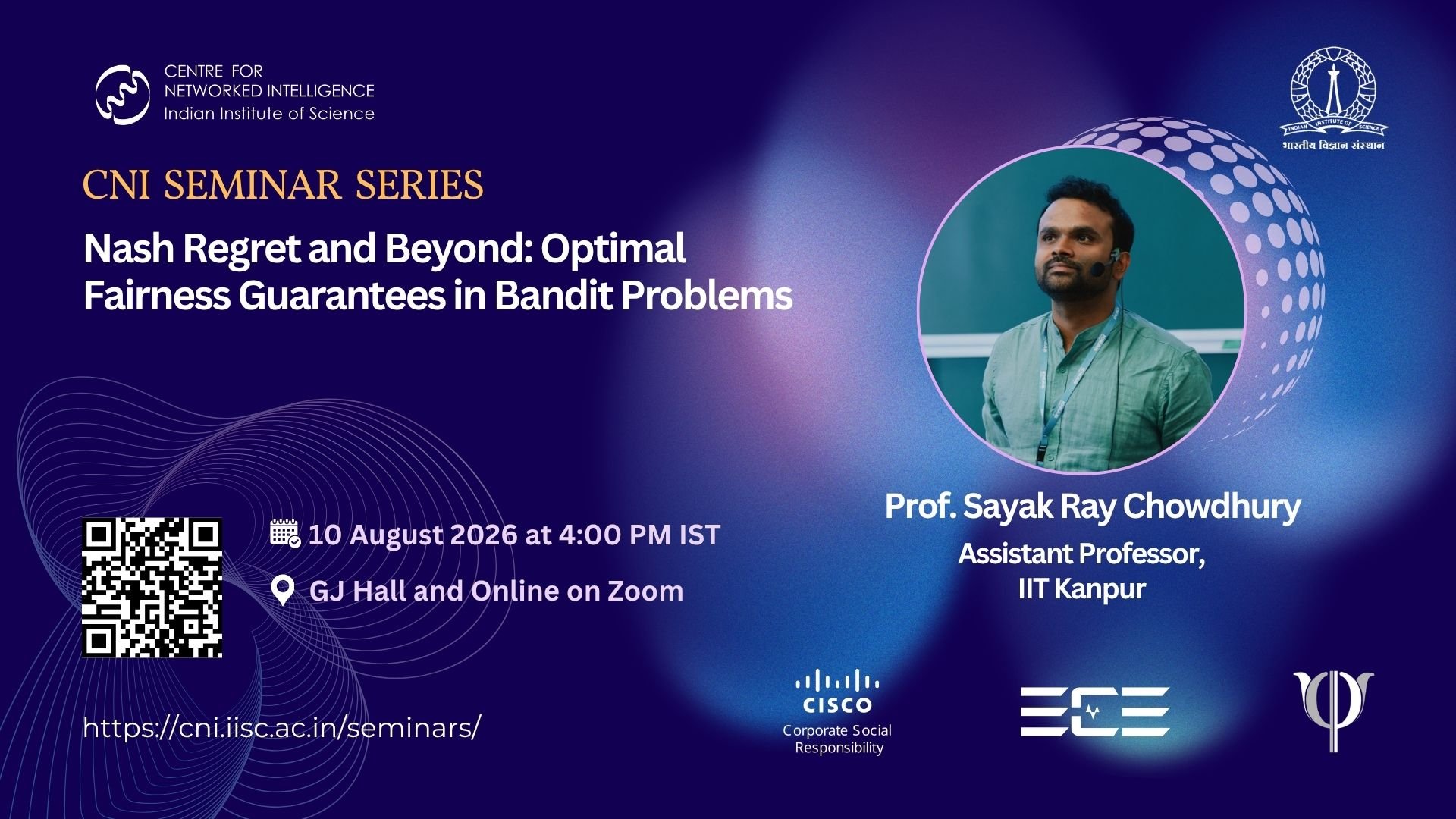
Prof. Sayak Ray Chowdhury discussed fairness in multi-armed bandit problems, where decisions must balance reward with equitable outcomes. He presented methods for achieving near-optimal Nash regret and extended these ideas to power-mean fairness objectives and linear bandits, showing that fairness can be incorporated without sacrificing statistical efficiency.
|
|
|
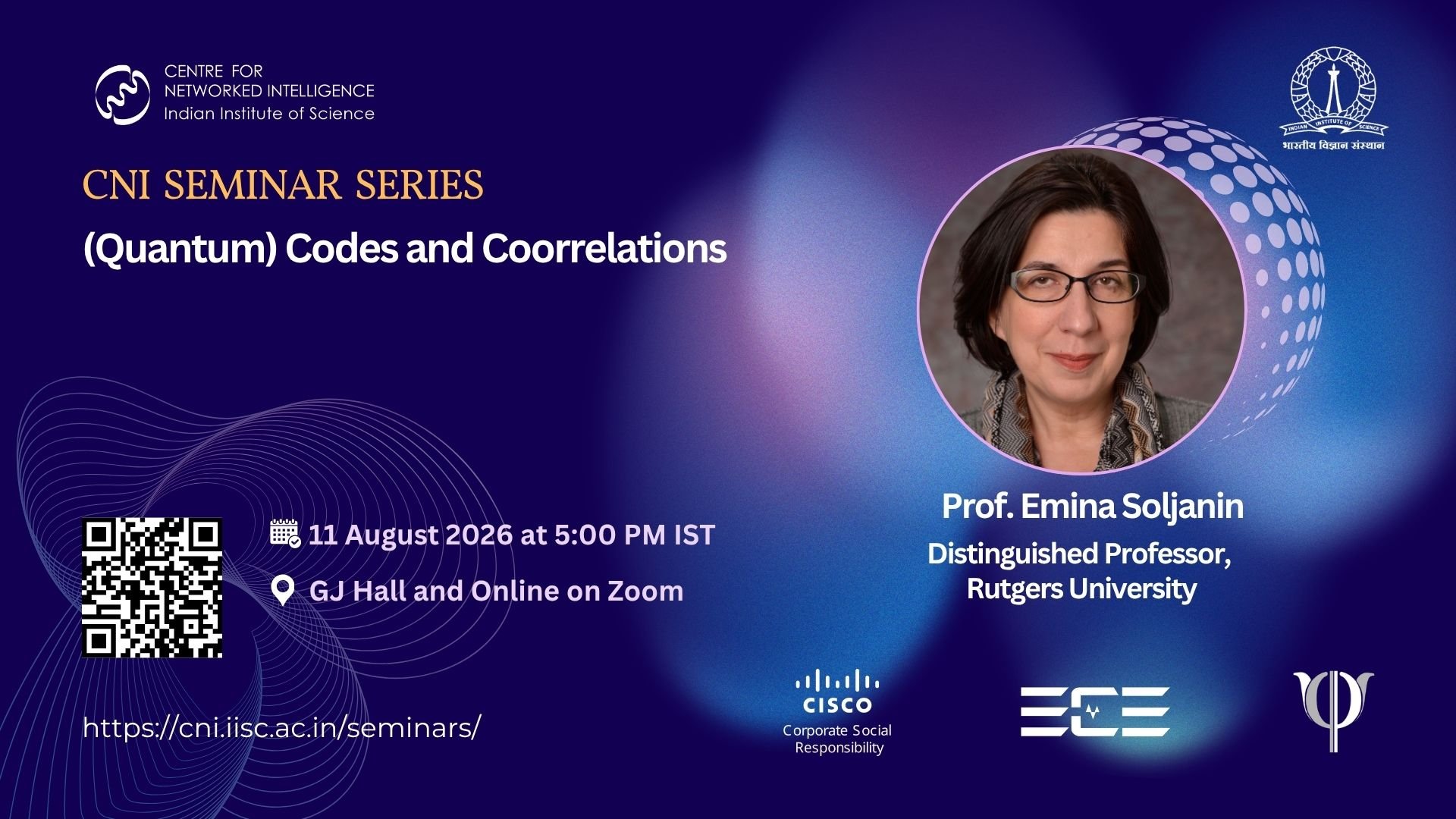
Prof. Emina Soljanin explored how coding and quantum entanglement can help players coordinate their guesses in games where communication is not allowed. Using examples from hat-guessing puzzles, she connected these games to coding theory, combinatorics, and communication complexity, and discussed how quantum correlations enable new coordination strategies with applications in quantum computing and cryptography.
|
|
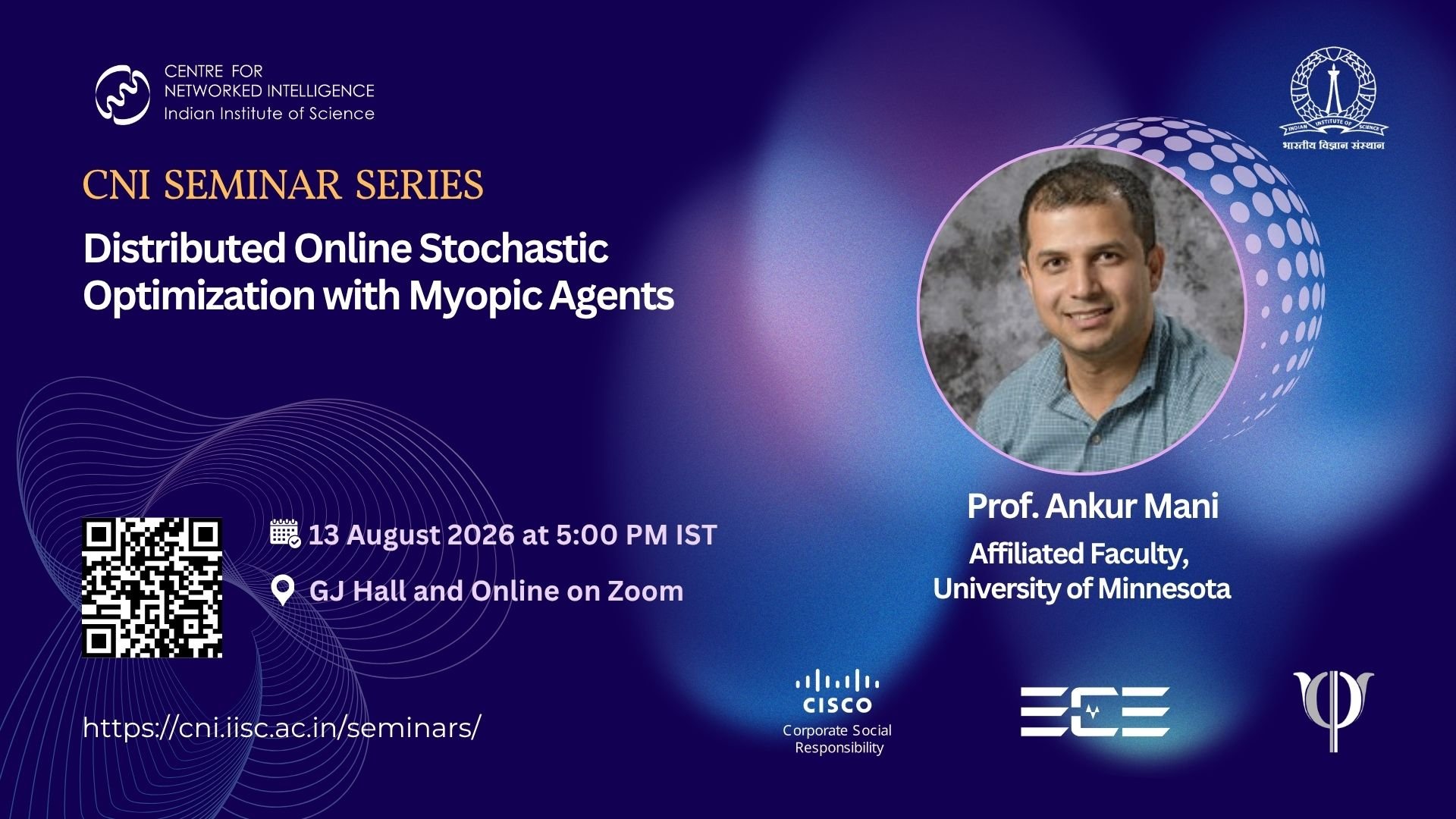
Prof. Ankur Mani discussed how a central planner can encourage experimentation among large groups of myopic agents who make decisions independently. He showed that selectively removing options can coordinate learning and achieve regret bounds comparable to a centralized setting, and extended the approach to online stochastic linear programs, reducing the cost of decentralization.
|
|
|
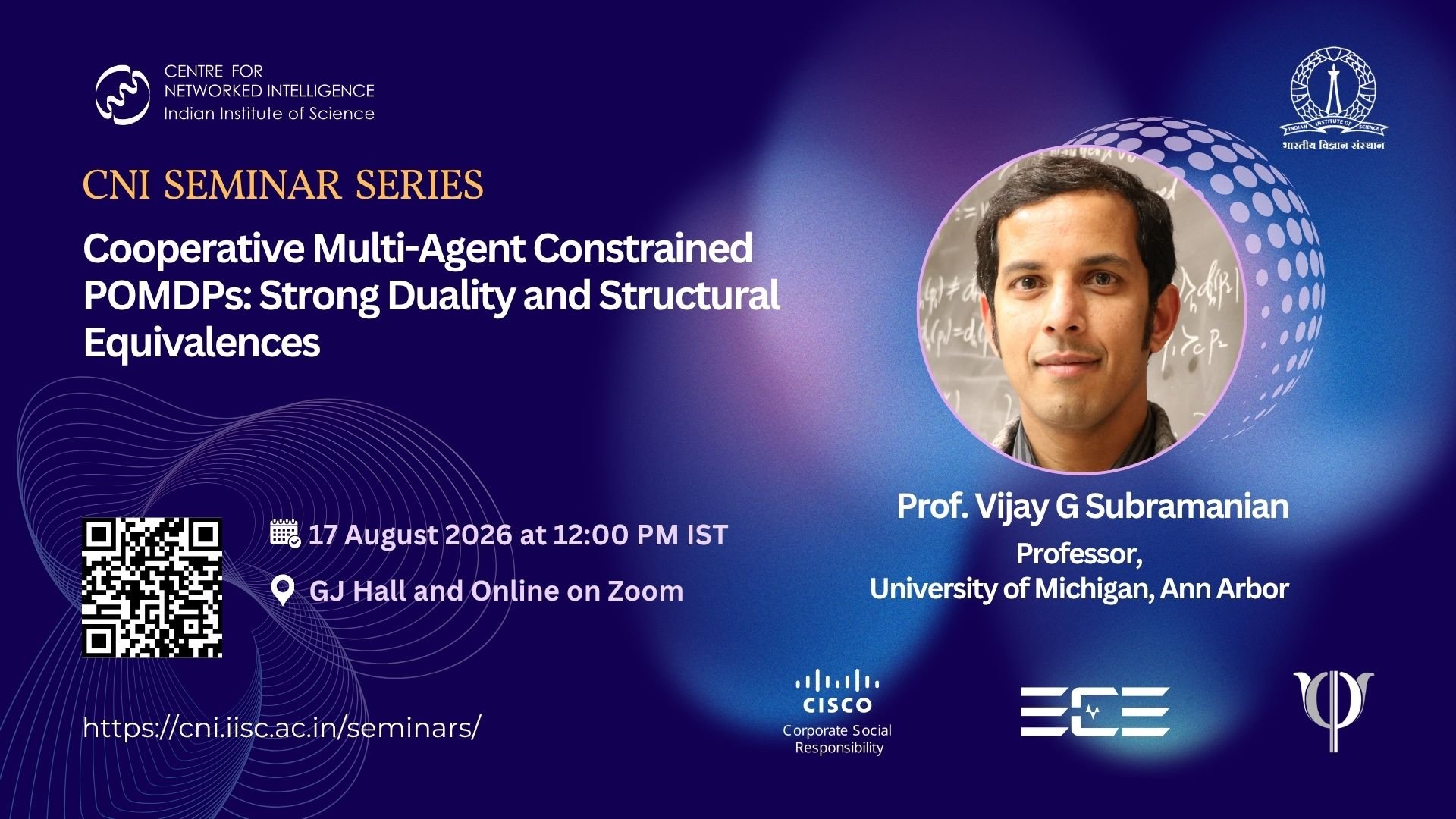
Prof. Vijay G. Subramanian talked about cooperative decision-making in multi-agent systems where agents have limited information and must balance long-term objectives with safety and operational constraints. He presented results on duality and policy coordination in constrained POMDPs, along with a primal-dual framework for optimal control and extensions to approximate information states for data-driven decision-making.
|
|
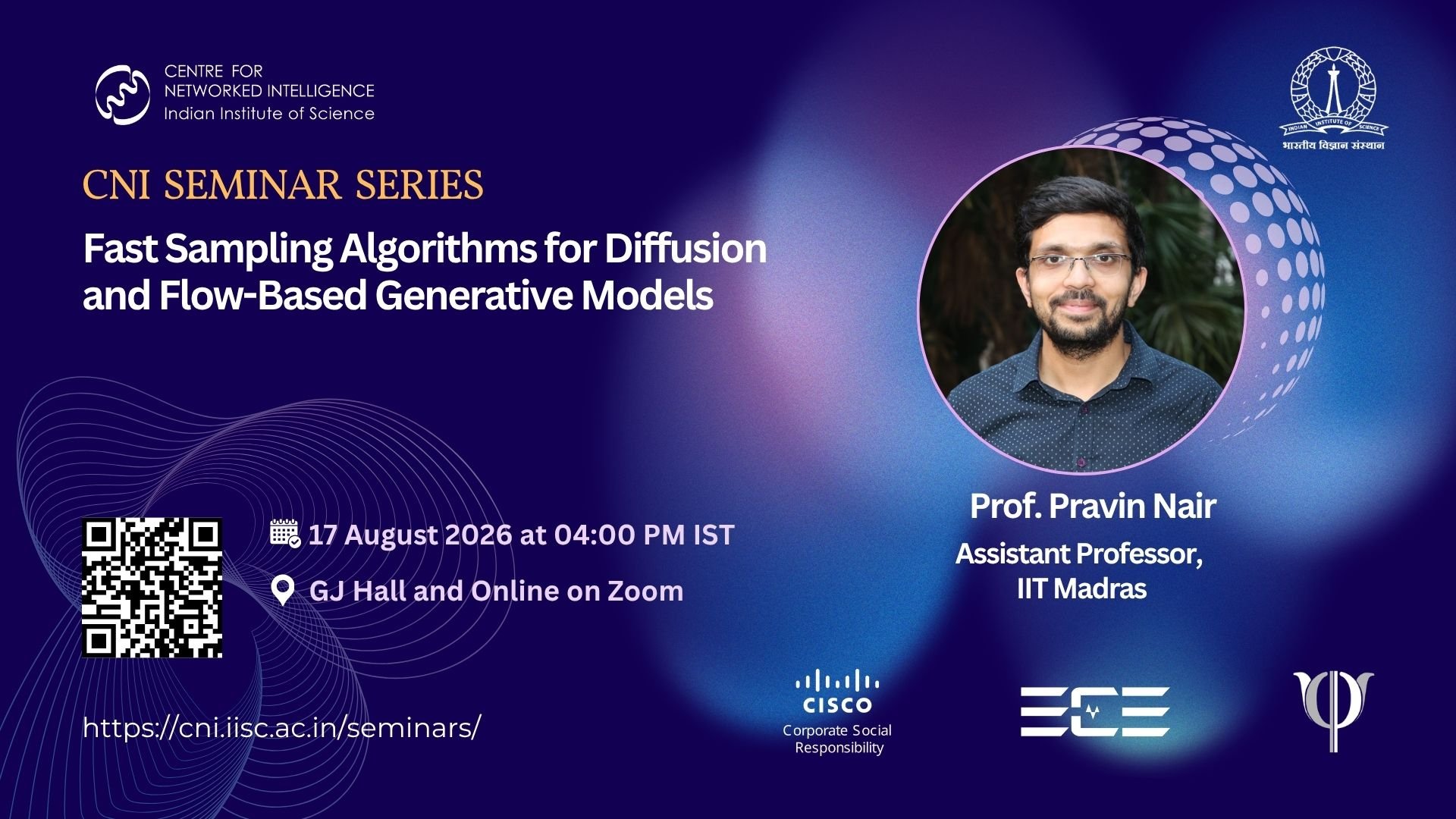
Prof. Pravin Nair discussed methods to accelerate sampling in diffusion and flow-based generative models, which often require many neural network evaluations to generate high-quality outputs. He introduced CAB, a training-free sampling method that improves the quality–efficiency trade-off in low-step generation, with applications including large-scale text-to-image models.
|
|
|
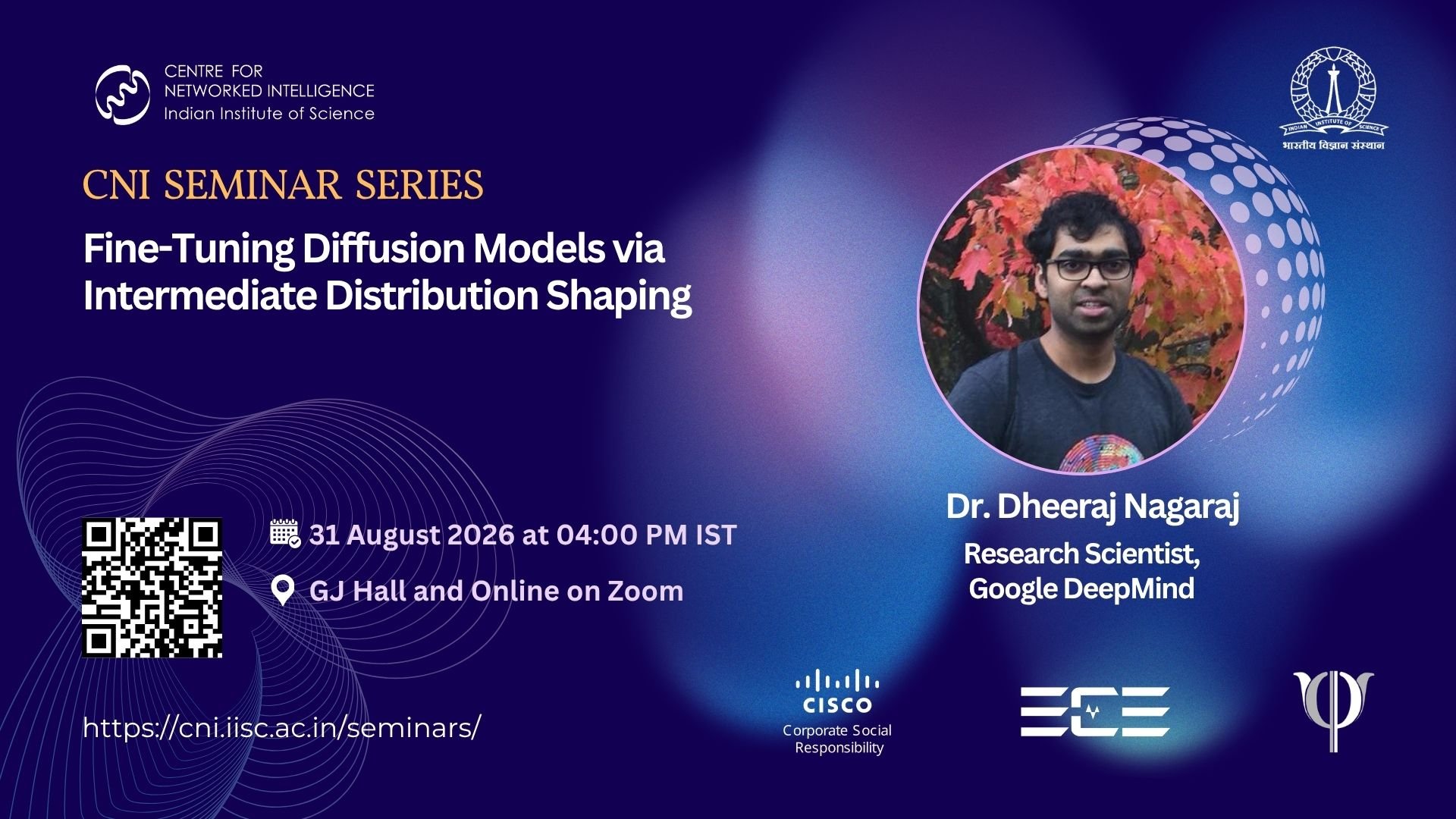
Dr. Dheeraj Nagaraj presented new approaches for fine-tuning diffusion models to better align generated outputs with specific objectives. He introduced GRAFT, a framework that connects rejection-sampling-based fine-tuning with policy optimization, and P-GRAFT, which shapes distributions at intermediate noise levels. The methods improve generation across images, layouts, and molecules while reducing computational costs.
|
|
|