
How sci-fi imagined future LA
In this edition: what the stories get right (and wrong) about the future of the city
I recently ran into the wickedly brilliant Anya Ventura, one of the organizers behind Place Settings, the nomadic, site-specific lecture series that takes place in locations around LA. (As part of the series, I once gave a lecture about the the history of the Oval Office on a cheap film set located deep in L.A.’s industrial core that was styled to resemble the Oval Office, and which I’m pretty sure was at one point used to shoot porn.) During our recent encounter, she was looking into doing something around John Portman’s Bonaventure Hotel in downtown, a place that has generated one middling sit-com and one well-known Marxist essay.
Which reminded me of a piece that I wrote for the LA Times several years ago, which, for whatever reason — managerial chaos? inefficiency? — never got published. It was about how the Los Angeles of the future has been portrayed in science fiction. The Bonaventure comes up in that story.
Since at this point, it’s safe to guess that the piece won’t run, I figured I’d share it with you all here. I’ve made a couple of tiny updates, but if it seems out of date, please forgive. This is from another time known as 2023.
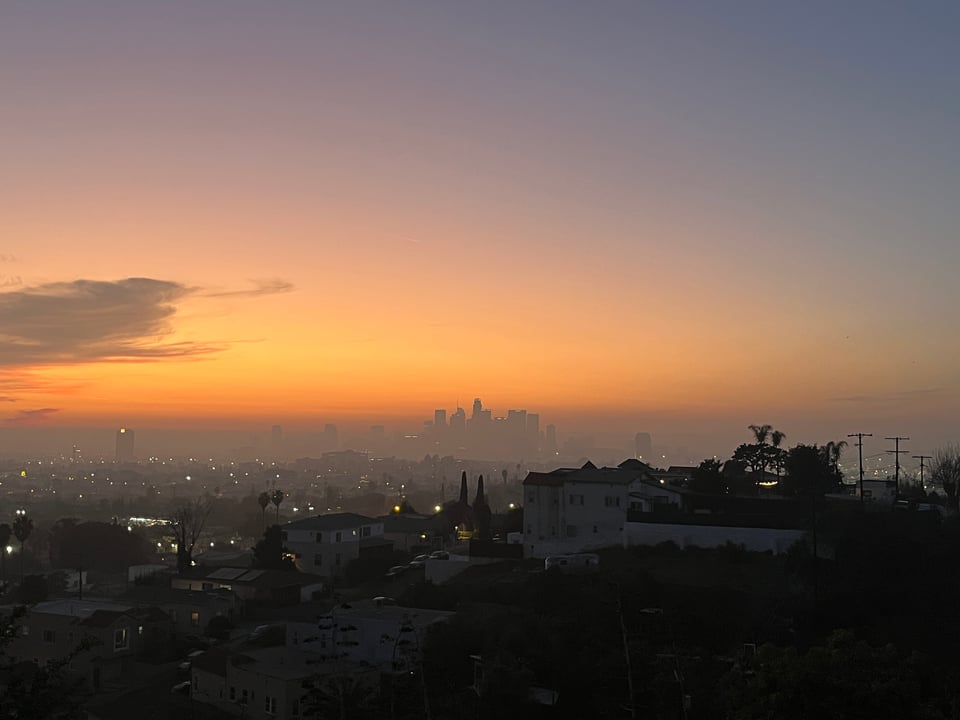
Destroying Los Angeles is the number one pastime of writers and filmmakers. Number two? Imagining its future.
Recently, I ran into the wickedly brilliant Anya Ventura, one of the organizers behind Place Settings, the nomadic, site-specific lecture series. (As part of it, I once gave a lecture about the the architectural history of the Oval on a cheap film set located deep in L.A.’s industrial core that was styled to resemble the Oval Office, and which I’m sure was at one point used to shoot porn.) She was looking into doing something around John Portman’s Bonaventure Hotel in downtown, a place that has generated one middling sit-com and one Marxist essay.
Which reminded me of a piece that I wrote for the LA Times several years ago, which, for whatever reason — managerial chaos? inefficiency? — never got published. It was about how the Los Angeles of the future has been portrayed in science fiction. The Bonaventure comes up in that story.
Since at this point, it’s safe to guess that the piece won’t run, I figured I’d share it with you all here. If pieces of it seem out of date, please forgive. This is from another that other time known as 2023.
Thanks for subscribing to Aesthetic Insecurity.
Destroying Los Angeles is the number one pastime of writers and filmmakers. Number two? Imagining its future.
L.A., the perpetual "City of the Future," will be filled with skyscrapers and get its water from Alaska, forecast one engineer in the 1960s. We will be perpetually surveilled, wrote the urban theorist Mike Davis 30 years later, eerily presaging the advent of the Ring doorbell. And there will be many more gated communities and more Latinos with political power, predicted a coterie of experts consulted by The Times on the eve of the new millennium.
No corner of the culture, however, has imagined the future of Los Angeles quite like science fiction.
There is Los Angeles as a contaminated metropolis simmering in acid rain (Blade Runner); as a place intensely split between haves who dwell in a space-age city and have-nots forced into grimy tunnels (Demolition Man); as a landscape of unfettered crime and natural disaster (too many books and movies to name here, but Octavia Butler's Parable of the Sower is a great place to start).
Los Angeles offers a compelling backdrop for future sci-fi because it's so sci-fi itself — an atomized city where Hollywood, the defense industry and esoteric communities all collided in the 20th century. It is a place where technology has made it possible to inhabit a challenged landscape — drought-prone, wracked by earthquakes and fire — and where successive waves of settlement have mercilessly paved over what came before.
"There is a long history of Los Angeles being imagined as a dystopian place and, to some degree, they got that right in the sense that there are a lot of endemic problems that haven’t been addressed," says Sheryl Vint, a professor of media and cultural studies at UC Riverside who studies speculative fiction. "It reflects the historical erasures."
Stories that take place in the future generally reflect the anxieties of the present. Blade Runner, for example, reflected Angelenos' dyspeptic view of its abandoned urban core in the 1980s. But sci-fi has a knack for imagining conditions that later emerge. The relentlessly campy Demolition Man — known for a memorable scene showcasing Sylvester Stallone's bare ass — predicted Arnold Schwarzenegger's political career as well as autonomous taxis.
There's a lot that the fiction gets wrong. (In Blade Runner, set in 2019, people are still reading print newspapers.) But there's plenty that it gets right, albeit in distorted ways. The hits cluster around very real deficiencies; the misses reflect the impulse to envision Los Angeles as being on the unlikely path to becoming Tokyo or New York. Because whatever the future holds for L.A., it will be a world of its own making.
High-rise L.A.
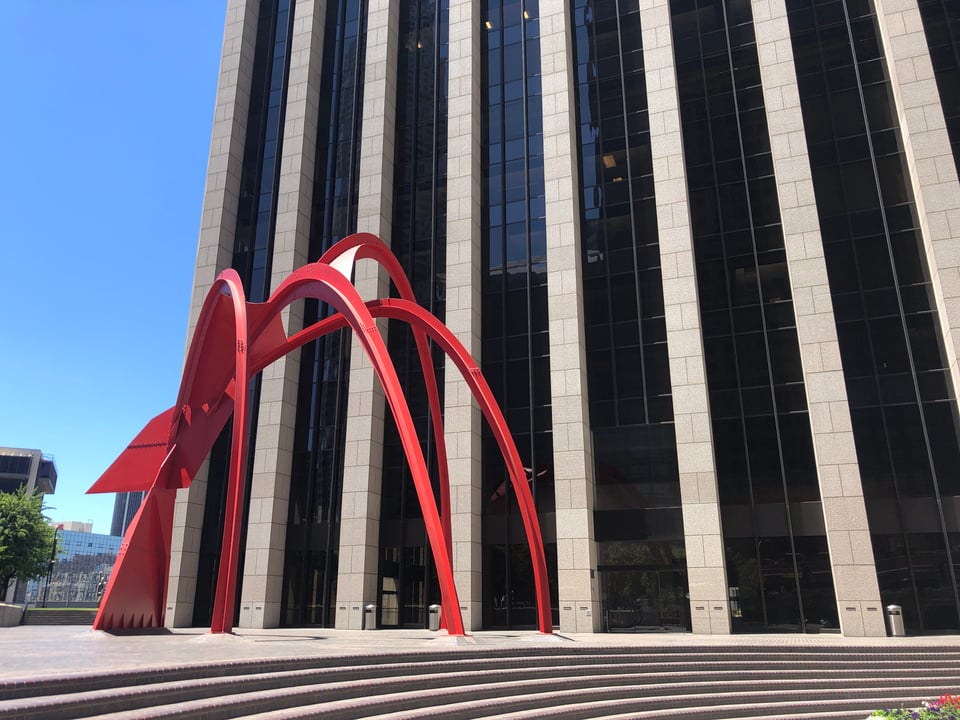
Any conversation about sci-fi and Los Angeles will inevitably start with Blade Runner, Ridley Scott's noirish 1982 tale about a detective (Harrison Ford) on the hunt for a pack of violent androids passing themselves off as human. The film's vision of L.A. is dark and cluttered, teeming with flaming industrial sites and two-bit scoundrels — "a hellish, claustrophobic city that has become a cross between Newark and old Singapore," wrote New Yorker critic Pauline Kael upon its release. It is also very tall, full of towers and pyramidal structures built on a monumental scale.
It's not the only vision of a high-rise L.A. Spike Jonze's 2013 film Her featured a skyscraper-dense, near-future Los Angeles crafted out of footage of L.A. and Shanghai. The third season of HBO's Westworld, set in 2053 (but released in 2020), fuses L.A., Singapore and Valencia into a mass of vertical density.
As Davis noted in Ecology of Fear, this vision is rooted less in the existing landscape of L.A., its "unbroken plains of aging bungalows, stucco apartments, and ranch-style homes," than in the vertical city depicted in Fritz Lang's 1927 silent classic, Metropolis. (It's worth noting that the 1968 novel on which "Blade Runner" is based, Philip K. Dick's Do Androids Dream of Electric Sheep?, is actually set in a hollowed-out, post-nuclear San Francisco.)
Since Blade Runner was released, Los Angeles has indeed grown taller and denser. Five-story podium apartment buildings have cropped up around the city and high-rise apartment towers dot parts of downtown (including the infamously abandoned Oceanwide Plaza complex). But L.A. is just barely getting around to building duplexes on lots once zoned for single family homes.
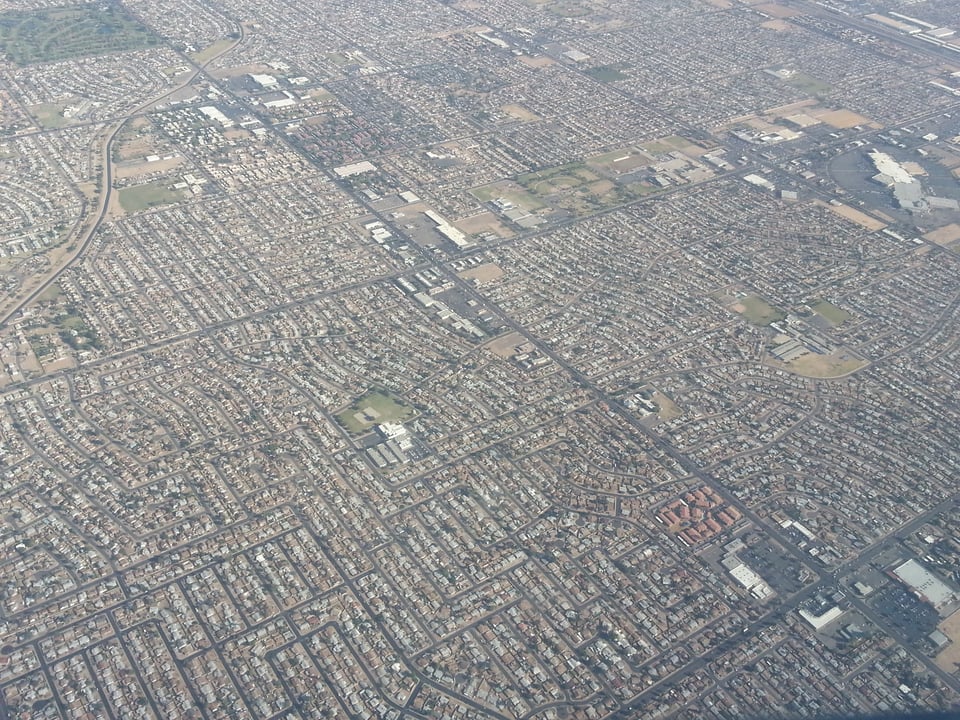
This is not just about the speed (or lack thereof) at which the city grows. It's about the enduring conflict between the reality of Los Angeles versus the fantasy of it. The county is a dense urban center, with a population of nearly 10 million people (more than most U.S. states). Yet the myth of sunny, backyard living, full of swimming pools and expansive lawns, retains its narcotic pull — a pull so powerful that single family homeowners will get shouty at community meetings to preserve it. Any developer that so much as whispers about constructing an apartment building in a neighborhood of single-family homes invariably finds themselves accused of assaulting "neighborhood character." But preserving all this "character" — and the traffic-choked sprawl that goes with it — has resulted in an acute housing crisis.
In sci-fi such as Blade Runner, density is rendered as suffocating. But, in reality, taller, denser construction (that takes affordability and access to mass transit into account) represents a solution to the city's housing problems. Even so, the majority of residential land in L.A. metro area remains zoned for single-family housing.
L.A. as a vertical city? Right now, that idea remains confined to the overheated sci-fi imagination.
Fortress L.A.
An urban vision of Los Angeles more rooted in reality is that of the city-within-a-city.
In Butler's Parable of the Sower, Lauren Oya Olamina, the book's young narrator, inhabits a neighborhood protected by a massive wall with a "looming presence" that keeps out marauding gangs. Neal Stephenson's 1992 novel Snow Crash — which imagined a virtual reality experience called "the Metaverse" — is likewise set in a city where "Burbclaves" function as independent city-states. Some of these are race-restricted, nodding to the housing covenants of L.A.'s past. "WHITE PEOPLE ONLY. NON-CAUCASIANS MUST BE PROCESSED," reads a sign at the entrance of a Burbclave called White Columns, where Y.T., a 15-year-old skateboarding courier, is allowed to enter only upon presenting her visa — which is tattooed to her chest.
Larry Niven and Jerry Pournelle's 1981 novel, Oath of Fealty, turns the concept of the self-contained city into a major narrative device. In that tale, also set in a near-future L.A., a building called Todos Santos occupies a piece of the city left barren by terrorists with firebombs. It is a behemoth structure, 2 miles long and 2 miles wide with walls more than 1,000 feet tall, and it features every imaginable amenity — malls, parks, restaurants — so that its residents do not have to set foot in an L.A. ravaged by crime. (Imagine an unholy union between the Westfield Century City mall and Neom, the super-city that Crown Prince Mohammed bin Salman has wanted to build in the Saudi desert with the aid of various starchitects.)
Todos Santos was inspired by the ideas of late counterculture architect Paolo Soleri, whose concept of the "arcology" argued for settlements that were dense and car-free. (He built the experimental desert community of Arcosanti in Arizona.) But in Niven and Pournell's hands, the arcology is deeply unsettling: not a civic state, but a highly surveilled corporate entity patrolled by private security who install cameras in spaces public and private. A sign at an entrance to an access tunnel announces, "IF YOU GO THROUGH THIS DOOR YOU WILL DIE!" (The future, it appears, will be in all caps.)
Todos Santos is wildly hyperbolic; a 4 square-mile building that would occupy much of downtown within the borders of 110, the 10 and the 101 freeways. But it also feels completely plausible, conjuring the sealed-off behemoths of Bunker Hill, a place that, as Davis wrote acerbically in City of Quartz, once felt like a neighborhood and now feels like, well, a series of bunkers.
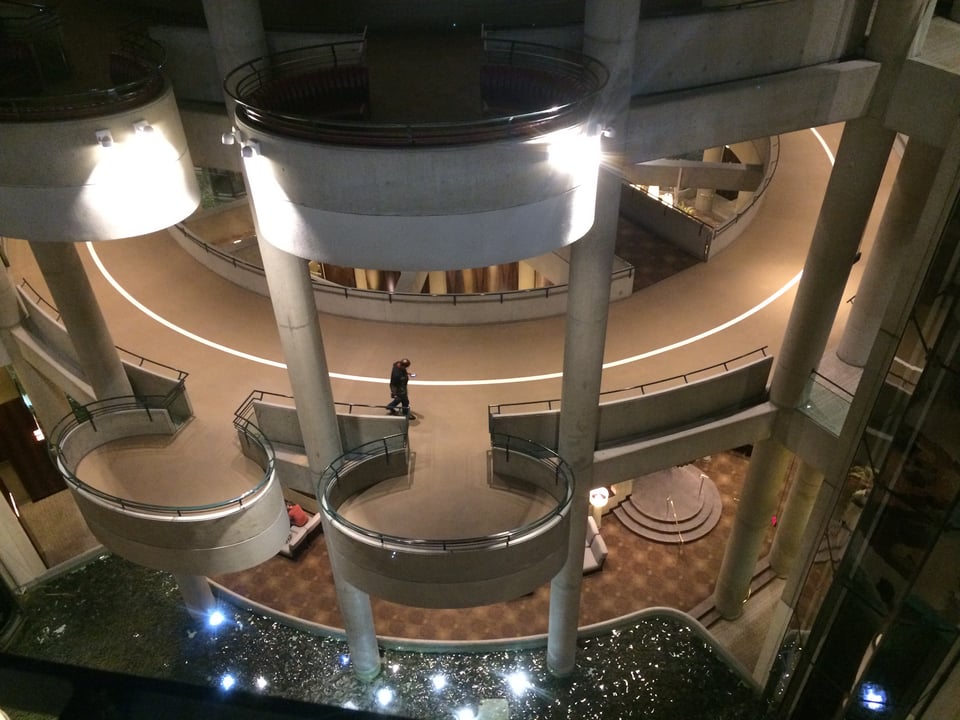
Take the the iconic Westin Bonaventure Hotel, which is an omnipresent part of the Bunker Hill skyline even as it remains closed off from the city around it. (Simply locating an entrance — not to mention the reception area — is an odyssey.) Conceived by architect John Portman and completed in 1976, it was designed as a deliberately self-contained unit, an architectural side-eye to the decaying urban core. The building so deftly insulates and disorients its inhabitants that it inspired a now famous essay about corporate Postmodernism by critic and philosopher Frederic Jameson. "Postmodern hyperspace," he wrote, "has finally succeeded in transcending the capacities of the individual human body to locate itself." In other words: good luck finding your way out.
With bunker architecture comes a bunker mentality — and it isn't limited to commercial spaces. By 2008, nearly a fifth of L.A.'s households were located within gated communities, a form of city-within-a-city that has seen a precipitous rise since the 1970s. These developments are often economically and/or racially homogeneous. (In L.A., they have been shown to increase segregation.) As the late legal scholar Gerald Frug wrote, it's also a type of development that engenders a fear of "the other" — and often the "other" is kept at bay through ubiquitous private security.
The fictional Todos Santos is an improbable mega-city. But the buildings of Bunker Hill and the gated communities that dot L.A. County operate as microcosm of that imagined reality. "We don't have police here," a sergeant in Todos Santos tells a new recruit in Oath of Fealty. "We're security people, and there's a lot of difference." Which is true — rather than public civic space, what they patrol is corporate entity.
Sci-fi's vision of the future is L.A.'s past and present.
Divided city
A city-within-a-city is the physical manifestation of a social divide. And in the Los Angeles of sci-fi, those divides are extensive.
The largely Latino underclass in Neill Blomkamp's 2013 film Elysium (set in 2154) lives in grim poverty on earth while a largely white upper class inhabits a fancy space station. In Demolition Man, the ruling classes (largely white) reside on the gleaming, meticulously landscaped surface of L.A.; the underclasses (mostly Brown and Black) inhabit a warren of tunnels beneath the city. Many of the Burbclaves in Snow Crash are divided strictly according to ethnicity or race, bearing cringe names like "Mr. Lee's Greater Hong Kong" and "Narcolombia."
In a remarkable short story published in the collection Speculative Los Angeles, S. Qiouyi Lu imagines a future L.A. in which the Chinese Exclusion Act has been renewed, and the narrator is forced to give up aspirations of becoming a professor at Caltech to go into "waste mining" — digging up the Puente Hills Landfill in search of raw materials.
The social chasms depicted in these stories are extreme — and, in that regard, sci-fi got the future right. A study published by the Othering & Belonging Institute at UC Berkeley in 2021, for example, shows that the Los Angeles metropolitan area is the sixth most segregated in the U.S. And that segregation carries a real cost for the city's racial and economic underclasses, whose neighborhoods contend with higher poverty rates and less employment opportunities, as well as limited access to parks, reliable transportation and quality grocery stores. (Living in a food desert will take a literal toll on your health.)
Some sci-fi narratives get at these social divisions in more nuanced ways than others. In the Hollywood pictures, there are heroes who fight for the little guy, and they are invariably white men. It is Matt Damon who leads the invasion of exclusive Elysium and comedian Dennis Leary who guides the underground hoards in Demolition Man. In "Her," all the minorities appear to have simply been gentrified out of existence. (In her illuminating series "Asian Futures," L.A. artist Astria Suparak examines how sci-fi frequently employs signifiers of Asian culture — shoji screens, kimono — without featuring actual Asians. The phenomenon, she writes, "fossilizes Asian cultures as ancient and static, in spite of the advanced timeline.")
Books offer a more complex tale. Butler's Parable of the Sower and Cynthia Kadohata's remarkable In the Heart of the Valley of Love, feature, respectively, protagonists who are Black and mixed-race. Both women must navigate intense precarity while making constant calculations related to their gender, race and social class. Allies, therefore, are critical. As the heroine of "Parable" writes in a spiritual treatise she titles Earthseed:
Embrace diversity.
Unite —
Or be divided,
robbed,
ruled,
killed
By those who see you as prey.
Embrace diversity
Or be destroyed.
Butler is right. As the Berkeley segregation study notes, life expectancy, homeownership and educational attainment for Black and Latino residents goes up when they inhabit integrated areas. But L.A. has yet to catch up to Lauren Olamina. For now, we remain divided.
Environmental calamity
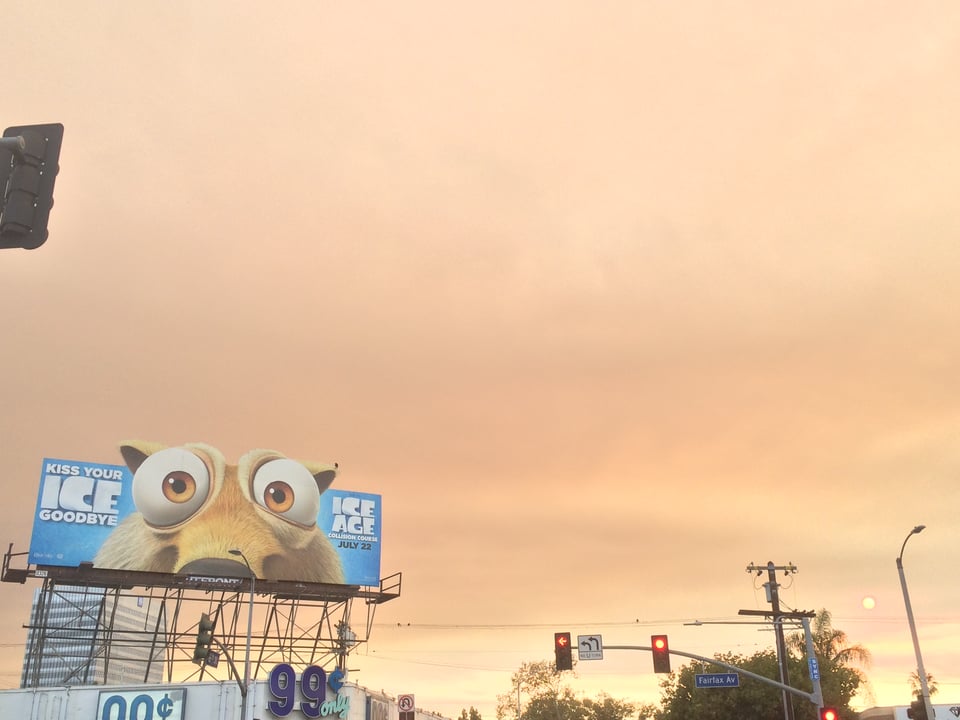
If there is a single thread that seems to run through every piece of speculative fiction set in Los Angeles, it's the environment.
These renderings can be cartoonish. In John Carpenter's Escape From L.A. (1996), a monster quake in the year 2000 turns the city into an island that becomes home to a motley band of outcasts, criminals and guerrillas as well as exiles fleeing a theocratic U.S. government — all of it requiring Kurt Russell (as the inimitable Snake Plissken) to don an eye-patch and surf a tsunami.
But generally, the visions are grim. Denis Villeneuve's Blade Runner 2049, released in 2017, shows San Diego as a trash dump, while a massive dam holds back rising seas. And, unlike the original, which opened with its cinematic pans of future L.A., this sequel begins with scenes of synthetic farms in an ecosystem that has experienced a full collapse. The only living things on this barren surface appear to be the humans — and, of course, the running question in both Blade Runner films is whether the humans are even human at all.
More realistic — and perhaps more unsettling — is the slow collapse depicted in a pair of novels published in the early '90s: Kadohata's In the Heart of the Valley of Love, set in the early 2050s, and Butler's Parable of the Sower, which takes place in 2024. Both books feature young women navigating environments where climate change has generated a gradual breakdown of civic life, intensifying poverty and violent crime. In Kadohata's future world, water is rationed, real plants are a rare luxury and people suffer mysterious skin illnesses; in Butler's, the landscape is ravaged by fire and drought, and freeways are no longer used by cars but by pedestrians who flee one collapsing city for another. "People have changed the climate of the world," notes Olamina. "Now they're waiting for the old days to come back."
Those days, however, are never coming back. And these visions are not far off from our current condition. The fires that afflicted Southern California throughout 2020 were devastating; the ones from 2025, apocalyptic. In 2023, my former colleague Hayley Smith reported on how a roller coaster of drought and flooding had pummeled the Central Valley, one of the most productive agricultural regions in the world. The following year, my colleague Ian James wrote about how climate change has been thrashing California with more violent storms. The slow motion disaster brings to mind Susan Heeger's insightful 1992 review of Kadohata's book: "The city might just limp on the way it's going, suffering a slow leak rather than a big bang."
Not all visions of L.A.'s future environment are ominous. Kim Stanley Robinson's 1990 novel Pacific Edge takes us to the Orange County of 2065, where the residents of El Modena have given up cars in favor of bikes and converted land-guzzling suburban homes into collectively inhabited, self-sustaining environments where residents can grow vegetables and raise fish.
Neither dystopia nor utopia, the book paints a picture of a protopia, where incremental progress has been made but challenges still abound. Water remains a precious commodity and fire is still a force to be reckoned with. ("When fire strikes," writes Robinson, "mesquite, manzanita, scrub, oak, sage, and many other plants do not so much catch fire as explode.") But the core of the narrative is about a local struggle over one of El Modena's last wild spaces: One faction wants to build; another is opposed.
The society the author describes is a very different one from our own. Corporations have had their power checked and humans now inhabit off-world settlements. But at the local level, communities are still tangling over issues like water and zoning. It's as if everything has changed, but nothing has changed. We'd be so lucky to inhabit that future.
L.A. in the sci-fi imagination
Science fiction, ultimately, presents a grim view of Los Angeles. "The urban imaginary of the future is so East Coast-based," says Vint, "that L.A. isn't imagined as a future city space, but as a future wasteland." Certainly, books and movies hyperbolize problems and paranoias, rather than presenting the city as a place where those issues might find resolution. (Though "Her" does imagine a future where Metro trains deposit passengers directly onto the beach.)
L.A.'s failure to regularly make the ranks of utopia (or even protopia) likely has a lot to do with the popular image of the city as apocalyptic. ("El A is A-pocalypse," says a fast-talking newscaster in Karen Tei Yamashita's sci-fi-inflected 1998 novel, Tropic of Orange. "It's bee ess I tell you. Earthquakes. Riots. Fires. Floods. It's just natural phenomena: earth, wind, fire, water.") But the city's continuous reemergence in fiction as a dystopia is rooted in a host of genuine social and environmental problems.
Sci-fi about L.A. gets plenty wrong — all that density; no Latinos — but in its otherworldly stories we find ourselves reflected. The images we see may be distorted, like in a cheap funhouse mirror. But ultimately, the source of those images is us.
Thanks so much for reading.
If you want more, here are a few recent stories I’ve written:
In the wake of Betye Saar’s death, I had a look at 7 essential works by the artist. RIP.
For Momus, I wrote about the friendship between the sculptor Mel Edwards and the painter Juan Sánchez and the lineages artists create for themselves.
How Magdalena Suarez-Frimkess uses comics in earnest ways.
Why the Cesar Chavez sexual assault scandal presents a good moment to rethink monuments to mass movements.
-
Brilliant


Add a comment: