
Linkfest #43: Archaeoacoustics, "Nocotourism", and the 8-bit Backrooms
Hello there!
It’s time for "the opposite of doomscrolling” — a new Linkfest, in which I sort through the planet-wide digital rummage-sale of the Internet to locate the finest items of culture, science and technology, just for you.
If you’re a subscriber, thank you! If not, you can sign up here — it’s a Guardian-style, pay-whatevs-you-want affair; the folks who kick in help keep the Linkfest free for everyone else. (Full archive of issues, including this one, is online free here.)
And: Please share this email with anyone who'd enjoy it.
Let’s begin ...
1) 🎨 Art created using the iPhone “Notes” app

I mostly use the Notes app on the iPhone to type little memos to myself. But it also has some crude drawing tools, which I had always assumed were just for adding markings to a picture or a message you’d typed.
Chris Silverman has pushed them a lot further. Back in December 2021, he was poking around with these drawing tools, got impressed, and decided to use them to do a new sketch every single day.
Years later, he’s still at it — and he has evolved a gorgeous, colorful style: Tiny scenes, often slightly fantastical, with lots of odd machinery and crepuscular lighting, like so …
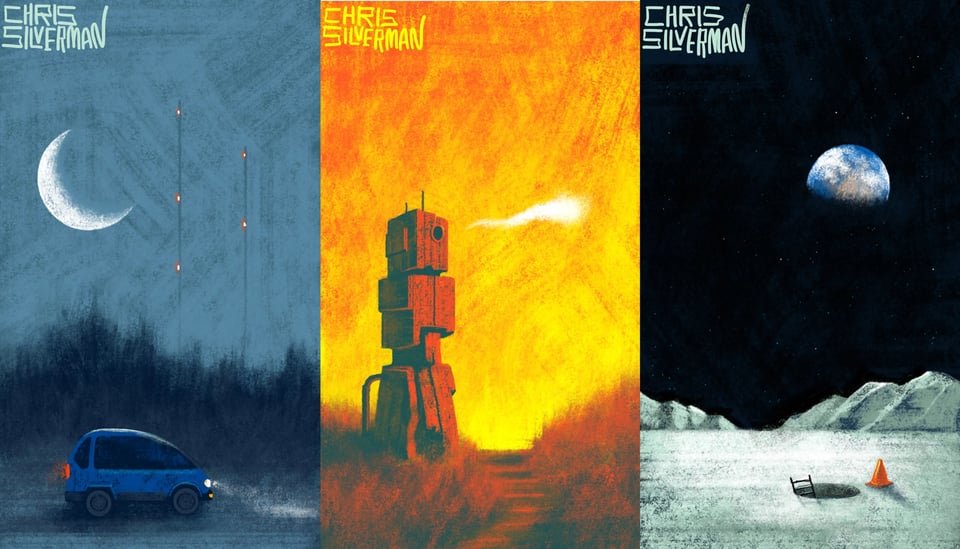
#notesArt is a style formed by the limitations of the medium. I draw with my finger on a screen the size of a 3-by-5 card, using drawing tools that were designed for annotating documents, not making artwork. Similar to an app, each work is minimalist and limited in scope. The simple nature of the tool allows me to focus on the essence of each piece; perhaps a strange thing to be able to do on a device known primarily for providing distraction.
The quality of work he’s coaxing out of Notes is astounding; look at the gorgeous shading on these pieces! You can see his full archive at his site, and he’s done several interviews online talking about his project, and produced his own short video about it.
2) 🕹 Pong Wars reborn
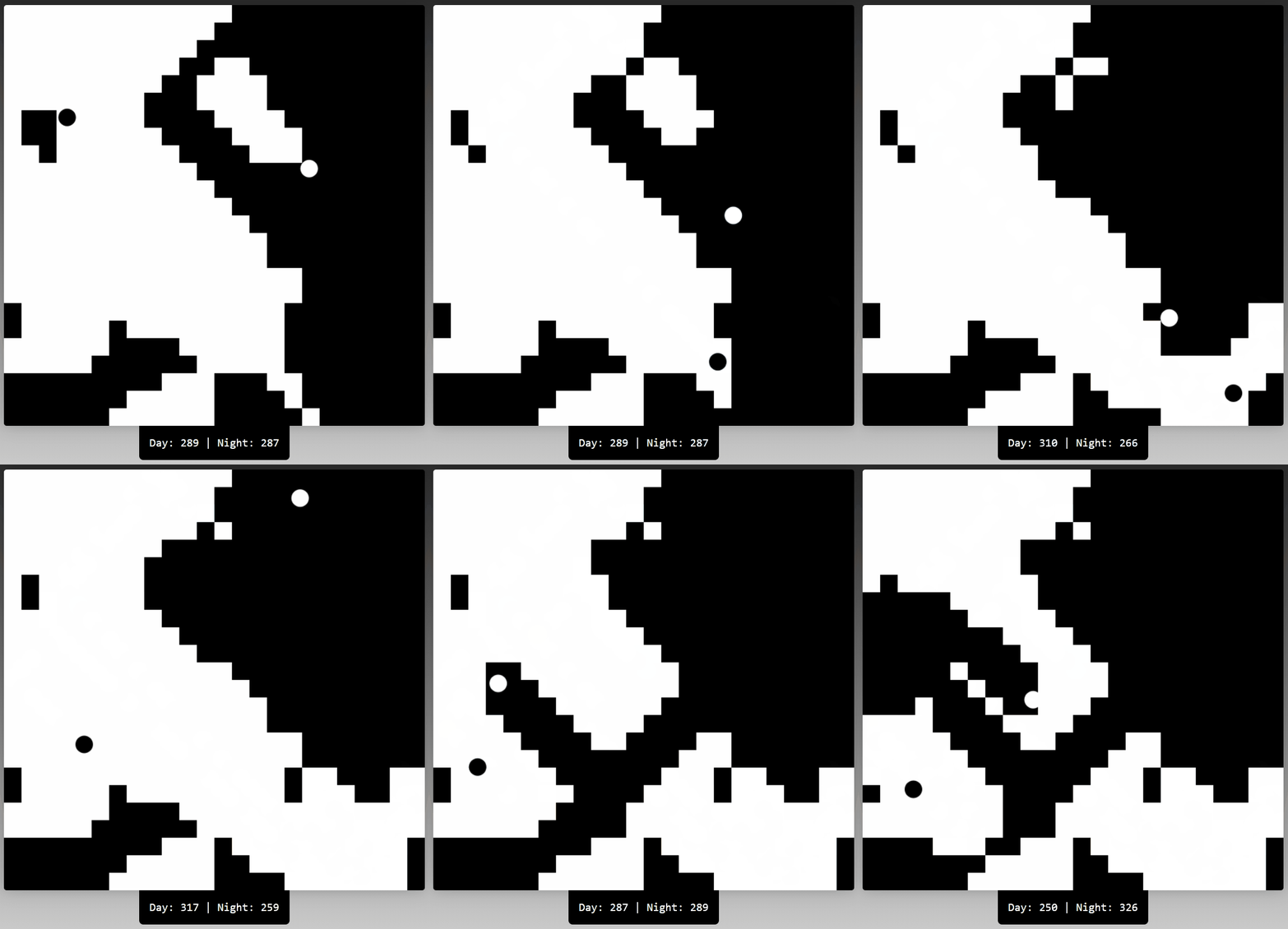
Behold Dynamic Pong Wars, a mesmerizing little web app where you watch two Pong balls locked in an endless, unwinnable battle over terrain. There’s a metaphor in here somewhere, right?
I say that as a joke, but truthfully I’ve had a career-long obsession with the metaphorically expressive nature of game dynamics. When folks ponder the artistic qualities of video games, they’re often understandably drawn to the graphical art, or the story, or even the music. But I love the expressive quality of the game mechanics themselves — the way they can evoke and expose the emotions and dilemmas of life.
Indeed, game mechanics are a really interesting fabric with which to illustrate ideas, because they’re a form of art/expression that requires the audience not just to watch things or listen to things or read things, but to do things. (This is part of what gives Dynamic Pong Wars such a hilariously meta edge: It’s a version of Pong where you don’t do anything — other than click “start”, and then ponder the on-rails behavior of the Pong balls.)
Anyway, go stare at Dynamic Pong Wars for a while, it’s pretty cool! This version is by Marco Denic, but as he notes, there have been terrific versions of this before, and the concept has quite an online lineage.
(Thanks to Joseph Stirt for this one!)
3) 🔊 Archaeoacoustics
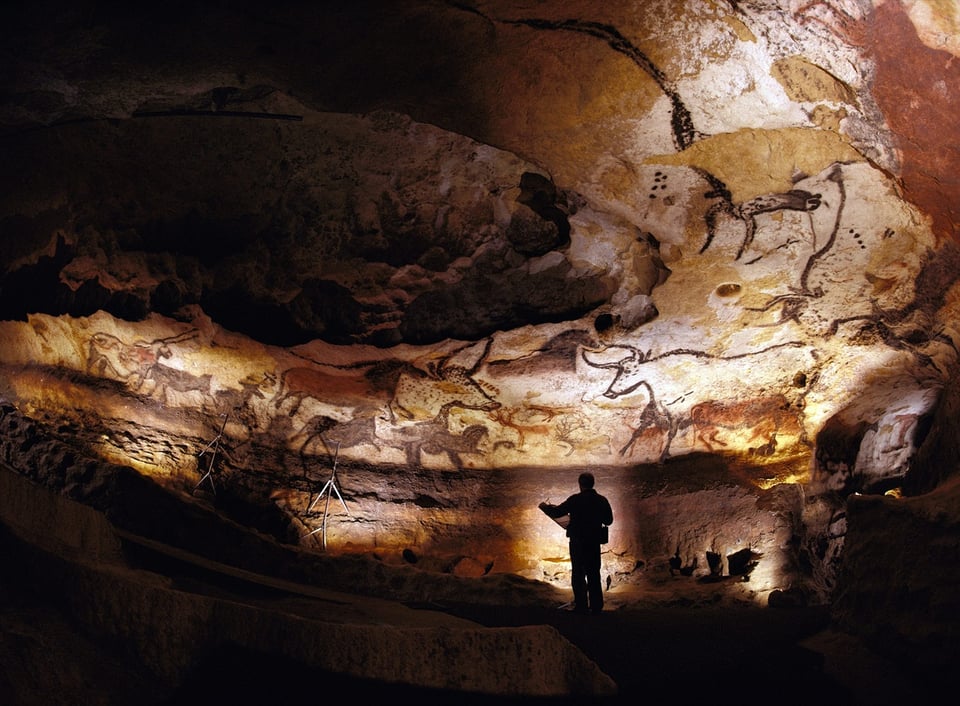
Back in the 1980s, the French musicologist Iégor Reznikoff discovered something weird about cave paintings: If you sang to them, they produced strange and eerie effects.
He kicked off a burgeoning field now known as “archaeoacoustics”, which studies the acoustic properties of cave-paintings. It turns out that the folks who painted this art — as long as 40,000 years ago — didn’t just pick any old walls in the caves. They carefully selected walls located in areas “where echoes, resonance and sound transmission created otherworldly sonic effects.”
Benjamin Taub wrote a fascinating piece about it New Scientist, interviewing the scholars who are currently studying this stuff, many of whom are with the Artsoundscapes research project. They’ve documented some wild acoustic qualities of the caves: Some seem to amplify far-off noise, such that a researcher standing in front of some cave art could hear a conversation far away “with astonishing clarity”. In other cases they’ve found unusual resonance: If you take a bass drum into the 5000-year-old Neolithic tomb of Ħal Saflieni in Malta, then hit it hard, “the bass frequencies sustain for about 35 seconds”.
Why would cave-painters care about the sonic qualities of a cave? Possibly because the echoes can create some truly psychedelic effects, as the researchers have found:
In Finland’s lake district, for example, prehistoric hunter-gatherers were inspired to leave their mark on cliffs that produced a disorienting sonic reflection. “The [wall] repeats, or doubles, every sound that you make in front of it, so that you experience a kind of doubled reality that is not normal,” says Riitta Rainio at the University of Helsinki in Finland. “It’s not a long echo like in caves, but a single reflection that’s very short, sharp and strong.”
Rainio and her colleagues have conducted psychoacoustic experiments to measure the subjective response of modern listeners to this auditory illusion. They found that people tend to perceive a “presence” at these painted sites. In one recent paper, they wrote that the sounds seem to “emanate from invisible sources behind the paintings” and that “a prehistoric visitor, who marvelled at the voices, music, and noises emanating from the rock, would have recognised them as coming from a human-like source, perhaps some kind of apparition or living person inside the rock”.
Speaking of her own experiences at the lakeside rock faces, Rainio says: “I was often quite scared, because I really thought that there was someone else there. There’s this phenomenon where it seems like someone is approaching you as you approach the cliff.”
It’s a fantastic piece, go read the whole thing!
4) 🌥 The Cloud Appreciation Society

The “Cloud Appreciation Society” is exactly what it sounds like: A social network where people share photos of remarkable clouds they’ve seen. As they write …
If you, like us, believe that clouds are the most evocative and dynamic of Nature's displays, you will be welcomed into the Cloud Appreciation Society with open arms.
Above is a fantastic photo by Philippe Peinhopf de Paula, and I just spent ten minutes scrolling through some truly amazing cloud porn. They also have members contributing poetry about clouds, if you’re down for that.
And, education! To help you identify clouds, they have a mobile app, a cool old-school cardboard-wheel cloud taxonomizer, and a picture book.
5) 🏚 The aesthetics of dead malls

Aryeh Bookbinder runs “Liminal Assembly”, an organization that takes people on tours of dead and dying malls in Toronto. Over at Hazlitt, the writer Lana Hall went on one of the tours, including the one above — Cumberland Mall, located smack dab in Toronto’s bustling downtown.
It was built in 1974, but its heyday is long gone …
Cumberland Terrace had somehow occupied the corner of Bay and Bloor Streets since the 1970s, wedged between luxury towers and some of Canada’s most expensive commercial real estate. I’d cut through Cumberland Terrace’s ghostly pathways hundreds of times en route to the subway, perplexed by its perpetually shuttered food court and wall of pay phones, its increasingly dwindling storefronts selling pantyhose, notary services, fake sixteenth-century Chinese pottery. It seemed out of place, occupying neither past nor present.
That latter point — “occupying neither past nor present” — is something that Hall meditates on. A lot of malls in the US have been abandoned; by some accounts, there were 2,500 in their heyday of 1980s, but that’s down to 700 today. Built for bustling activity, reduced mostly to tomblike silence, malls are an archetypical “liminal space”, a location that seems stuck in a phase transition that never finished.
Part of what makes malls seem so uncanny is that they were built with great care and detail, as if they ought to persist for centuries, yet they’re now mostly empty; what’s more, much of that “great care and detail” all happened in a very short time period — the 1960s to 80s — so they all possess the identical now-extinct visual palette. It’s no wonder Stranger Things plumbed so much creepiness out of that period.
Aryeh told me that standing in the wreckage of these spaces unlocks a sensation people often crave, but can’t name. He called it a “rare emotion,” the same haunted feeling one experiences after a particularly powerful piece of literature or music.
“When you go to these places that have what I like to say is importance built into them, in the detail of the tiles and the polished brass railings and all these elements, they suggest this place is a very important place,” he said. “But when you see it empty, there’s something very uncanny and eerie about that … You feel things and go, ‘huh, that is really unique.’ And I think that is the escape that people feel when they come to these liminal spaces.” He told me this is a feeling that seems to transcend cultures and geographies, that many people report feeling relieved and delighted when they find there are others who experience this pang of emotion in these spaces. “It’s something core in the human experience.”
Go read the whole piece! It’s really thought-provoking. While you’re at it, pick up Meet Me By The Fountain, a fantastic book about the rise and fall of the American mall, by the phenomenal Alexandra Lange.
And! Here’s another item about liminal spaces …
6) 👾 Retro video-game version of The Backrooms
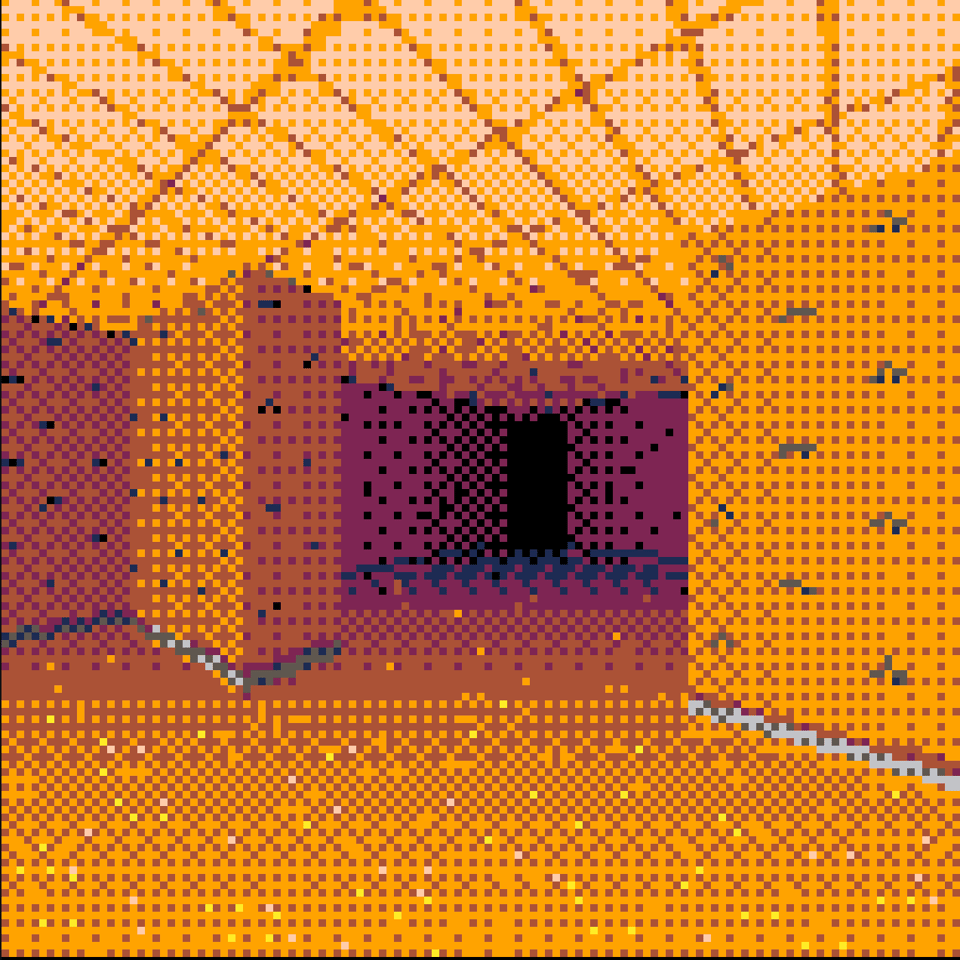
The Backrooms is a meme literally about liminal corporate spaces. If you haven’t heard of it, the tl;dr is that back in 2019, someone on 4chan posted the following picture …
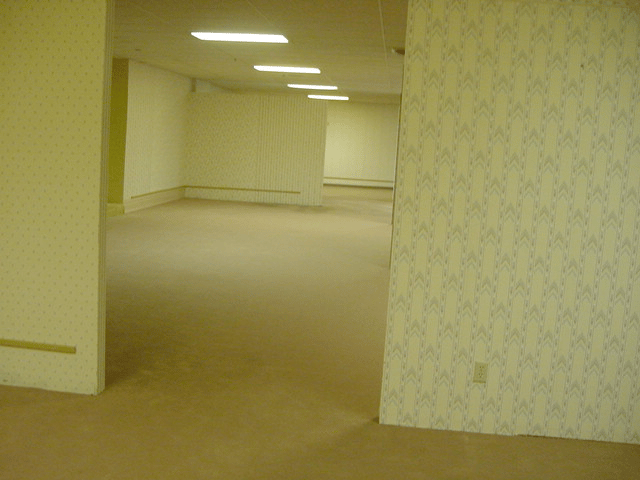
… and it looked so weird and creepy that it created an entire online subculture devoted to developing lore about these “Backrooms”: They were an extradimensional space that went on seemingly forever, populated by the occasional hostile alien lifeform. You can read the Wikipedia page for more details, or watch a terrifically unsettling Youtube series based on it, but basically know that Backrooms culture riffs on precisely the sense of liminality that one finds in those semi-abandoned 80s-era malls and industrial offices. Liminality is clearly a real vibe now, because A24 is apparently making a theatrical version of the Backrooms.
And heyo, I just stumbled upon something deeply cool — a video-game version of the Backrooms, created using the Pico-8 game engine! That’s a screenshot above, and you can play it for free here in your browser.
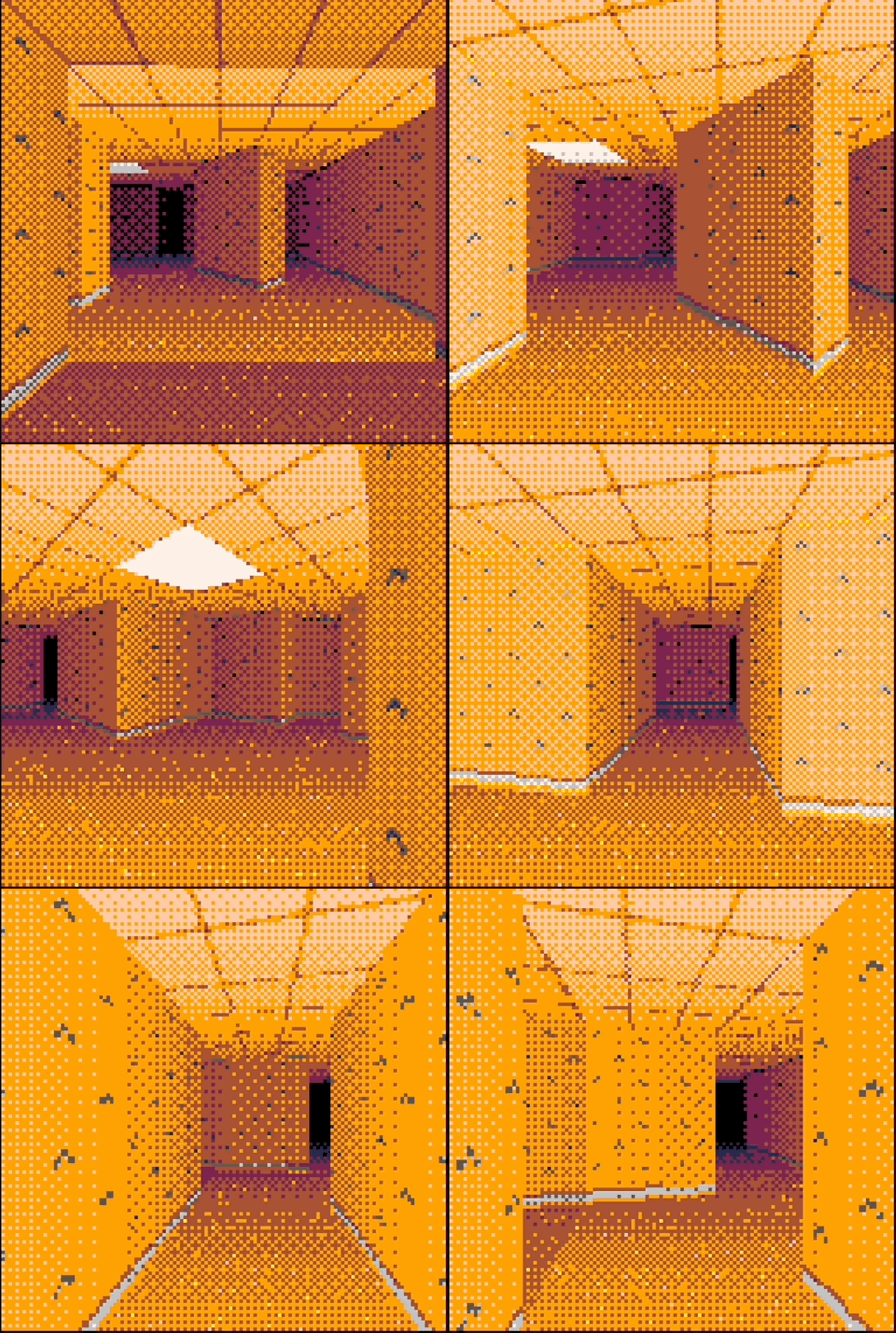
Ironically — or appropriately? — the Pico-8 game engine was created specifically to replicate the crushingly tiny hardware constraints of video-game systems back in the 80s. You can only use 32K worth of code in any game (it’s called a game “cartridge”, lol), and the screen resolution is pretty low. So this Pico-8 version of The Backrooms is thus: 1) Based on a modern meme that is 2) itself based on the aesthetics of 1980s corporate offices, rendered in 3) a game system itself designed to mimic the constraints and aesthetics of the 80s.
I will now step into a wormhole that will transport me to precisely 15 minutes ago, the moment when I started writing this entry.
7) 📨 Collection of “hold-to-the-light” postcards
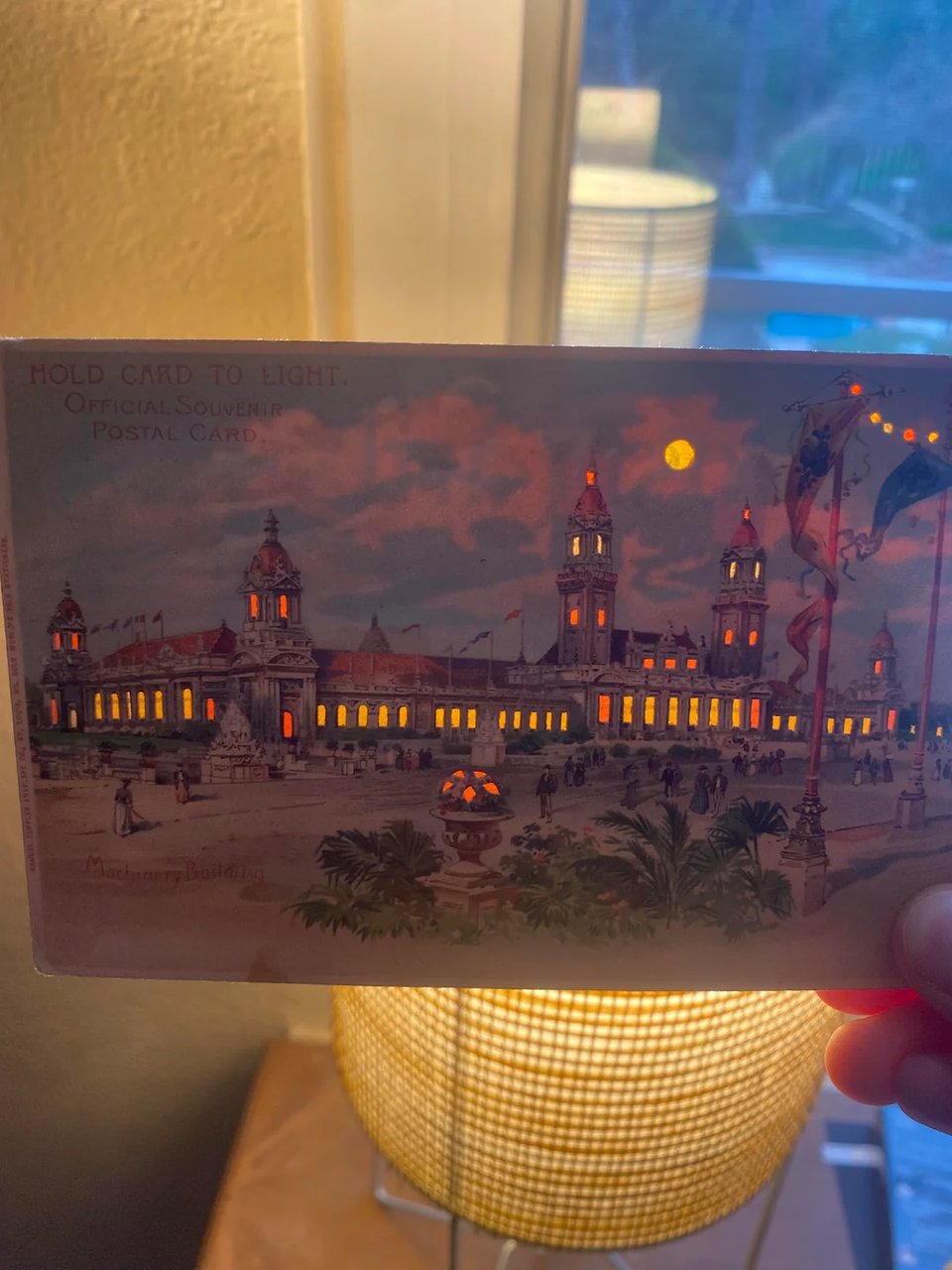
Over at r/ephemera, the Redditor named EphemeralTypewriter has posted a gallery of their collection of “hold-to-the-light” postcards.
I was unaware such gorgeous creations existed! As EphemeralTypewrite notes …
Each of the cards have been intricately “carved” out and painted with bright colors allowing those areas to glow when held up to the light, the thicker parts of the paper don’t let any light through.
All of the cards pictured are from the early 1900’s, most likely between 1903 and 1910, because two of the cards I have depict the 1904 St Louis World’s Fair, and 2 of the 4 Coney Island cards pictured depict an area of Coney Island called Dreamland which burned down in 1911.
8) Children paint more like Jackson Pollock than adults do
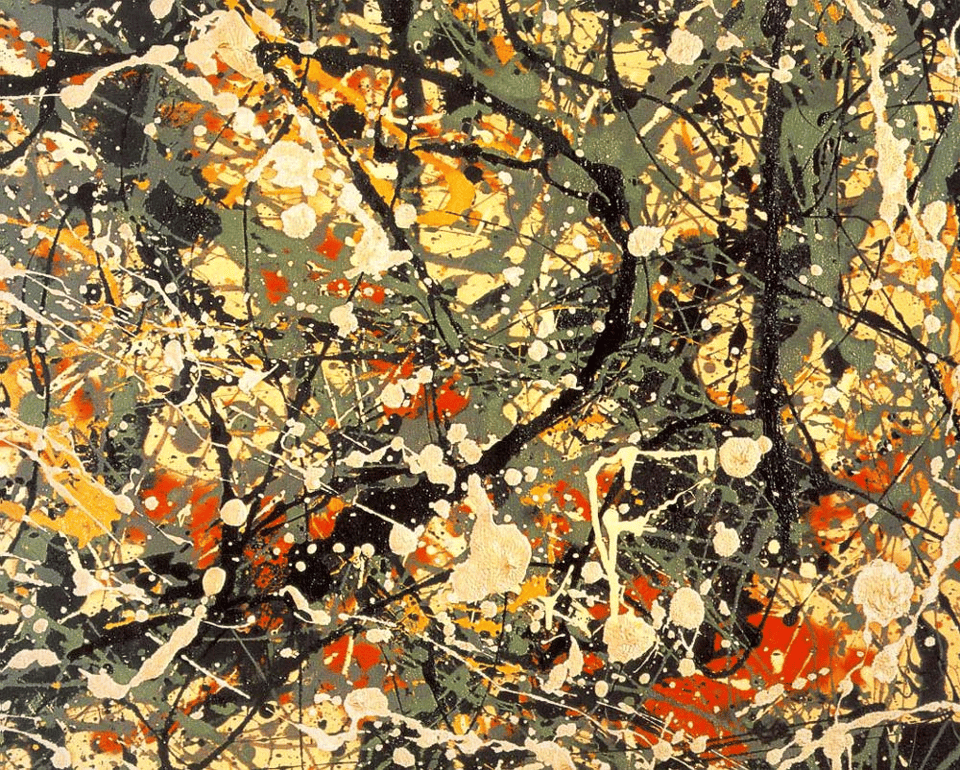
My kid coulda done that. That’s the classic insult levied at modern art, right?
But hey, when it comes to Jackson Pollock, there may be a grain of truth here!
Recently an international group of scholars asked a group of adults (aged 18 to 25) and children (aged 4 to 6) to do drippy paintings in Pollock’s style. Then they studied them using fractal analysis and “lacunarity”. Basically, fractal analysis is a measurement of complexity — and lacunarity “reveals something more subtle: the rhythm and space in a complex network.”
Their top-line finding? Yeah: Your kid really can do that. But an adult can’t!
As Kristen French reports in Nautilus …
“Remarkably, our findings suggest that children’s paintings bear a closer resemblance to Pollock paintings than those created by adults.”
It turns out that the adults tended to try and make things too complicated, whereas the children — and Pollock himself — would just go with the flow:
The researchers found that the children’s art featured lower fractal dimensions and higher lacunarity—they were simpler, with less detailed fine structure, and showed more clumping, with larger gaps between clumps. Adult paintings showed the opposite: higher fractal dimensions and lower lacunarity. In other words, the adult works had more complex detailed patterns, while the lines of paint were more evenly spread out.
It’s a truism that children’s art often possesses a rawness, or un-self-consciousness, that can be incredibly compelling — and which we adults, in our design to do work that seems “good” or sophisticated, can’t as easily access. What’s fun about this study is that it neatly measures this effect. The reason Pollock was so compelling is that, on some level, he managed to retain a childlike element in his technique.
The original study, unpaywalled, is here.
9) ⚙️ Liquid gears
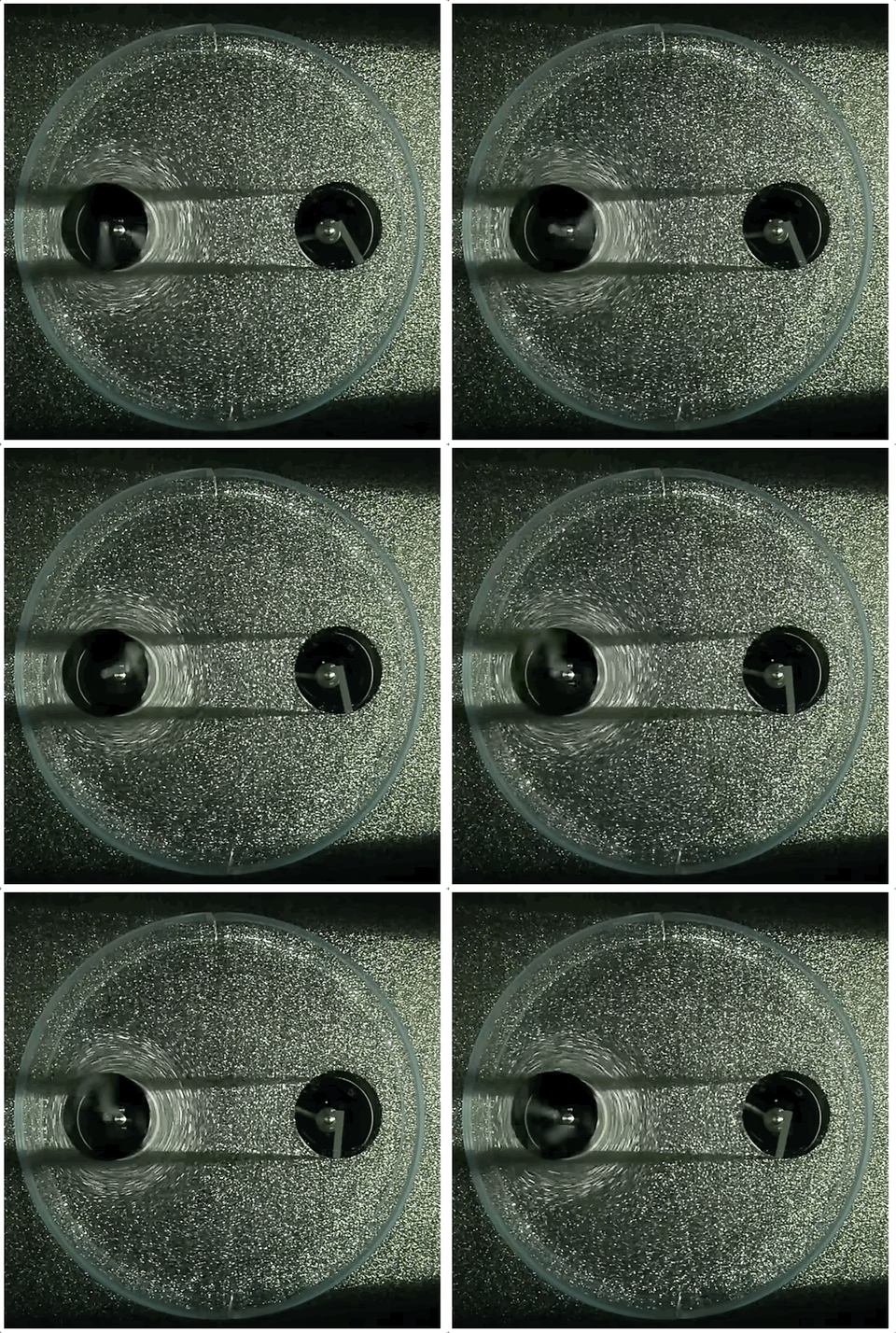
If you want to connect two hubs in a machine, you need to connect them with something. Historically you do that by using gears that drive a chain, or maybe a rubber band that holds tight to each hub.
But a group of scientists at NYU did something new: They connected two hubs with nothing but water.
They knew that when you spin a hub in a vat of water, the water around the hub also starts to spin. So then they wondered, huh: Could the water act as a medium to transfer energy from the spinning hub to another one nearby? Or to put it more simply, if you spin a hub fast enough in a vat of water and glycerin, will the other hub start spinning too?
Turns out it works! Very slowly, but it works. In that animated gif above, you can see that the first spinning hub swirls the water, and then the swirling water makes the other gear very gradually spin too. Here’s the full video. I sped up the gif to make the movement more quickly noticeable.
Depending on how fast the rotor spun and how close the cylinders were, the fluid behaved in two distinct, almost magical ways.
At close range, the fluid acts like microscopic teeth. It pushes against the second cylinder, forcing it to spin in the opposite direction — exactly like the gears in a Swiss watch.
If the cylinders are moved farther apart, the fluid begins to loop around the second cylinder like an invisible fan belt. This pulls the second rotor along in the same direction.
The potential uses here are quite intriguing, because while these fluid-gear connections don’t seem very powerful — they’re not transferring tons of energy — they might be far more long-lasting, or usable in systems where hard gears and bands aren’t viable:
“Regular gears have to be carefully designed so their teeth mesh just right, and any defect, incorrect spacing, or bit of grit causes them to jam,” explained Leif Ristroph, an associate professor of mathematics at NYU’s Courant Institute School of Mathematics, Computing, and Data Science.
“Fluid gears are free of all these problems, and the speed and even direction can be changed in ways not possible with mechanical gears,” Ristroph explained.
Because the parts never actually touch, there is nothing to snap. If a piece of grit enters the system, the fluid simply flows around it.
One potential use of liquid gears could be in soft robotics. In the future, it could replace hard metal parts with fluid-based motion. It may pave the way for flexible machines that can adjust gear ratios instantly by simply fine-tuning the fluid’s properties.
10) 🪰 Why maggots could be the next superfood

Maggots are incredibly efficient at turning what they eat into body mass. When you feed a chicken, it’s about a 3:1 ratio; for every three units of stuff a chicken eats, about one turns into the chicken’s body mass.
But with maggots? It’s closer to a 1:1 ratio. Plus they grow so quickly it’s like “newborn to blue whale in two weeks.”
The Innovafeed facility in Nesle, France, has a production floor area the size of eight soccer fields. It has an annual output of 25,000 tons of larvae. “Imagine two Boeing 747s of maggots per week,” Walraven says, memorably, when we speak by phone. Who in Europe is buying all this insect protein? Fish farms are a key market. More than half of the world’s farmed Atlantic salmon comes from Norway, and the alternative protein source—wild-caught feeder fish—are being exploited by overfishing.
Given the maggots’ 1:1 ratio, you could use them to pull some wild stunts in sustainability:
On a small scale, it’s possible to envision a completely zero-waste circular economy. Let’s say you keep chickens. You can feed maggots to the chickens, and feed human food waste to the maggots, while using the maggots’ own waste as manure to grow more produce. A local luxury establishment, the Ololo Safari Lodge & Farm, has had success with this.
In the US, they’re already selling maggot-derived protein as a component in pet food. Studies have found that when dogs eat the stuff, they’re in better shape than with many regular forms of dogfood — and their breath smells better, lol.
It’s a fascinating and long story, and the details just get weirder the further you go along.
11) 🐕 Urban raccoons get shorter snouts as they domesticate

I grew up in Toronto, where raccoons were omnipresent — and completely unafraid of humans. I once woke at 2 am to discover three raccoons had sauntered into my kitchen through the cat door, and were calmly cleaning and munching my cat’s dry food (while my cat observed curiously from a few feet away).
To try and shoo them, I banged two pots together. The raccoons looked in my direction slowly — literally, a Hollywood-slow turn of the head — and gazed at me curiously and fearlessly for perhaps ten seconds before turning away, just as slowly, and sidling back out the cat door. I nailed it shut the next day.
Anyhoo! Raffaela Lesch, a professor of biology at the University of Arkansas at Little Rock, knew of this sort of urban raccoon behavior. She wondered whether raccoons were evolving in the same way dogs did:
“I wanted to know if living in a city environment would kickstart domestication processes in animals that are currently not domesticated,” Lesch said. “Would raccoons be on the pathway to domestication just by hanging out in close proximity to humans?”
How do you test for the beginnings of domestication? Well, one strong marker is when an animal’s snout gets shorter. That’s what happened to dogs as they evolved away from their wolven ancestors.
So Lesch — and a team of 16 students — gathered 20,000 photos of raccoons from the citizen-science site iNaturalist. They compared pictures of urban raccoons to wild ones, and le voila: The snouts of the urban raccoons were 3.56% smaller than the wild ones.
When it comes to raccoons, Lesch said that “trash is really the kickstarter.”
“Wherever humans go, there is trash” Lesch said. “Animals love our trash. It’s an easy source of food. All they have to do is endure our presence, not be aggressive, and then they can feast on anything we throw away.”
Apparently their data supports “Neural Crest Domestication Syndrome hypothesis”, which posits that early embryonic development is affected by the pressure towards tameness. The full, unpaywalled paper is here.
(Thanks to Susan Glickman for this one!)
12) 🔬 Ultrasound could clear out the brain after a stroke

In a “haemorrhagic stroke”, a blood vessel in the brain ruptures, and the regions of the brain get clotted with dead blood cells. To clear out the area, usually you have to do a pretty invasive treatment — like putting a catheter into the brain.
Recently, Raag Airan at Stanford University stumbled upon a much gentler way to clean things up — by beaming ultrasound waves into your skull. He was experimentally beaming ultrasound into the brains of mice to try and activate drugs. But one day he accidentally left the ultrasound beam on for longer than he’d intended, and he noticed something interesting:
“What I saw was that the spots of drug that I put in the brain were just like smeared out, like being transported further throughout the brain in a [cerebrospinal] fluid that usually clears gunk from the brain,” he says. “So I thought, ‘Can we actually use ultrasound to drive stuff out the brain?’”
He did some more experiments on mice that had strokes, and sure enough, he discovered that beaming ultrasound into their brains improved their ability to navigate, their grip strength, and extended their lifespan — compared to post-stroke mice that didn’t get this ultrasound treatment.
I love scientific stories like this — where the discovery stemmed from an accident. The history of science is filled with such fascinating combos of luck, chance, and useful blundering. My favorite is probably when Alexander Fleming accidentally grew mold in a petri dish and discovered that it killed the bacteria within. Bingo: Pencillin!
13) 🖼 Rubbery Mondrian
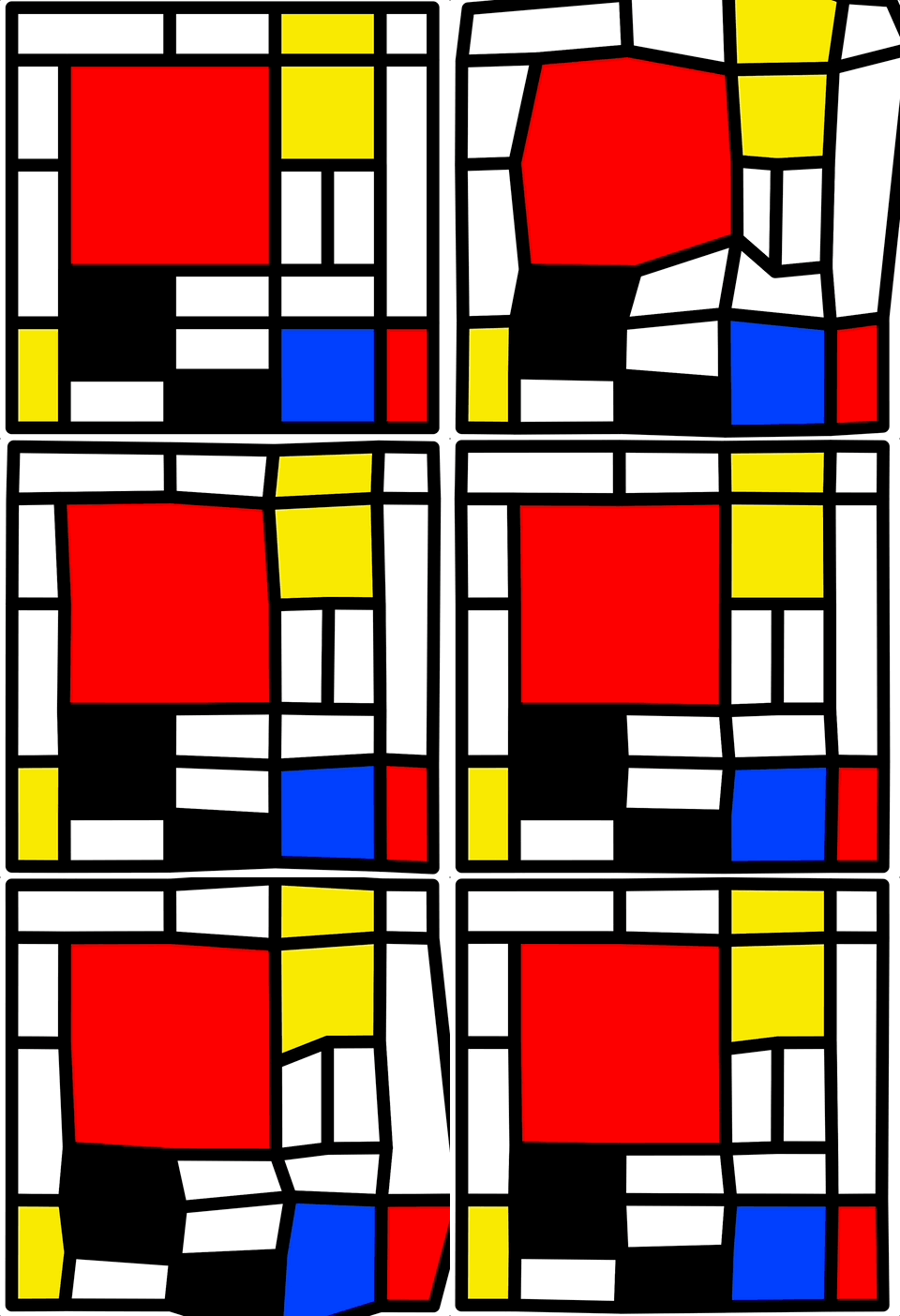
Behold “Mondrian” — a web toy created by “LeeT", which presents you with a little Mondrian-style image, the lines of which you can yank on like rubber bands. It is strangely delightful.
BTW, the site at which it’s hosted, OpenProcessing? It’s one of my favorite sites on the whole dang internet. It’s a tool for writing and sharing interactive software written (mostly) in P5, a Javascript library designed specifically for “creative coding” — i.e. artistically intriguing wee bits of software.
If you go to the “trending” page you’ll see oodles of truly gorgeous and weird digital oddities. Find one you like, then look at everything else its creator has made on the site. (Here’s the page for LeeT, the creator of that Mondrain thingamabob.)
I describe the Linkfest as “the opposite of doomscrolling”, and spending a half hour poking around on OpenProcessing is exactly the same thing.
14) 🧱 A final, sudden-death round of reading material
Chain Words. 🧱 Noctourism. 🧱 Plant machete. 🧱Seashell P5 animation. 🧱 A card game about collecting wine. 🧱 AI chabot prose is in the “Lydian” mode. 🧱 Archive of found mixtapes. 🧱 The life-saving promise of rectal oxygenation. 🧱 Making a Risk game-board that’s a globe. 🧱 The rise of fake Casio scientific calculators. 🧱 Playing Doom on a cash-register thermal printout. 🧱 A swirling sculpture of 8,000 books. 🧱 1,500-year-old Norwegian reindeer-trapping system. 🧱 Software to turn webcam images into Braille. 🧱 Using static to remove frost. 🧱 Interoception. 🧱 408-mph DIY rocket drone. 🧱 The chess bot on Delta Airlines is shockingly good. 🧱 Did Socrates help Euripides with his plays? 🧱 Slop Evader. 🧱 The journalist who didn’t exist. 🧱 Snail heist. 🧱 Online store for 1980s media formats. 🧱 Rat taxidermy. 🧱 AdaFold. 🧱 Jellyfish sleep 8 hours a day. 🧱 Drones that charge by perching on power lines. 🧱 The case for the “R Corporation”. 🧱 Sleep data predicts incidence of 130 diseases. 🧱 When the optimum path isn’t the right one. 🧱 The award-winning poem by Renee Nicole Good. 🧱 They finally found the “Atlantic Equatorial Water”. 🧱 Core War. 🧱 Dome A has been installed. 🧱 Secret medieval tunnels. 🧱 Squishy Go. 🧱 Online low-fi beatmaker. 🧱 Bic pen lamp.
CODA ON SOURCING: I read a ton of blogs and sites every day to find this material. A few I relied on this week include Strange Company, Link Machine Go, Hackaday, Messy Nessy, Numlock News, the Awesomer, Book of Joe, the Morning News, and Mathew Ingram’s “When The Going Gets Weird”; check ‘em out!

