
Argumentum ad machinam
I wish Umberto Eco were still alive. I would have written him a letter to suggest adding a move to the old manual of fallacies: the argumentum ad machinam.
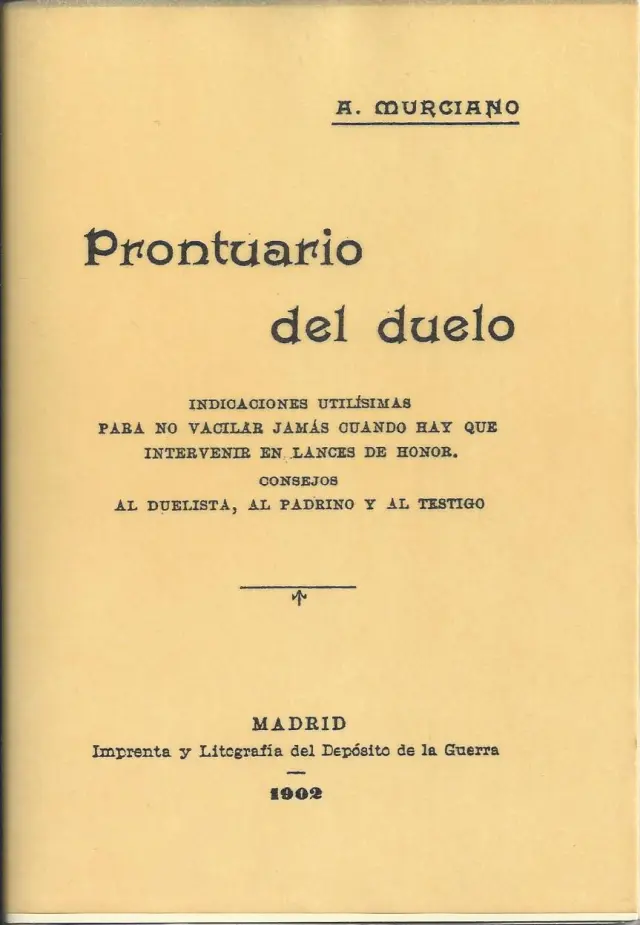
I once found, at a used book fair in Valencia, a Prontuario del Duelo, published in 1902 by A. Murciano. Its subtitle was:
Indicaciones utilísimas para no vacilar jamás cuando hay que intervenir en lances de honor.
It contained everything one needed to know to settle that most serious matter: murder by mutual consent. In my memory, at its centre were diagrams: guards, openings, lunges and parries. Every way to prepare oneself. Every way to strike.
We live in different times. Yet the same discipline applies to argumentation. Rhetoric, too, has its guards, its feints, its favourite attacks.
A new move has appeared in our public sphere in recent years. It is not a new family of fallacies; rather a contemporary variant of an old failing: judging an idea by its origin rather than by its soundness. But it has become common enough to deserve a name.
I claim the privilege of naming it: the argumentum ad machinam.
It consists of dismissing an argument solely on the suspicion, founded or not, that it was produced by generative AI, without examining its content. Its popular form fits in four arrogantly brief letters: AI;DR.
Vigilance, of course, is no fallacy. AIs go wrong, hallucinate, produce false references or a shoddy synthesis. Verifying their output is entirely legitimate. Indeed, necessary.
What is not legitimate is allowing a text's suspected origin to become sufficient grounds for dismissing its contents.
Before parrying, though, one ought to know who is delivering the blow, and why.
Sometimes, the motive is genuine caution. We know these systems are fallible, so we doubt.
Sometimes the motive is one of privilege. Reports drafted by teams of researchers, speeches polished by advisers, papers revised by anonymous assistants rarely undergo an authenticity trial. Suspicion falls much more readily upon someone assisted by a machine. What presents itself as a defence of authenticity is sometimes little more than inequality disguised as principle.
Sometimes it runs deeper: the belief that only thoughts originating entirely within a human brain deserve intellectual standing. This human exceptionalism fails to consider that the decisive criterion here is not origin but responsibility. What matters is who stands behind the argument, who accepts responsibility for it, who is prepared to defend it, revise it, or retract it.
And sometimes, finally, it is just a cheap shot from someone running out of arguments.
The question that remains is how to respond. The answer, I believe, is the one that has always been opposed to the ad hominem: never defend yourself on ground chosen by your opponent. To deny having used a machine, to apologize for it, or to justify it, is already to lose the duel. Doing so concedes that the relevant question is: who held the pen? When it should remain: does the argument hold?
The riposte, then, should be calibrated to the hand delivering the blow.
If it is caution one does not parry, one welcomes it: you are right to doubt; let's verify together, on the substance.
If it is elitism, one defends nothing. One holds up a mirror instead. The brief built by assistants, the draft that does not need to be revised by native speakers, these have rarely faced this same trial of authenticity. Suspicion falls mainly on the help one couldn't afford to buy.
If it is human exceptionalism, the duel changes nature. It is no longer about the argument, but about the very right to state it. There, the only tenable guard is to endorse responsibility. I endorse it. I answer for it.
If it is, finally, the cheap shot, one does not riposte. One simply remarks, aloud, that nothing has yet been said about the argument itself. And one lets that silence do its work.
In all four cases, the same rule holds: origin may call for vigilance; it can never substitute for examination. Whoever claims to settle a debate without engaging with the content has not won. They have only refused the fight.
There is, of course, a legitimate objection. Generative AI has reduced and externalised the cost to produce text. It has not made it any cheaper to read. Too many AI-assisted texts mistake quantity for quality, drowning their readers in repetition, padding, and rhetorical fog. That criticism is entirely fair. It judges the writing itself, not the fact that a machine helped produce it. The argumentum ad machinam begins only when authorship replaces argument as the object of criticism.
I imagine this move will have its season. At the pace at which technological and social transformations are unfolding, this aversion may eventually lose its force. But in the meantime, let us welcome the ideas one can build with these new tools, without giving up vigilance as to their soundness.
Garde haute. Et de grâce, pas de paresse.
-
https://danslesalgorithmes.net/2026/06/16/cest-de-lia-je-ne-lai-pas-lu/


Add a comment: