We Failed to Break Up Microsoft — and now Google is Unstoppable
A couple quick plugs:
I’m a guest of honor at PhilCon this weekend, and it’s going to be awesome.
Do you like vampires who can time-travel? How about if they fall deliriously in love? Pre-order my novel Good Things Are Coming Your Way! Get it signed/personalized.
You can still get Star Trek: Zero Point #1!
How the Microsoft lawsuit led to the rise of Google
How successful was the 1998 lawsuit against Microsoft? There's a lot of debate about this. It's easy to find plenty of experts who believe this landmark antitrust case was an unambiguous win, because it constrained Microsoft's power. It's also possible to find experts who see it as having fallen short.

Last week, I wrote about why this lawsuit was important in creating a path for antitrust lawsuits against big tech companies — but now it's time to talk about the lasting impact of the government's victory, and why it actually helped lead to the rise of worse monopolies.
Here's what happened, in a nutshell: the government won in court and judge Thomas Penfield Jackson ordered Microsoft to be broken up. Microsoft immediately appealed, citing statements Jackson had made to the press that suggested anti-Microsoft bias, and the appeals court decided that breaking up the company was too harsh a remedy. By 2001, the Bush administration was handling the case, and new Attorney General John Ashcroft reached a settlement with Microsoft.
I linked to it last week, but this whole 2024 panel discussion from the Stigler Center is worth watching for a great discussion of the ins and outs of the case:
So there's good news and bad news. The settlement, and the scrutiny that came with the case, did constrain Microsoft from throwing its monopolistic weight around afterward, allowing for more innovation. And Microsoft's new lenience allowed newer tech titans, especially Google, to arise. But the failure to break up Microsoft into two different companies also set a precedent that makes it harder to break up other giant tech firms, including Google.
"Shell-shocked"
Microsoft only rose to power in the first place because the then-dominant IBM "became scared enough of the antitrust authorities to pull back on its aggressive burning down and then salting the earth of market space available to competitors," said U.C. Berkeley economist J. Bradford DeLong. IBM had been previously been more aggressive in preventing the growth of competition in the 1960s and 1970s.
Similarly, after the 1998 lawsuit, Microsoft was "so shell-shocked" that it failed to stifle the growth of new tech giants in the 2000s. This was the true goal of Janet Reno's antitrust case: "not so much to diminish Microsoft's monopoly profits in the present moment, as to reduce the odds that it would do to other businesses in their infancy what it had [already] done to Netscape," DeLong told me. "And on that, they won. For a while."
Subscribe now! !! !! !The state and federal settlements in the 1998 Microsoft case called for the formation of a "technical committee" to oversee Microsoft's compliance, and computer consultant Ron Schnell became the committee's general manager. Schnell told the Stigler Center panel above that the committee was supposed to be three people, but the technical requirements were so complex that it became a separate corporation with 93 employees across three offices.
Making sure that Microsoft wasn't giving preferential treatment to its own Internet Explorer browser was the easy part of the job, Schnell explained to the Stigler Center panel. Much more challenging was requiring Microsoft to document all its proprietary communications protocols, to ensure that third parties could build their own servers that could talk to Windows desktops. Prior to this, Schnell said, "Microsoft was not the type of company that kept good records about their about their software development."
And this added scrutiny was beneficial to the nascent Google in particular.
Attorney Gary Reback, who helped launch the Microsoft case, told the Stigler Center panel that Microsoft considered having this pop-up warning people that Google was unsafe:
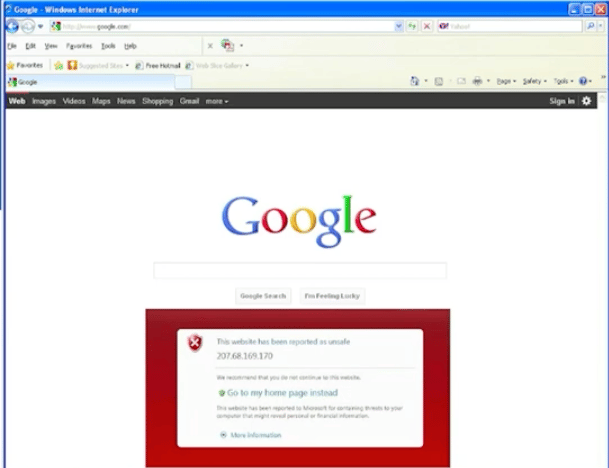
Another plan that was considered within Microsoft was having a browser redirect so when people typed in Google.com, they'd be redirected to MSN Search.
"Even the Google people agreed it would have killed their company," Reback told the panel. Without that settlement, Amazon, Facebook and other large tech firms also might not have grown to their current dominance, Reback said. And he added that in newer cases, the monopolists are unlikely to cooperate as much as Microsoft did in the mid-2000s, so the remedies in newer antitrust cases will need to be effective on their own merits.
Should Microsoft have become two companies?
In a 2022 episode of the Stigler Center's Capitalisn't podcast, attorney David Boies recalled being leading the prosecution team against Microsoft. According to Boies, Microsoft had "dominant positions" in two areas: operating systems and applications such as Office. Boies's team recommended splitting those two into separate companies, each of which might have become a healthy entity in its own right.
"The ultimate result in terms of remedy, I think, left something to be desired," said Boies. Still, he also argues the most important legacy of the Microsoft case was proving that "antitrust laws apply to big tech companies," and in setting out some of the principles we talked about in last week's newsletter.
There's nothing "radical" about breaking up large firms — if anything, the antitrust laws contemplate breakups as a solution to excessive market power, said Doha Mekki, who helped to lead the Biden Administration's antitrustment enforcement. "What happened in Microsoft was a doctrinal evolution, where the DC Circuit imposed heightened standards for breaking up a firm. And that continues to be the subject of discussion and disagreement. This [disagreement] was something that was taken up in the Google search case," Mekki told me.
Subscribe now! It’s free and mostly p good.In fact, in the two recent Google antitrust lawsuits, the court sided with the government — but in both cases, the judges ultimately refused to break up Google into separate companies as the government had asked. So it's worth asking: Could things have gone differently if the government had already succeed in breaking up Microsoft 25 years earlier?
This seems quite likely, said Sandeep Vaheesan, legal director at the Open Markets Institute.
"If Microsoft had been broken up twenty-five years ago, we would have an example of a major tech company being subject to a break up," Vaheesan told me. There would be "the history of ideally a successful breakup: the logistics of it [showing] how the application parts of the business [were] separated from the operating-system parts of the business. There would be a template."

And having "even one precedent" involving breaking up a big tech company "would steel the resolve of judges," who generally "don't want to rock the boat," said Vaheesan. Judges would have a model that they could apply to companies like Google — and without that, "judges are really afraid to take the first step." They may view breakups as something that only worked with "companies with extensive physical infrastructures," like AT&T or Standard Oil.
"No judge wants to be viewed as the person who wrecked an American national champion" by breaking it up, Vaheesan added. If a breakup goes wrong and a formerly dominant company becomes "a shell of its former self," no judge wants to be held responsible.
There's also the fact that it's easier to undo a merger than to break up a company like Google, which developed Chrome and its ad business internally. After a merger, "oftentimes the acquired company isn't fully integrated," and there may be a holding company that owns different arms of a firm as separate entities.
The most clear-cut scenario for a breakup would be Meta, which had bought WhatsApp and Instagram rather than developing them internally — but that antitrust case failed before it even got to remedies, said Vaheesan.